
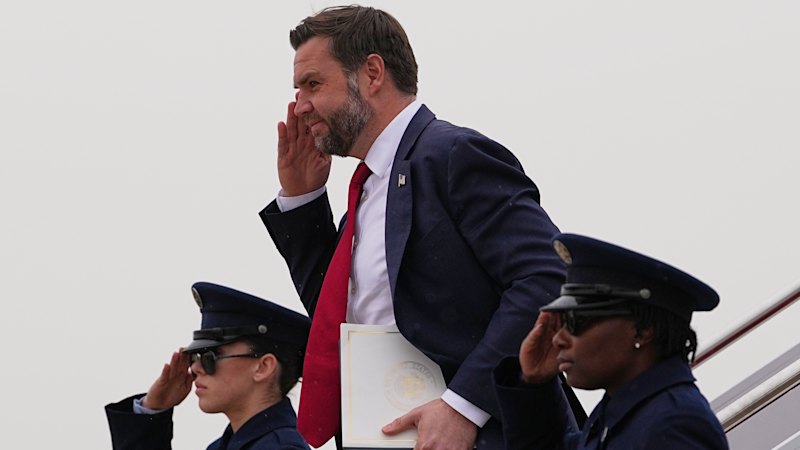
Aboard Air Force Two: US Vice President JD Vance has assured that while military strikes against Iran are on the table, there is “no chance” of the United States becoming embroiled in a protracted conflict in the Middle East. This statement comes amidst heightened tensions and ongoing discussions about Iran’s nuclear ambitions.
Speaking on Thursday, Vance emphasized that President Donald Trump is considering various options regarding Iran, including potential military action to prevent the nation from acquiring nuclear weapons. However, he stressed the preference for diplomatic solutions.
“The idea that we’re going to be in a Middle Eastern war for years with no end in sight – there is no chance that will happen,” Vance told The Washington Post during an interview while returning from an event in Wisconsin. His remarks counter predictions from some foreign policy experts who warn of a potential escalation.
Context and Background
The current situation follows a series of military and diplomatic maneuvers by the United States aimed at curbing Iran’s nuclear program. Last year, the US conducted operations targeting Iranian nuclear sites, and more recently, the capture of Venezuelan President Nicolás Maduro highlighted the administration’s assertive foreign policy stance.
Vance, a Marine veteran with experience in the Iraq War, has been vocal about his skepticism of foreign military interventions. He has previously criticized the rationale behind the US involvement in Iraq, citing misinformation. Despite this, he maintains that President Trump shares a cautious approach to military engagements.
Diplomatic Efforts and Military Presence
Amidst these developments, diplomatic talks between the US and Iran are ongoing in Geneva, though no resolution has been reached. The discussions are set to continue, with mediators hopeful for progress. Meanwhile, the US has significantly increased its military presence in the region, marking one of the largest deployments since the Iraq War in 2003.
President Trump has openly expressed a desire for regime change in Iran, aiming to remove Supreme Leader Ayatollah Ali Khamenei from power. This ambition aligns with the administration’s broader strategy of exerting pressure on Iran to abandon its nuclear aspirations.
Internal Debates and Conservative Views
Within the conservative movement, there is an ongoing debate about the US’s role in the Middle East, particularly concerning its relationship with Israel. A growing segment of conservatives, especially younger voices, question continued military support for Israel, challenging traditional party stances.
Vice President Vance has advocated for a more inclusive debate, encouraging diverse perspectives within the party. This approach has stirred discussions on foreign policy and antisemitism, reflecting a broader ideological shift.
Controversial Conversations
Recently, a conversation between former Fox News host Tucker Carlson and US Ambassador to Israel Mike Huckabee sparked controversy. Their discussion included contentious remarks about Israel’s territorial ambitions and cultural heritage. Vance, while acknowledging the debate, views it as a necessary dialogue for the conservative movement.
“I guess my takeaway is it’s a really good conversation that’s going to be necessary for the right, not just for the next couple of years, but for long into the future,” Vance commented.
Looking Ahead
As the US navigates its foreign policy in the Middle East, the administration faces the challenge of balancing military readiness with diplomatic efforts. The outcome of the ongoing talks in Geneva and the administration’s next steps will be crucial in shaping the region’s future stability.
Vice President Vance’s assurances aim to quell fears of a prolonged conflict, yet the complexities of the Middle East require careful consideration of both historical lessons and current geopolitical dynamics.