
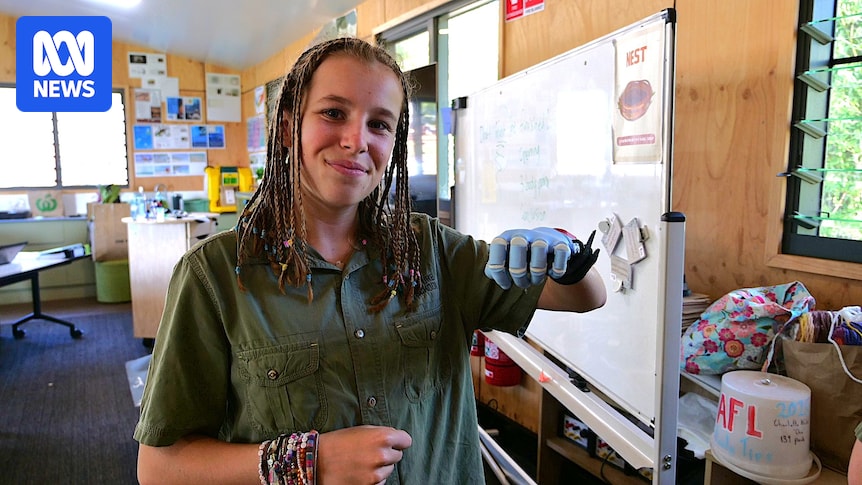
What began as a personal quest for a 13-year-old student to create a 3D-printed prosthetic hand has blossomed into a groundbreaking project involving her entire school. Lois Agnello, a Year 7 student at The Nature School in Port Macquarie, New South Wales, was born with only part of her left hand. Her curiosity and determination led her to approach her science and technology teacher about using the school’s 3D printer to craft a prosthetic hand.
“Being born without a hand doesn’t really stop me,” Lois shared. “I wanted to create my own hand with my friends so I could show them what it’s like.”
Lois had been using a prosthetic hand she received at the age of eight. Her teacher, Lloyd Godson, noted the students’ enthusiasm after Lois presented a video about her hand. “It really struck a chord with a bunch of her peers,” he said.
From Idea to Innovation
The project took shape with the help of an open-source design from Free 3D Hands, an Australian charity. Over three months, Lois and her peers dedicated their lunchtimes to developing the prototype, experimenting with various materials and designs.
“We were all super excited about it,” Mr. Godson remarked. “It was a big learning curve — most of them had never used a 3D printer before.”
The initial prototype, though basic, was functional. It operated through upper-arm activity, allowing Lois to pick up objects. “I was like, ‘Oh my god this is crazy,'” Lois exclaimed, amazed at the success of their efforts.
Refining the Design
The students have since collaborated with Free 3D Hands to enhance their design, producing three more advanced versions. The focus now is on increasing the comfort and functionality of the prosthetic.
Free 3D Hands founder Mat Bowtell and his engineering team have been instrumental in this process. “They were very enthusiastic in being a part of the brainstorming process in regard to what we might be able to improve in the next design,” Bowtell said.
Student Wren McDowell expressed her satisfaction with the project, saying, “It makes me feel pretty good, because we are designing loads of different styles.”
Joel Banwell, another student, highlighted the rewarding nature of the project. “I felt fairly good that Lois was able to get a hand that worked and it made me want to make one that was even better,” he said.
Global Recognition
The project has gained international attention, earning a spot at the Be the Change Summit in Japan. This global initiative brings young leaders together to share innovative solutions to pressing global issues, including climate change, mental health, and inequality.
Mr. Godson expressed his excitement about Lois sharing her story on such a significant platform. “To see her in Tokyo talking about her limb difference and how Mr. Bowtell’s work had helped her and others would be incredible,” he said.
Lois hopes her story will inspire others to explore 3D printing for prosthetics. “Other kids will be like, ‘Woah, that’s cool — like, can I try that?'” she said.
The Broader Impact
This project not only highlights the potential of 3D printing technology in creating affordable prosthetics but also underscores the power of student-led innovation. The collaboration between Lois, her classmates, and Free 3D Hands exemplifies how young minds can contribute to solving real-world challenges.
As the students continue to refine their designs, the implications for the future are significant. Affordable, customizable prosthetics could become more accessible globally, offering new opportunities for individuals with limb differences.
Looking ahead, the success of this project could pave the way for similar initiatives in schools worldwide, encouraging students to engage with technology and innovation in meaningful ways.