

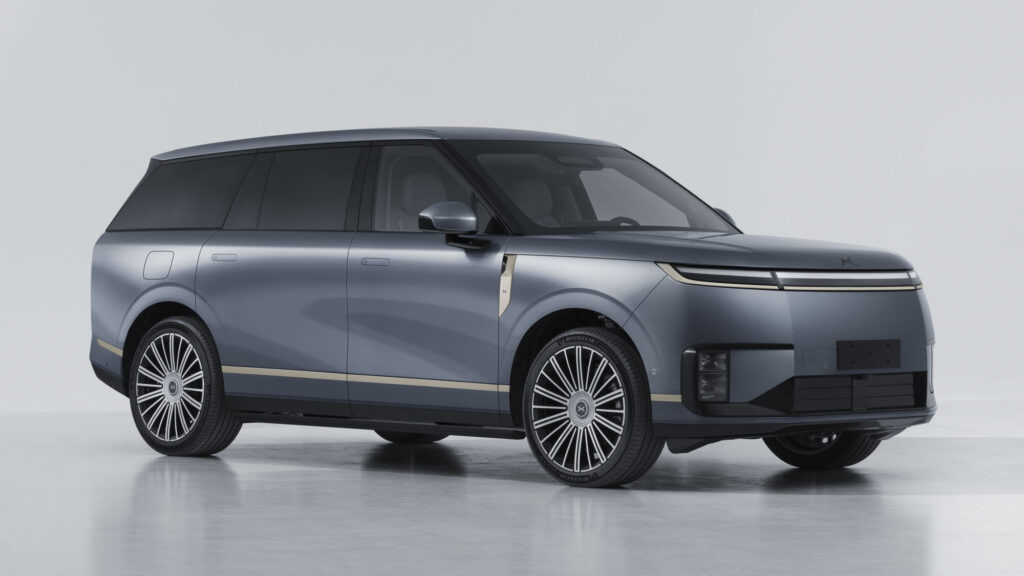
The Xpeng GX, a full-size crossover SUV, is poised to make a significant impact in the Chinese automotive market with its innovative EREV and BEV powertrains. Recently, the vehicle applied for a sales license in China, revealing its impressive specifications. With a length of 5.3 meters and a peak power output of 430 kW (577 hp), the Xpeng GX also features an L4-ready assisted driving system boasting a computing power of 3,000 TOPS. The EREV variant can travel up to 320 km in electric mode alone.
This development follows Xpeng’s strategic move to expand its product lineup with its first full-size crossover. The GX’s exterior design bears a resemblance to the Range Rover, featuring retractable door handles, an active air intake, and blackened pillars that create a floating roof effect. Its distinctive two-storey lights with low-set headlamps further enhance its modern aesthetic.
Design and Dimensions
The Xpeng GX stands out with its substantial dimensions of 5265/1999/1800 mm and a wheelbase of 3,115 mm. The SUV offers a choice between 21 or 22-inch wheels, depending on the version. Notably, the front and rear overhangs measure 980 mm and 1,170 mm, respectively, with approach and departure angles of 18 and 20 degrees. The vehicle features a six-seat configuration in a 2+2+2 layout and a split tailgate, echoing the design of the Range Rover.
Weighing between 2,690 and 2,890 kg, the Xpeng GX’s full weight ranges from 3,240 to 3,405 kg. These specifications highlight the vehicle’s robust build, designed to cater to the growing demand for spacious and versatile SUVs in China.
Powertrain Variants and Technological Advancements
The Xpeng GX offers two distinct powertrain options. The entry-level electric variant is equipped with a single TZ230XY01G01X electric motor, delivering 270 kW (362 hp), manufactured by Luxshare. This version is powered by a CALB-made LFP battery, although its capacity remains undisclosed. The rear-wheel-drive (RWD) model achieves a top speed of 200 km/h.
Meanwhile, the all-wheel-drive (AWD) electric variant incorporates an additional Xpeng-made YS230XY01G01E e-motor at the front, producing 160 kW (215 hp). This configuration results in a combined peak power output of 430 kW (577 hp), with electric motors powered by a ternary NMC pack from CALB. The top speed for this variant also reaches 200 km/h.
EREV Variant
The EREV version of the Xpeng GX is equipped with a 1.5-liter DAM15NTE turbocharged petrol engine, manufactured by Dongan Powertrain, a subsidiary of Changan Automobile, producing 110 kW (148 hp). However, this internal combustion engine (ICE) does not directly power the wheels but instead charges the battery and electric motors.
Available exclusively with dual-motor AWD, the EREV variant features a front electric motor with a peak power output of 160 kW and a rear motor producing 210 kW (282 hp). The system’s combined peak power is 370 kW (496 hp), powered by a 63.3 kWh CALB-made LFP battery, allowing for an electric range of 320 km. The top speed remains at 200 km/h.
“Xpeng officials have indicated that the GX EREV crossover will include four Turing AI chips, offering a total computing power exceeding 3,000 TOPS, enabling L4 autonomous driving capabilities.”
Market Implications and Future Prospects
The introduction of the Xpeng GX into the Chinese market represents a significant advancement in the country’s automotive sector, particularly in the realm of electric vehicles. With a price range of 400,000 to 500,000 yuan (approximately 57,650 to 72,070 USD), the GX is positioned to compete with other premium SUVs, offering consumers a blend of luxury, performance, and cutting-edge technology.
As the demand for environmentally friendly vehicles continues to rise, Xpeng’s strategic focus on developing both EREV and BEV models underscores its commitment to innovation and sustainability. The GX’s advanced autonomous driving features and robust powertrain options are likely to attract tech-savvy consumers seeking a versatile and high-performance vehicle.
Looking ahead, Xpeng’s entry into the full-size SUV segment could set a precedent for other manufacturers, encouraging further advancements in electric and hybrid vehicle technologies. As the automotive industry evolves, the Xpeng GX stands as a testament to the potential of sustainable transportation solutions in shaping the future of mobility.