



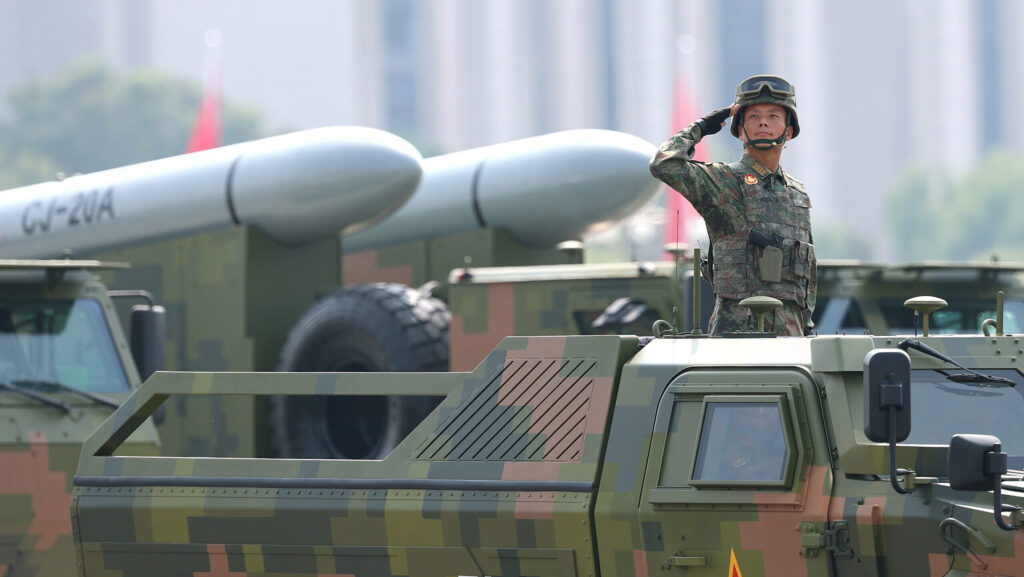
Since 2023, the senior leadership of the Chinese People’s Liberation Army (PLA) has undergone significant upheaval. The latest high-profile removal is Zhang Youxia, one of the two vice chairmen of the PLA’s Central Military Commission (CMC), marking a continuation of a series of purges that have reshaped China’s military hierarchy.
Zhang’s dismissal follows the removal of several other key figures, including Gen. Li Yuchao of the PLA Rocket Force in 2023, Defense Minister Li Shangfu in 2024, the other vice chairman He Weidong, and the head of the Political Work Department Miao Hua in 2025. The head of the Joint Staff Department Liu Zhenli was also removed alongside Zhang. These roles remain unfilled, leaving Xi Jinping and Gen. Zhang Shengmin, head of the CMC Commission for Discipline Inspection (CMCCDI), as the only official members of the CMC.
Corruption and Relationship Networks
The purges have not been limited to the CMC. In October 2025, the Army and Navy political officers, as well as Gen. Lin Xiangyang, head of the Eastern Theater Command, were relieved of their duties. Much of the PLA Rocket Force leadership was removed earlier on corruption charges, a recurring theme in these dismissals.
Corruption is often cited as a primary reason for these purges. China’s endemic corruption within the People’s Republic of China (PRC) and the Chinese Communist Party (CCP) makes these allegations plausible. A notorious case in recent history involved Lt. Gen. Gu Junshan, who received a suspended death sentence for corruption in 2015, having amassed significant wealth, including a solid gold bust of Mao Zedong.
“Corruption has real implications for the PLA’s performance in any major contingency, be it in the Taiwan Straits, the South China Sea, or the Sino-Indian border.”
Another critical factor is the influence of “guanxi (关系),” or relationship networks. These networks, based on familial, educational, and career ties, are integral to Chinese society and the PLA. In a low-trust society, relationships become crucial for operations, staffing, and information flow. Many activities termed as “corruption” are often part of these unofficial networks.
Bureaucratic Politics and Military Reforms
The purges also highlight bureaucratic politics within the PLA. A potential rivalry exists between the Political Work Department (PWD) and the CMCCDI. The PWD, responsible for political warfare and training, has seemingly failed to root out corruption, as evidenced by the removal of numerous senior political officers, including Adm. Miao Hua.
The PLA has undergone significant reforms since Xi Jinping took power in 2012. The military has been restructured into four services and four “arms,” with the latter responsible for training and equipping forces. The seven military regions have been replaced with five theater commands, shifting from peacetime to wartime command structures.
“The elevation of the CMCCDI, now equivalent to the Joint Staff Department and the PWD, represents a major change in the PLA’s organizational structure.”
These reforms have led to bureaucratic upheaval, affecting funding priorities, bureaucratic influence, and promotion opportunities. The removal of Gen. Zhang Yongxia and Liu Zhenli, accused of “severely trampling and disrupting the Chairman responsibility system,” suggests professional differences with Xi’s reforms.
Implications and Future Prospects
Despite the purges, the PLA continues its operations, notably around Taiwan, with China’s third aircraft carrier transiting the Taiwan Straits. There is little indication of reduced Chinese cyber or space activities, and military modernization efforts remain unaffected.
The impact of these disruptions on commanders’ discretion is less visible. Those under investigation may adhere strictly to regulations, potentially improving unit readiness. The purges have not significantly affected theater commands, which are crucial for planning and implementing military actions.
Looking ahead, Xi Jinping is expected to repopulate the CMC, offering an opportunity to elevate new thinkers and potentially access new networks. This could lead to another major shift within the PLA, with implications for its future readiness and operational capabilities.
Dean Cheng, a non-resident fellow with the Potomac Institute for Policy Studies, suggests that the full impact of these changes will only become clear over time, as the PLA continues to evolve under Xi’s leadership.