



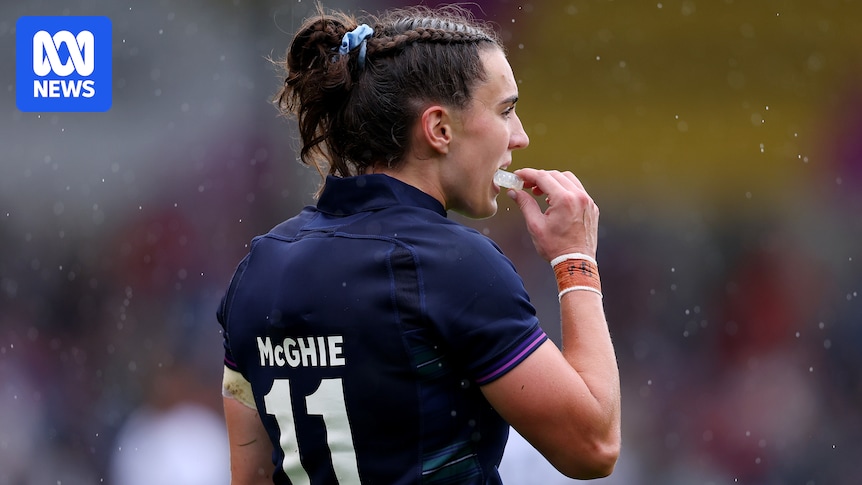
This year’s Women’s Rugby World Cup, hosted in England, is not only breaking records in viewership but is also setting new standards in player safety with a pioneering approach to concussion management. The tournament has introduced LED mouthguards designed to flash upon detecting impacts that could lead to concussions, marking a significant advancement in sports safety technology.
The introduction of these mouthguards comes amid growing concerns over concussion-related injuries in sports, highlighted by increasing cases of chronic traumatic encephalopathy (CTE) diagnosed posthumously in athletes. This concern is underscored by the recent case of former West Coast Eagle Adam Hunter.
Revolutionary Mouthguard Technology
Players from 16 nations participating in the World Cup are trialing these innovative mouthguards, which represent a potential breakthrough in concussion management. Developed under the guidance of World Rugby’s science and medical manager, Dr. Lindsay Starling, and consultant Dr. Eanna Falvey, these devices aim to predict rather than diagnose concussions.
Dr. Falvey, who has previously worked with the British and Irish Lions, explains that the mouthguards use an in-built sensor and a ‘threshold’ system. When a player experiences an impact exceeding a certain force, the mouthguard flashes red and sends a Bluetooth signal to support staff, indicating the need for a head injury assessment (HIA).
“We know that bigger impacts are more likely to cause a concussion event, so what we’ve done is used the mouthguard to identify those large impacts,” Dr. Falvey says.
How the Mouthguards Work
The mouthguards determine the threshold based on two key factors: the speed at which the head moves forward or backward (peak linear acceleration) and the speed at which the head rotates (peak angular acceleration). While these metrics provide a robust estimate of potential concussions, they are not infallible.
Dr. Falvey notes, “What we’ve seen from our data set is that most of the concussion events happen above the threshold, but there are some that sit lower, and that’s what we’re currently evaluating.”
Over one weekend of the World Cup’s group stages, the mouthguards triggered six alert events, one of which was not initially detected by medical staff. This suggests that the technology may identify concussions that manifest symptoms days later, offering a chance for earlier intervention.
Understanding Gender Differences in Concussion
One of the critical factors in current concussion modeling is sex, with the alert threshold set lower for women than men. Dr. Falvey states that while women and men experience concussions at similar rates, the mechanisms differ. Women tend to be concussed at lower intensities, resulting in a comparable overall number of concussions despite less intense hits.
Female athletes also report more concussion symptoms and for longer durations than their male counterparts. This insight is invaluable for medical teams in understanding and supporting female athletes better.
“It’s really helpful, even if those symptoms aren’t related to a concussion incident, because it’s a check-in point for our medical teams to understand what’s going on with our players,” Dr. Starling said.
Individualized Concussion Management
There are individual differences in how concussions are experienced, and the World Rugby team hopes to incorporate these into the evolution of the mouthguard technology. Factors such as a player’s history of concussions and recovery patterns are crucial in determining personalized thresholds.
Dr. Starling emphasizes the need for extensive data to achieve this personalization. “To individualize, you need to have a lot of data on a person, so we need players to wear their mouthguards for a long period to really understand what that player’s picture looks like,” she said.
Broader Implications and Future Prospects
The data collected at the elite level is expected to benefit community sports, where concerns about concussions are prevalent. While the intensity of hits is lower in community sports, the LED mouthguards can still play a crucial role by alerting those present to potential concussions.
World Rugby is working on setting a lower threshold for community-level mouthguards and is collecting additional data in collaboration with Biocore, a US company that works with the NFL. This research could have far-reaching implications beyond sports, attracting interest from organizations like the FBI and the American Department of War.
“My attitude on this is that the data is not a competitive thing; this is something we can all share and learn from each other,” Dr. Falvey said.
With rugby’s extensive reach across 120 countries, the potential for data sharing and learning is immense, offering insights not just for contact sports but for various fields concerned with head impacts.