




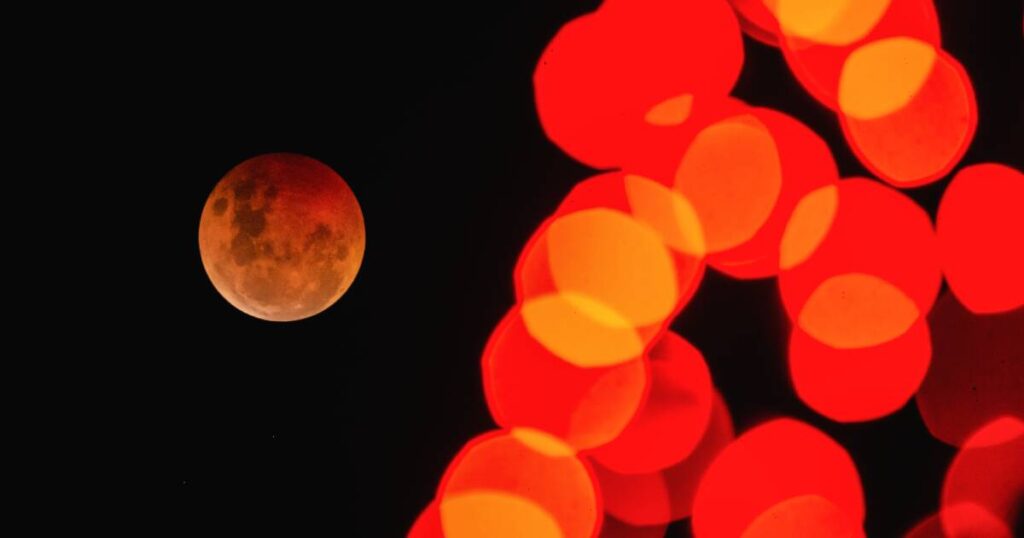
The night sky over the east coast of Australia is set to dazzle stargazers as a total lunar eclipse occurs on Tuesday, March 3. This celestial event will see the moon transform into a crimson orb as it passes directly through Earth’s shadow, offering a rare visual treat to skywatchers.
Starting at approximately 9 PM, residents will observe a gradual shadow creeping across the full moon, culminating in a full eclipse around 10:30 PM. During the peak of the eclipse, the moon will be enveloped in vivid shades of copper and auburn, emitting a striking red glow. This will be the last opportunity to witness such deep reds until 2029, as the upcoming six eclipses will only partially dip into Earth’s shadow.
The Science Behind the Phenomenon
Unlike solar eclipses, which are brief and require protective eyewear, lunar eclipses unfold over several hours and can be viewed safely with the naked eye. The event will last approximately 75 minutes as the moon enters Earth’s shadow, known as the partial eclipse phase. This will be followed by an hour of totality, where the moon takes on its characteristic red hue, and another 75 minutes as it emerges back into full brightness.
The eclipse will also be visible in New Zealand and Western Australia. Due to the vast size of Earth’s shadow compared to the moon, everyone on the planet’s night side will experience the eclipse simultaneously, adjusting only for local time zones.
Local Enthusiasts and Community Engagement
Amidst the anticipation, local astronomers are preparing to gather at Foreshore Park near Nobbys Beach, equipped with telescopes to capture the best views. Mike Anderson, president of the Newcastle Astronomical Society, emphasized the rarity of witnessing the moon so vividly red and encouraged the public to join the society’s members for public viewings, weather permitting.
“It’s great. People always are fascinated by the night sky in particular because, you know, there’s just so much to see,” Mr. Anderson said.
The Newcastle Astronomical Society, active for 30 years, frequently organizes events for both its members and the general public. Anderson highlighted the importance of community engagement, especially with those interested in astronomy.
Challenges and Viewing Conditions
Despite the excitement, the weather forecast poses a potential challenge, with a 50-60 percent chance of cloud cover during the eclipse. However, enthusiasts remain hopeful that some aspects of the lunar event will still be visible.
The announcement of this celestial event comes at a time when interest in astronomy is burgeoning, with many people seeking solace and inspiration in the night sky. The leisurely pace of a lunar eclipse, stretching over a few hours, allows for a more relaxed and contemplative viewing experience compared to the fleeting nature of solar eclipses.
Looking Ahead: Future Eclipses
While tonight’s total lunar eclipse offers a unique spectacle, future eclipses will not provide the same intensity of color until 2029. The upcoming partial eclipses will result in a lighter effect, as the moon only partially enters Earth’s shadow. This makes tonight’s event a must-see for those eager to witness the full splendor of a total lunar eclipse.
As the night unfolds, Australians and others in the region are encouraged to look up and enjoy the celestial show, a reminder of the wonders of the universe and the beauty that lies beyond our earthly confines.