



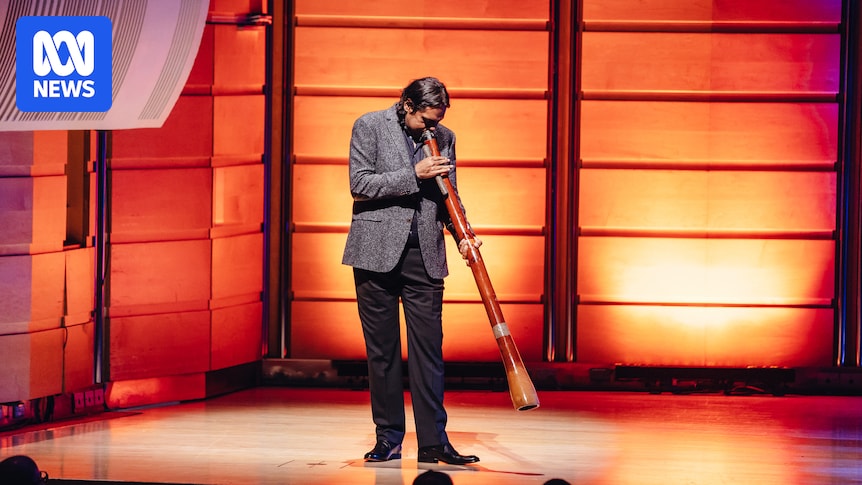
Aboriginal and Torres Strait Islander readers are advised that this article contains references to people who have died. In the world of music, few instruments carry the profound cultural resonance of the yidaki, often referred to as the didgeridoo. This ancient instrument, crafted from termite-hollowed tree branches, is a staple of Australian soundscapes. Its distinctive drone is familiar to many, yet William Barton, a Kalkadunga songman, has elevated its presence by blending it with the refined tones of classical music.
Barton, a cultural knowledge-keeper and educator, has graced stages from Australia to New York’s Carnegie Hall, performing alongside icons like Jimmy Barnes and the late Gurrumul. He is celebrated for his unique ability to weave the yidaki’s ancient voice into the fabric of European classical music, collaborating with symphony orchestras and ensembles worldwide.
The Yidaki: A Cultural and Musical Legacy
The yidaki, known in various regions by names such as yigi yigi and didgeridoo, holds a special place in Indigenous Australian culture. Barton explains, “Growing up, I was always fascinated by the mystery of the instrument, and I felt the very raw power of it as a cultural lens and a message stick.” His journey with the yidaki began in his youth, crafting instruments alongside his elders and learning the cultural song lines that define his heritage.
Each yidaki is unique, its pitch determined by the length and diameter of the branch from which it is made. Barton describes the process of making these instruments as a cultural rite, “I remember the feeling of achievement from cutting down the branch of a tree, and the smell of the tree resin from the friction of the saw.”
Blending with Classical Music
Barton’s foray into classical music was inspired by his mother, who introduced him to its mysteries even before his birth. His first major classical performance came at the age of 16 with the Queensland Symphony Orchestra, a pivotal moment that set him on a path of artistic fusion.
“I was barely 16-and-a-half to 17 years old when I performed with the Queensland Symphony Orchestra. It was just after my dad died.”
His collaboration with Peter Sculthorpe, a luminary in Australian classical music, marked a significant milestone. In 2004, Barton performed at the premiere of Sculthorpe’s requiem dedicated to Indigenous Australians, a moment that underscored the powerful intersection of cultural and musical narratives.
Collaborating with the Brodsky Quartet
In 2023, Barton embarked on a new chapter with the Brodsky Quartet, renowned for their innovative performances. Their collaboration, which began at the Canberra International Music Festival, is a testament to the enduring legacy of Sculthorpe, a mutual friend and mentor.
Their current tour includes performances of Sculthorpe’s String Quartet No. 11, Jabiru Dreaming, featuring the yidaki, alongside other works such as Robert Davidson’s Minjerribah and Barton’s own Square Circles Beneath the Red Desert Sand.
Looking Ahead: A Legacy in the Making
Barton’s influence extends beyond performance; he is a composer and multi-instrumentalist, utilizing the piano and guitar as tools for composition. His signature tune, Kalkadunga Song, embodies his cultural heritage and musical innovation.
As Barton and the Brodsky Quartet tour Australia from February 25-28, audiences will experience a unique blend of ancient and modern, a testament to Barton’s vision of cultural harmony through music. Their performance at the Adelaide Festival will be broadcast on ABC Classic on March 20, offering a wider audience the chance to witness this extraordinary fusion.
William Barton’s journey is not just a personal odyssey but a bridge between worlds, a celebration of cultural identity and musical exploration that continues to inspire and captivate audiences globally.