



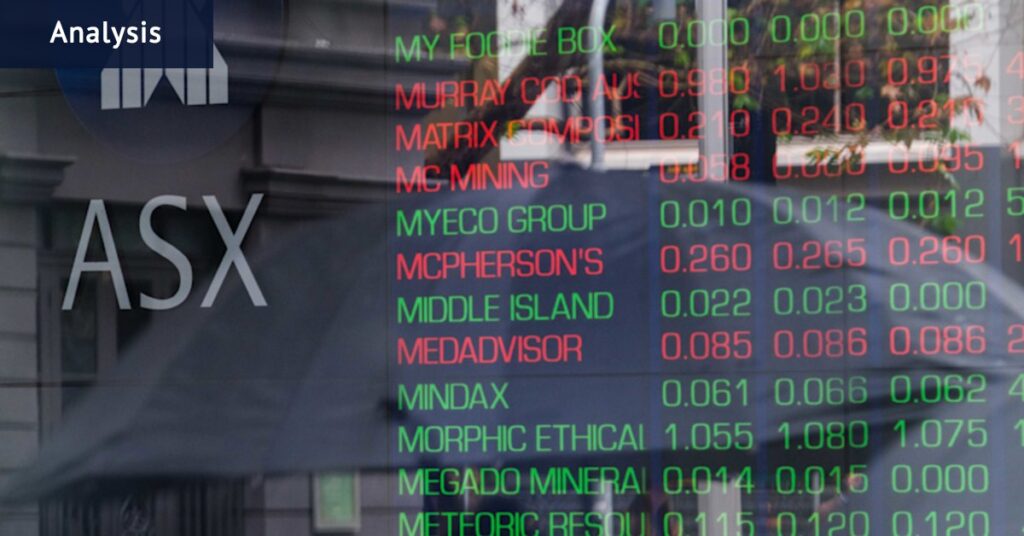
Investors in Australian shares might find themselves envious as they compare their portfolios’ performance this year with international markets. With just one month remaining in 2025, it’s evident that the Australian Securities Exchange (ASX) has been a global laggard. Not only has it trailed behind the pivotal U.S. market, but it also lags behind markets in Europe, Britain, China, and Japan.
The ASX 200 has risen about 5% since the beginning of the year, significantly lagging behind the more than 15% returns seen in the U.S., UK, and Europe, approximately 14% in China, and over 25% in Japan. While these figures exclude dividends—of which Australian companies are known to pay generously—the underperformance is unmistakable.
Understanding the ASX’s Underperformance
So, why is this happening? The primary reason for the ASX’s softer performance is its composition, which leans towards traditional sectors rather than the tech-heavy indices of Wall Street. However, other factors have also played a role, including the diminishing prospects of interest rate cuts by the Reserve Bank of Australia, reliance on a weakened Chinese economy, and a period of subdued corporate profits.
Globally, sharemarkets often move in tandem, typically led by the U.S., the world’s largest market. However, the composition of these markets reveals stark differences. In the U.S., technology giants like Nvidia, Microsoft, Apple, and Alphabet constitute about 30% of the S&P 500 index, driven by the artificial intelligence boom.
In contrast, the ASX has a more ‘old-world’ feel. Financial firms, mainly banks, make up almost a third of the index, while miners account for another 20%. Although these companies are considered stable “blue chip” investments, their performance is heavily tied to global growth and, notably, China’s economic health.
The Impact of Market Composition
Does the ASX’s lack of high-flying tech stocks and its reliance on miners and banks matter? The market has missed out on the AI boom, even though financials have performed reasonably well, rising about 4% this year, and materials have surged over 20%. However, superannuation funds, which now hold more overseas shares than Australian ones, are still expected to achieve returns close to their long-term average.
This conservative market composition can be advantageous during turbulent times, as seen earlier this year during Donald Trump’s “Liberation Day,” when investors sought safe havens. According to Morgan Stanley Australia equity strategist Chris Nicol, the ASX outperformed during periods of risk aversion, as high-priced banks appeared attractive to global investors seeking stability in the face of Trump’s policies.
Challenges and Opportunities Ahead
Aside from investor sentiment, another straightforward reason for the ASX’s weakness is the lack of corporate profit growth. AMP chief economist Shane Oliver notes that earnings per share have been soft for the past three financial years, reflecting an economy recovering from cost-of-living challenges and a weakened Chinese export market.
Perpetual’s head of investment strategy, Matt Sherwood, highlights that projections for earnings per share growth over the next year remain modest, yet share prices are relatively high.
“The Australian sharemarket is expensive relative to its own history, and relative to comparable markets such as the US and Europe,” he says. “You’re paying high prices for low earnings growth.”
This year, debates over the valuation of individual stocks, particularly the market’s largest, Commonwealth Bank of Australia (CBA), have resurfaced. Despite being a well-managed bank, questions arise about its $300 billion valuation earlier this year. With CBA shares falling about 20% from their peaks, many investors believe better value lies elsewhere.
Looking Forward: Potential for Rebound
Despite a less stellar year for the ASX, some analysts anticipate a rebound. UBS strategist Richard Schellbach recently predicted that 2026 could bring the strongest earnings per share growth for the ASX200 in four years, driven by stronger profits from miners.
Moreover, there is a case to be made that the ASX’s solid, if unexciting, performance would fare better if Wall Street is indeed caught in an AI bubble, as some fear. Schellbach points out that after the early 2000s tech wreck, Wall Street suffered a collapse, while the ASX experienced a far more modest decline.
In conclusion, while the ASX has not matched the performance of its tech-heavy peers this year, its composition could prove advantageous in the event of a tech market correction. As the global economic landscape continues to evolve, investors will be closely watching for signs of a potential rebound in the Australian market.