



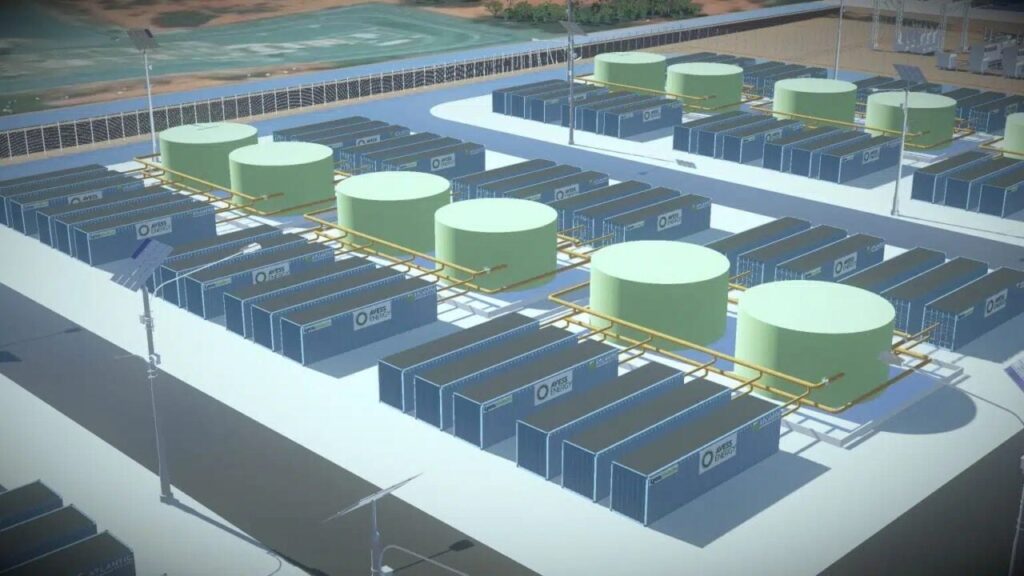
In a significant leap for Australia’s energy sector, Western Australia has unveiled plans for a groundbreaking 500MWh vanadium flow battery project. This initiative, described as a “pivotal moment” by a spokesperson from AVESS Energy, marks the largest vanadium redox flow battery (VRFB) installation outside of China and the first of its kind to connect to Australia’s major electricity markets.
The Kalgoorlie project, spearheaded by Perth-based AVESS Energy, is set to transform the landscape of battery manufacturing and energy consumption in the region. According to AVESS, the project will serve as a catalyst for expanding vanadium flow battery deployments across Australia and beyond.
Breaking New Ground in Energy Storage
The Kalgoorlie project is not just a milestone for Western Australia but also a significant development in the global energy storage arena. As the first large-scale VRFB project in Australia, it will connect to the National Electricity Market (NEM) and the Wholesale Electricity Market (WEM), integrating into the South-West Integrated System (SWIS).
AVESS Energy is collaborating with Atlantic Vanadium and Lycopodium to submit a Stage One Expression of Interest (EOI), assessing market capabilities and metrics of interested parties. Atlantic Vanadium, described as a “shovel-ready vanadium producer,” brings essential resources to the consortium.
Technological and Commercial Challenges
AVESS Energy’s acquisition of a majority stake in KORID Energy, a South Korean vanadium flow battery technology company, in 2023, has been pivotal. This strategic move grants AVESS access to KORID’s advanced battery stack technology, crucial for the Kalgoorlie project’s success.
The company has already demonstrated its capabilities with a commercial-scale VRFB installation in early 2024, utilizing a 50kW module with a 5-hour discharge duration. However, scaling up to meet the demands of the Kalgoorlie project presents unique challenges.
“The biggest technical challenge lies in the fact that a plant-style VFB system of this scale has never been attempted before in Australia,” the AVESS spokesperson noted. “Commercially, the challenges will be in the scale of cell-stack manufacturing and battery pack assembly.”
To address these challenges, AVESS plans to fast-track manufacturing facility expansion and vanadium electrolyte supply, with over 30 million liters required to support the 500MWh energy storage capacity.
Vanadium: A Strategic Resource
Australia holds approximately one-third of the world’s recoverable primary vanadium reserves, positioning it as a key player in the global vanadium market. While most vanadium is currently a byproduct of steel production in China, Australia’s reserves offer a strategic advantage.
The Queensland government has long recognized the potential of vanadium, aiming to leverage this resource to strengthen supply chains as VRFB technology gains traction worldwide. Western Australia’s focus on local companies further limits competition, with firms like Australian Vanadium and VSUN Energy making significant strides in the industry.
VSUN Energy, a subsidiary of Australian Vanadium, has already commissioned a 78kW/220kWh trial project for Horizon Power, showcasing the potential of long-duration energy storage technologies in remote communities.
Looking Ahead: Implications and Opportunities
The Kalgoorlie project’s expected commercial operation date in 2029 leaves room for further developments and potential new entrants in the market. The VRFB technology, initially invented in Australia, has seen significant advancements, particularly in China, driven by supportive policies.
“VRFBs are an ideal technology for Australia’s bushfire-prone and drying climate,” the AVESS spokesperson emphasized, highlighting the safety and longevity of vanadium flow batteries compared to lithium-ion alternatives.
With a multi-decade storage asset life and serviceable components, the Kalgoorlie vanadium battery energy storage system (VBESS) promises economic benefits and robustness, potentially offering a more cost-effective solution over its lifespan than similar lithium-ion systems.
As the project progresses, it not only represents a significant step forward for Australia’s energy infrastructure but also sets a precedent for future large-scale energy storage initiatives worldwide.