


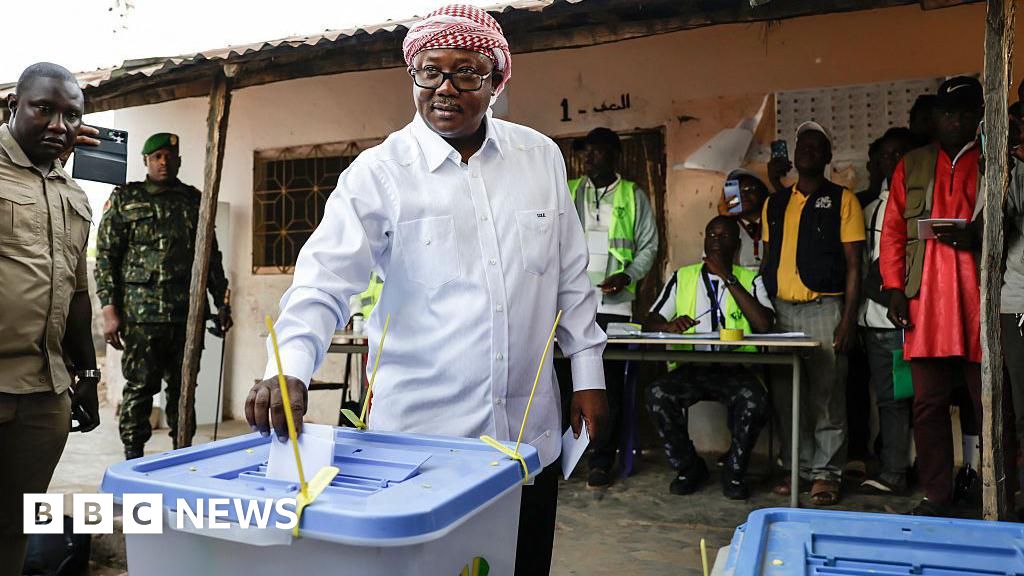
Senegal’s Prime Minister Ousmane Sonko and Nigeria’s former President Goodluck Jonathan have cast doubt on the legitimacy of the recent military coup in Guinea-Bissau, describing it as a “sham.” The ousting of former President Umaro Sissoco Embaló occurred just a day before the anticipated release of election results, raising suspicions about the military’s motives.
The military has since suspended the electoral process and blocked the announcement of the results, claiming it acted to prevent a plot aimed at destabilizing the already politically fragile nation. Despite these assertions, Sonko and Jonathan have called for the immediate release of the election results, although they have not provided concrete evidence to support their claims that the coup was staged.
Controversy Surrounding the Coup
Embaló, who was reportedly ousted by the military, arrived in Senegal on a chartered military flight following his release. In an unusual turn of events, he personally announced his own overthrow during a phone call to the French television station France 24, stating, “I have been deposed.”
Goodluck Jonathan, who led an election observation team from the West African Elders Forum to Guinea-Bissau, described the incident as a “ceremonial coup.” He questioned the sequence of events, noting the peculiarity of Embaló being the first to announce his own removal, contrasting it with recent coups in the region.
“What happened in Guinea-Bissau was a sham,” declared Senegal’s Sonko to lawmakers, echoing the sentiments of the opposition who also allege the coup was staged without presenting evidence.
International and Regional Reactions
In response to the military takeover, the African Union suspended Guinea-Bissau, a move mirrored by the West African bloc Ecowas, which urged the military to return to the barracks. Meanwhile, Guinea-Bissau’s transitional leader, Gen Horta N’Tam, appointed Ilidio Vieira Té, the former finance minister, as the new prime minister.
Guinea-Bissau has a tumultuous history with coups, further complicated by its struggles with drug trafficking. The military justified its actions by alleging a plot by unnamed politicians, backed by a notorious drug baron, to destabilize the country.
Local Reactions and Historical Context
The coup has elicited mixed reactions among the citizens of Guinea-Bissau. A mother of three recounted to the BBC her experience of hearing gunfire and the subsequent scramble to safety, noting that despite the country’s history of coups, the timing was unexpected as citizens awaited election results.
“This doesn’t help anyone. Because it puts the country into chaos,” lamented Mohamed Sylla, a resident of Bissau.
Conversely, some residents have expressed support for the military, hoping for improvements in living conditions. “I am not against the military regime as long as they improve the living conditions in the country,” Suncar Gassama told the BBC.
Looking Ahead
The unfolding situation in Guinea-Bissau is a stark reminder of the region’s ongoing political instability. As international and regional bodies call for a return to democratic processes, the focus remains on whether the military will heed these calls or further entrench its power.
With the election results still withheld and the political climate tense, the coming weeks will be crucial in determining Guinea-Bissau’s path forward. Observers and citizens alike are watching closely, hoping for a resolution that will bring stability and progress to the nation.