



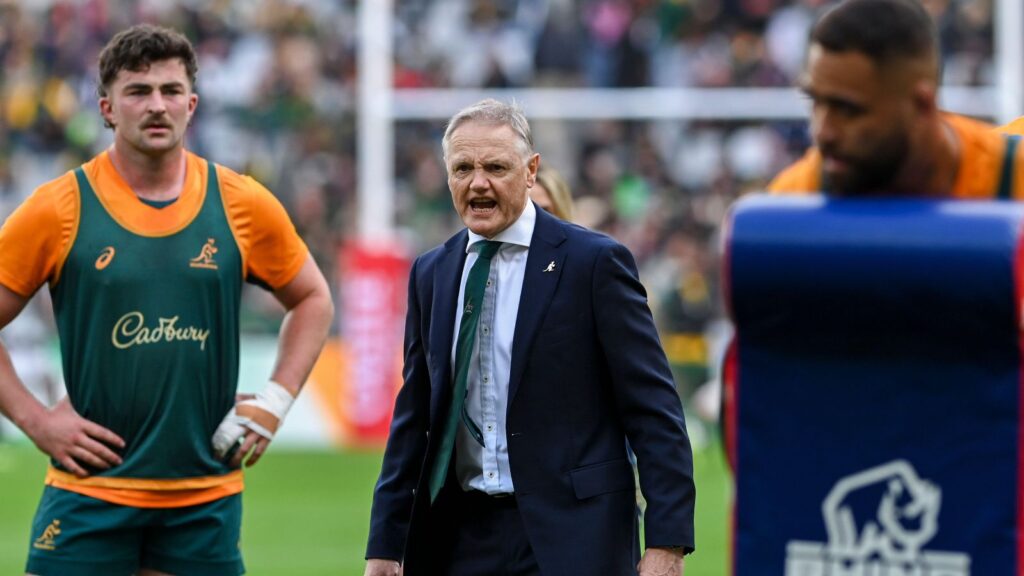
Australian rugby has witnessed a remarkable transformation under the guidance of Joe Schmidt, a shift that has not gone unnoticed by pundits and fans alike. Matt Williams, a seasoned commentator on the Rugby Championship, has praised the Wallabies’ recent improvements, attributing their success to Schmidt’s leadership. This transformation, according to Williams, did not require “rocket science” but rather a return to fundamental principles.
The Wallabies’ resurgence began with a victory over South Africa in Johannesburg, followed by a narrow loss in Cape Town. As they prepare to host Argentina in Townsville, Williams, who previously coached Leinster before Schmidt took over in 2010, offers an in-depth analysis of the changes within Australian rugby.
The Road to Redemption
Rugby Australia faced a significant setback when the abrupt dismissal of Dave Rennie led to Eddie Jones’ appointment as head coach. The team then suffered a historic pool-stage elimination at the 2023 World Cup. However, the decision to bring Schmidt on board in 2024, following his tenure as an assistant with the All Blacks, marked a turning point.
Under Schmidt’s leadership, the Wallabies have experienced a notable upswing. They defeated England at Twickenham last November and held their ground against the British and Irish Lions, culminating in a victory over the Springboks at Ellis Park. Williams notes, “After the Wallabies came within a whisker of winning the Lions series, then defeated the world-champion Springboks, Ireland are claiming the Wallabies coach as one of their own.”
Strategic Appointments and Fitness Focus
Williams credits Schmidt’s strategic appointment of experienced coaches, such as Mike Cron and Laurie Fisher, as a key factor in the Wallabies’ revival. These seasoned professionals have helped guide a young team that had lost its identity and confidence. Additionally, Schmidt’s emphasis on fitness has been pivotal. Williams asserts, “An absolutely crucial aspect of the Wallabies’ improvement is that Schmidt has worked these Wallabies into supreme condition.”
This focus on fitness has not only improved physical performance but also bolstered the team’s self-belief and confidence, elements that had been lacking in Australian rugby for years.
Consolidating Talent and Building Cohesion
Schmidt has also benefited from the decision to streamline Australia’s Super Rugby teams, concentrating talent into four stronger teams. This move, made by Herbert and Waugh in 2024, has elevated the performance of Australian Super teams, creating a winning habit that carried into the national team.
Moreover, Schmidt has maintained a core group of players, including captain Harry Wilson, and worked to reintegrate key overseas players like Will Skelton. This strategy has been crucial for a nation with a relatively small rugby talent pool.
Challenges and Future Prospects
Despite these successes, Schmidt’s tenure has not been without its challenges. A record loss in Argentina last year was a low point, but Williams remains optimistic about the Wallabies’ future under Schmidt’s leadership. “The culmination of all of these decisions is that Schmidt now has a competitive group of about 25 international quality players that he can select from,” Williams states.
Schmidt’s approach has not only led to victories but also revitalized the Wallabies’ playing style. “The Wallabies have played magnificent, intelligent, running rugby that has tapped into both the Australian tradition and spirit,” Williams concludes. As the Wallabies face a long season ahead, one thing is clear: Schmidt has firmly established himself as an integral part of Australian rugby’s future.