




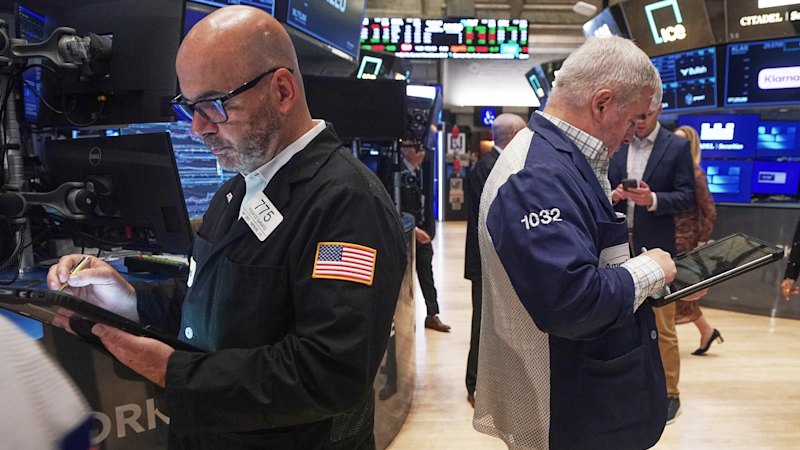
The US stock market experienced a mixed session overnight as conflicting reports on the world’s largest economy left investors uncertain about the future trajectory of interest rates. The S&P 500 slipped 0.2%, remaining just below its record high set last week. Meanwhile, the Dow Jones Industrial Average declined by 0.6%, while the Nasdaq composite rose by 0.2%.
In Australia, the sharemarket is poised for a flat opening, with futures down 2 points at 8591. The ASX saw a 0.4% decline on Tuesday, marking its second consecutive day of losses. The Australian dollar was trading lower at US66.30¢ at 8.31am AEDT.
Mixed Economic Indicators
Treasury yields initially dropped following reports indicating the US unemployment rate reached its highest level since 2021 last month, even as employers added more jobs than economists had anticipated. A separate report highlighted that an underlying measure of retail revenue strength in the US grew more than expected in October.
The mixed data initially sent Treasury yields lower in the bond market. The reports seemed to suggest that the Federal Reserve might view the slowing job market as a greater threat to the economy than inflation, potentially leading to further interest rate cuts in 2026. However, yields quickly recovered and fluctuated throughout the session.
“What the Fed does with interest rates is a top driver for Wall Street because lower rates can boost the economy and investment prices, though they may also exacerbate inflation.”
Inflation Concerns Loom
A report released on Tuesday, after US trading began, suggested that price pressures are intensifying, with average selling prices for businesses rising at one of the fastest rates since mid-2022. Preliminary data from S&P Global indicated that overall business activity growth slowed to its weakest level since June.
According to Chris Williamson, chief business economist at S&P Global Market Intelligence, “Higher prices are again being widely blamed on tariffs, with an initial impact on manufacturing now increasingly spilling over to services to broaden the affordability problem.”
Sector-Specific Impacts
On Wall Street, the most significant losses were observed in the oil sector as crude prices continued to fall. Expectations that oil production is sufficient to meet global demand have pushed US crude prices to their lowest since 2021, with a 2.7% drop overnight. Brent crude, the international benchmark, also fell by 2.7%, settling at $US58.92 per barrel.
This decline impacted stocks like APA, which fell by 5.2%, Marathon Petroleum, which dropped 4.7%, and Halliburton, which decreased by 4.3%.
Meanwhile, artificial intelligence technology stocks showed mixed results after dominating the market in recent days. Oracle and Broadcom saw gains of 2% and 0.4%, respectively, despite previous sharp losses. Conversely, CoreWeave, a company renting access to advanced AI chips, saw its shares fall by 3.9%.
Corporate Movements and Market Reactions
Shares of Warner Bros Discovery fell 2.7% amid reports that the company plans to reject Paramount Skydance’s hostile takeover bid due to concerns about financing and other terms. Sources close to the deliberations, who requested anonymity, indicated that Warner Bros still sees its deal with Netflix as more valuable. Paramount shares fell 1%, while Netflix shares rose 0.9%.
Elsewhere, Pfizer’s stock dropped 3.4% after issuing a profit forecast for 2026 that fell short of some analysts’ expectations. However, its revenue forecast for next year was in line with predictions. Kraft Heinz saw a 0.7% increase after announcing that Steve Cahillane, former CEO of Kellanova, will assume the role of CEO on January 1. Post-split in 2026, Cahillane will lead the company retaining the Heinz, Philadelphia, and Kraft Mac & Cheese brands.
Global Market Trends
Internationally, stock indexes fell across Europe and Asia. Japan’s Nikkei 225 declined by 1.6% ahead of an anticipated interest rate hike by the Bank of Japan later this week. Other Asian markets experienced significant fluctuations, with South Korea’s Kospi dropping 2.2%, and indexes in Hong Kong and Shanghai falling by 1.5% and 1.1%, respectively.
The current market dynamics underscore the ongoing uncertainty and volatility driven by mixed economic data and geopolitical factors. Investors and analysts alike are closely watching upcoming economic reports, particularly those related to inflation, to gauge future market movements and central bank policies.