




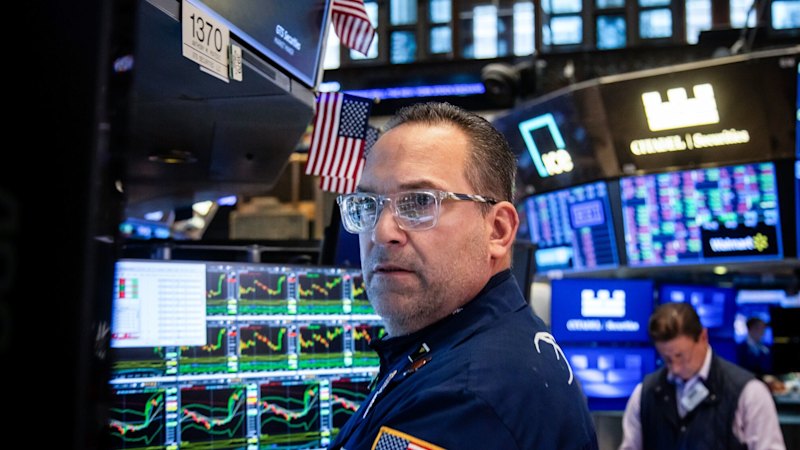
The Australian sharemarket experienced a robust start to the day, mirroring gains on Wall Street where investors returned with renewed confidence. This resurgence was fueled by strong quarterly corporate results and indicators of a resilient U.S. economy that have bolstered investor sentiment.
As of 10:56 AM AEDT, the S&P/ASX 200 index climbed 51.4 points, or 0.6%, reaching 8853.40. Mining stocks spearheaded the advance, buoyed by an overnight rise in gold prices. Tech stocks also rebounded after Wednesday’s losses, which had previously dragged the ASX down by 0.1%. Concurrently, the Australian dollar was trading at $US65.10¢.
Banking Sector Sees Mixed Results
National Australia Bank (NAB) shares dropped 1.1% after reporting a slight decline in cash profits by 0.2% for the year ending September. This was attributed to higher charges for bad loans and rising expenses in its business banking division. Meanwhile, the other major banks displayed mixed performances. Westpac, which announced a 1% fall in full-year profits to $6.9 billion earlier this week, saw its shares fall by 1.7%. In contrast, the Commonwealth Bank rose by 0.9%, and ANZ Bank added 0.6%.
James Hardie Industries faced a dramatic 9.4% plunge in early trading, prompting a halt in its stock trading pending further announcements.
Materials and Tech Stocks Lead the Charge
Materials emerged as the strongest sector early in the session. Iron ore giants BHP, Fortescue, and Rio Tinto rebounded from previous losses, with respective gains of 1.1%, 0.8%, and 1.3%. Gold miners also capitalized on the rise in bullion prices, which climbed 1.4% to $US3988.88 per ounce overnight. Northern Star Resources advanced 2.5%, Evolution Mining rose 2.3%, and Newmont increased by 2.8%.
Tech stocks showed resilience, reversing the previous day’s global sell-off. Software companies WiseTech Global and Technology One saw increases of 2.8% and 0.6%, respectively, while Life360, known for its family tracking app, rose by 2.1%.
Wall Street’s Influence and Broader Market Trends
The local bourse’s rise was in tandem with a rebound on Wall Street, where the S&P 500 increased by 0.4%, the Dow Jones by 0.5%, and the Nasdaq by 0.7%. This followed a Tuesday pullback that had raised concerns about market overvaluation. However, strong U.S. corporate earnings and positive private economic data helped restore investor confidence.
“For investors with cash on the sidelines, the recent market pullback seems like a good time to buy, especially for investors with a longer time horizon,” said Robert Edwards of Edwards Asset Management. “Earnings are crushing it and growing faster than revenues, and that often leads to multiple expansion.”
Several major companies contributed to Wall Street’s uplift. Alphabet, Google’s parent company, surged by 2.4%, and McDonald’s gained 2.2% following a sales boost from its popular Snack Wraps. International Flavours & Fragrances saw a 4.1% rise after surpassing Wall Street’s profit forecasts.
Economic Indicators and Federal Reserve Outlook
Amid the U.S. government shutdown, the latest earnings reports have provided crucial insights into consumer behavior and economic conditions. ADP Research Institute’s data showed an increase in U.S. jobs in October, while the Institute for Supply Management reported an expansion in services activity, the fastest in eight months.
“The survey provides a reassuring sign that economic growth persisted in October despite the government shutdown,” noted Bill Adams, chief economist for Comerica Bank.
However, a weakening job market remains a significant concern for the Federal Reserve. The Fed recently cut its benchmark rate for the second time this year to support the economy. Despite this, Fed Chair Jerome Powell and other officials have expressed reservations about further rate cuts, given persistent inflation concerns.
“For Fed watchers, this ADP report should make it clear that a December rate cut is now in play,” said Jamie Cox, managing partner for Harris Financial Group. “We are nearing stall speed in the labor market, and that will get the Fed’s attention.”
Investors have adjusted their expectations for another interest rate cut in December, with current forecasts indicating a 65% probability, down from 90% prior to the last rate cut, according to CME FedWatch.
As the market continues to navigate these economic signals, the interplay between inflation, employment, and Federal Reserve policy will remain at the forefront of investor considerations.