



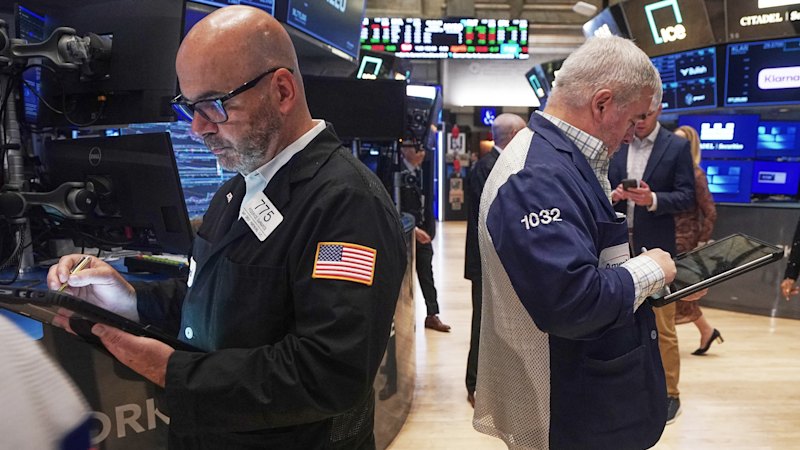
The US stock market experienced a mixed session overnight as new economic data failed to provide clarity on the future direction of interest rates. The S&P 500 slipped by 0.2%, remaining just below its record high set last week. Meanwhile, the Dow Jones Industrial Average fell by 0.6%, and the Nasdaq composite saw a slight increase of 0.2%.
In Australia, the share market is expected to open flat, with futures down by 2 points to 8591. The ASX experienced a 0.4% decline on Tuesday, marking its second consecutive day of losses. The Australian dollar was trading lower at US66.30¢ as of 8:31 AM AEDT.
Economic Data and Market Reactions
Treasury yields initially dropped before stabilizing after reports indicated that the US unemployment rate had reached its highest level since 2021. Despite this, employers added more jobs than economists had anticipated. Another report revealed that an underlying measure of retail revenue strength in the US grew more than expected in October.
“The mixed data initially sent Treasury yields lower in the bond market. The knee-jerk reaction seemed to be that the reports could encourage the Federal Reserve to see the slowing job market as the biggest threat to the economy, rather than high inflation, and cut interest rates further in 2026.”
The Federal Reserve’s decisions on interest rates are critical for Wall Street, as lower rates can stimulate economic activity and boost investment prices, albeit at the risk of exacerbating inflation. An upcoming report on Thursday is expected to shed light on the inflation rates for the previous month, with economists predicting that consumer prices in the US continue to rise at an undesirable pace.
Market Sectors and Key Players
On Wall Street, the oil sector faced significant losses as crude prices continued to decline. Expectations of sufficient oil supply to meet global demand pushed the price of US benchmark crude to its lowest level since 2021, falling by 2.7% overnight. Brent crude, the international standard, also dropped by the same margin. US crude settled at $55.27 per barrel, while Brent settled at $58.92.
APA’s stock fell by 5.2%, Marathon Petroleum by 4.7%, and Halliburton by 4.3%, marking some of Wall Street’s largest losses.
Conversely, artificial intelligence technology stocks showed mixed results. Oracle rose by 2%, and Broadcom increased by 0.4%, recovering from last week’s losses despite reporting stronger-than-expected quarterly profits. CoreWeave, however, saw a 3.9% decline, raising questions about the profitability and productivity of current AI investments.
Corporate Developments and International Markets
Warner Bros Discovery’s shares fell by 2.7% amid reports that the company plans to reject Paramount Skydance’s hostile takeover bid due to concerns over financing and other terms. Sources close to the situation, who requested anonymity, indicated that Warner Bros continues to see its deal with Netflix as more valuable. Paramount’s shares decreased by 1%, while Netflix saw a 0.9% increase.
Elsewhere, Pfizer’s stock dropped by 3.4% after issuing a profit forecast for 2026 that fell short of some analysts’ expectations. However, its revenue forecast for the next year was in line with predictions. Kraft Heinz gained 0.7% following the announcement that Steve Cahillane, former CEO of Kellanova, will take over as CEO on January 1. Post its expected split in the second half of 2026, Cahillane will lead the company retaining the Heinz, Philadelphia, and Kraft Mac & Cheese brands.
Internationally, markets across Europe and Asia also faced declines. Japan’s Nikkei 225 dropped by 1.6% ahead of an anticipated interest rate hike by the Bank of Japan. Other Asian markets experienced significant fluctuations, with South Korea’s Kospi falling by 2.2%, and indices in Hong Kong and Shanghai decreasing by 1.5% and 1.1%, respectively.
This ongoing economic uncertainty and market volatility highlight the complex interplay between global economic indicators and investor sentiment. As the Federal Reserve prepares for its next steps, markets worldwide remain on edge, awaiting clearer signals on interest rates and inflation trends.