




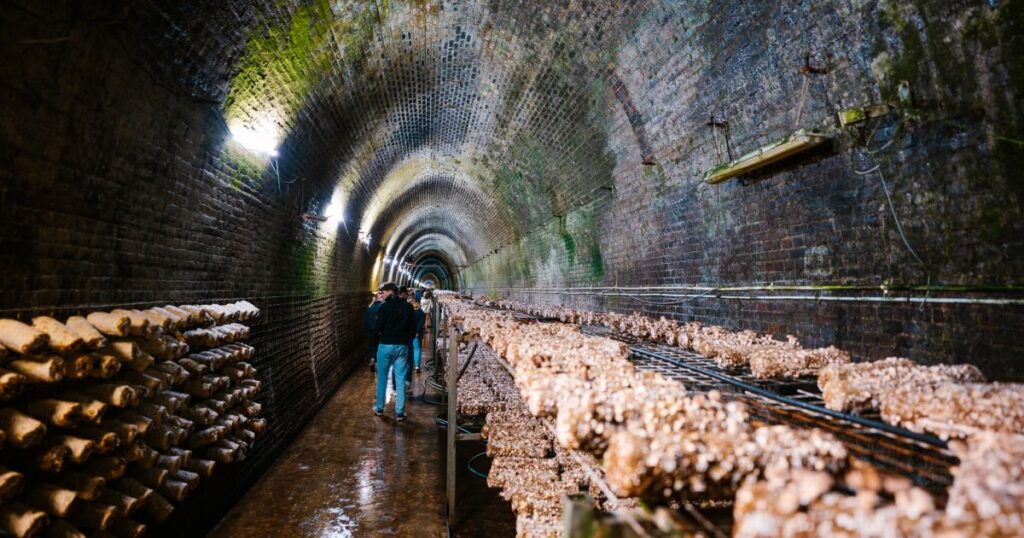
Twenty years ago, Peter Wenzel’s passion for mushrooms often left party-goers uninterested. Today, as the owner of Fungi Co in Canberra, his enthusiasm is met with curiosity and intrigue. “Now there are movies about fungi; people are interested in their culinary value, ecological uses, medicinal value, and the benefits of microdosing to treat anxiety,” Peter tells Region.
Fungi Co, established in the late 1990s, began as a modest commercial venture in a simple polytunnel. After a period of dormancy, Peter revitalized the business a decade ago. He now cultivates unique and exotic mushrooms in Victorian-era train tunnels in the Southern Highlands, supplying chefs, grocers, and the general public. The tunnels also serve as educational grounds for school-aged children from kindergarten to year 10.
Turning Abandoned Tunnels into a Mushroom Paradise
While abandoned train tunnels might seem an unusual choice for a business location, the mushrooms thrive in these conditions. “The thermal mass of the mountain keeps them at 17 degrees year-round and a bit damp; it’s like Narnia for mushrooms,” Peter laughs. The tunnels’ unique environment not only supports mushroom growth but also attracts visitors for tours.
“There are two things that attract people to the tunnels. There are the people who are interested in the mushrooms, and then there are the tunnel enthusiasts,” Peter explains. The tours, tailored to visitors’ interests, delve into both the mushroom cultivation process and the history of the tunnels, which were hand-built by candlelight in an era before dynamite.
A Lifelong Passion and Global Connections
Peter’s fascination with mushrooms began in childhood, collecting plants and fungi in the forests near his home. He once dreamed of creating a “mushroom zoo,” a concept akin to a traditional zoo but filled with living mushrooms. Lacking a specialized degree in mycology, Peter pursued broader studies in science and biochemistry.
His dedication to mushrooms led to collaborations with other enthusiasts, such as Kunihide Inoue, a Japanese professor of mycology. Together, they advanced mushroom cultivation techniques and initiated farm trials in Japan and Kota Kinabalu. “He was born in 1935; he was just a dude, I couldn’t keep up with him,” Peter recalls fondly.
Overcoming Challenges and Embracing Opportunities
Despite his deep knowledge, Peter approaches all aspects of mushroom cultivation with humor and passion. Conversations inevitably touch on the ‘mushroom murders,’ a topic he addresses with characteristic wit. “Leonie got a bit tired of it at the markets. People would inevitably come up and say, ‘You got any deathcaps?’ but she would respond with a quip like, ‘We used to, but we didn’t get enough repeat customers!’”
Although sales dipped slightly in 2023, they have since rebounded. “We’re at this point finally where fungi are in the limelight, and the applications for humanity, for medicine, for food and for the environment are broad,” Peter notes.
“From a culinary perspective, we introduce people to mushrooms that have such diverse flavors and textures. We have mushrooms that taste like bacon; there are ones with lilac overtones, there are deep meaty ones and thin crunchy ones,” Peter enthuses.
Building a Future for Fungi
Peter and Leonie’s efforts aim to cultivate a market for mushrooms in Australia. Without passionate advocates like them, mushrooms risk remaining in obscurity, confined to the dark corners of their Narnian tunnels. Their work not only highlights the culinary delights of mushrooms but also their potential in various fields, from environmental cleanup to art and fashion.
As Peter continues to champion the cause of fungi, his journey serves as a testament to the power of passion and innovation in transforming forgotten spaces into thriving ecosystems.