



Twenty years ago, Peter Wenzel’s enthusiasm for mushrooms often left partygoers bewildered. Today, as the owner of Canberra-based Fungi Co, his passion is met with curiosity and interest. “Now there are movies about fungi; people are interested in their culinary value, ecological uses, medicinal value, and the benefits of microdosing to treat anxiety,” Peter shares with Region.
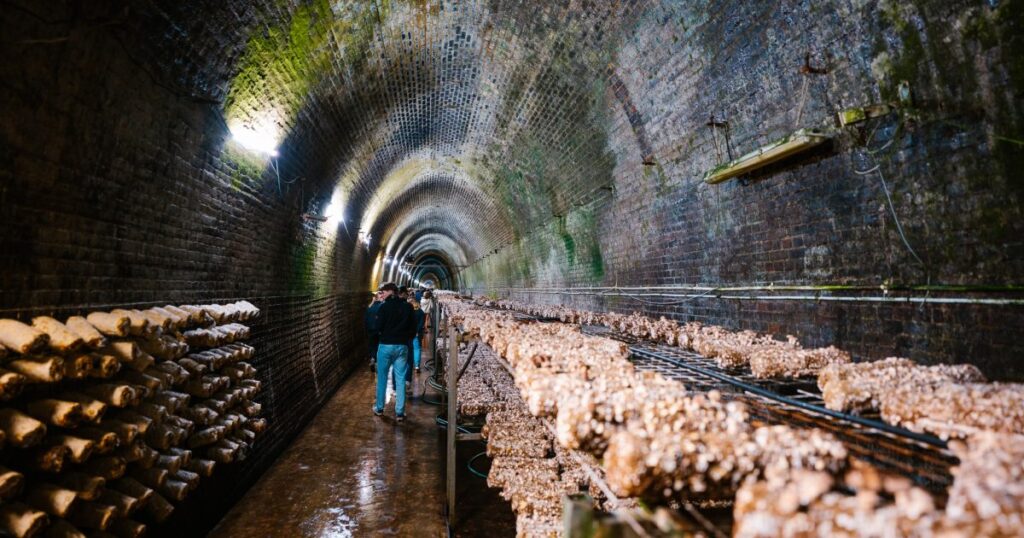
Founded in the late 1990s, Fungi Co began as a modest commercial enterprise operating from a simple polytunnel. After a period of dormancy, Peter revitalized the business a decade ago, finding an unusual yet perfect location for his mushroom cultivation: the Victorian-era train tunnels in the Southern Highlands. These tunnels provide an ideal environment for growing exotic mushrooms, maintaining a consistent temperature of 17 degrees Celsius year-round, and offering the dampness mushrooms thrive in. “It’s like Narnia for mushrooms,” Peter laughs.
The Unique Appeal of Train Tunnels
The use of these historic tunnels not only provides optimal growing conditions but also attracts a diverse group of visitors. Peter and his partner Leonie have capitalized on this unique setting by offering regular tours, drawing in both mushroom enthusiasts and tunnel aficionados. “There are two things that attract people to the tunnels. There are the people who are interested in the mushrooms, and then there are the tunnel enthusiasts,” Peter explains.
These tours are tailored to the interests of the visitors, offering deep dives into the mushroom cultivation process and the history of the tunnels themselves, which were hand-built by candlelight before the advent of dynamite. Leonie, with her penchant for historical research, continually enriches the tours with new details from the National Library’s Trove.
A Lifelong Passion for Fungi
Peter’s fascination with mushrooms dates back to his childhood, spent collecting plants and fungi in the forests near his home. He once dreamed of creating a “mushroom zoo,” a concept akin to a traditional zoo but filled with living mushrooms. Lacking a specialized degree in mycology, Peter pursued a broader science education, later focusing on biochemistry.
Throughout his career, Peter has crossed paths with other mycology experts, including Kunihide Inoue, a renowned Japanese professor. Together, they advanced mushroom cultivation techniques and initiated farm trials in Japan and Kota Kinabalu. “He was born in 1935; he was just a dude, I couldn’t keep up with him,” Peter recalls fondly.
The Mushroom Market and Cultural Impact
Despite occasional setbacks, such as the “mushroom murders” which briefly affected sales in 2023, Peter remains optimistic about the future. “We’re at this point finally where fungi are in the limelight, and the applications for humanity, for medicine, for food and for the environment are broad,” he asserts.
Peter highlights the diverse culinary potential of mushrooms, noting their varied flavors and textures. “From a culinary perspective, we introduce people to mushrooms that have such diverse flavors and textures. We have mushrooms that taste like bacon; there are ones with lilac overtones, there are deep meaty ones and thin crunchy ones,” he enthuses.
“We have all these cultures in our culture bank just waiting to go onto the Australian market.”
The efforts of Peter and Leonie aim to cultivate a broader market for mushrooms, ensuring that these fungi find their rightful place beyond the shadows of the Victorian tunnels.