


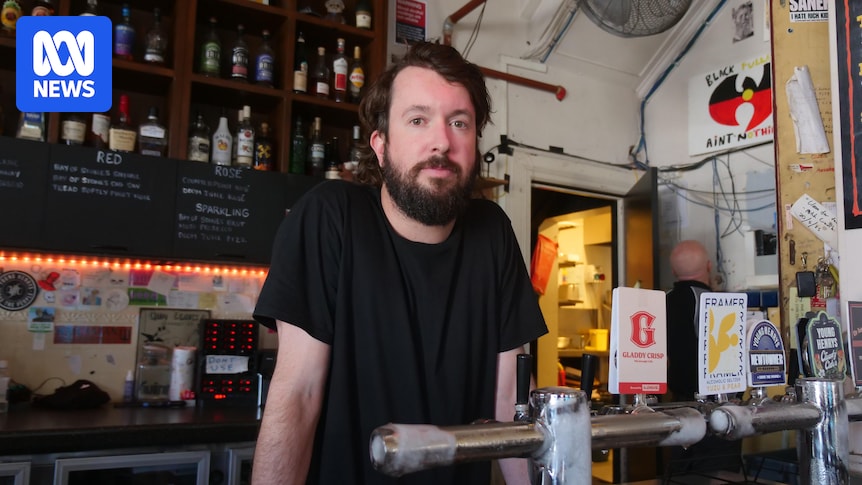
When Mitch Crum, owner of the Lord Gladstone Hotel in Sydney’s inner city, decided to remove poker machines from his pub, he anticipated a straightforward process. Instead, he felt as though he was navigating a bureaucratic labyrinth. “It was an absolute stuff-around. It was so hard, it was so difficult for me to get these machines out,” Crum shared with ABC Radio Sydney Afternoons. “It was like I was doing a bloody crime trying to get rid of these things. It was going through hurdles after hurdles.”
Mr. Crum’s experience highlights a broader issue faced by venue owners across New South Wales (NSW) who wish to remove poker machines. NSW hosts nearly 88,000 poker machines, with players losing over $1 million every hour, according to Wesley Mission data. The state government has recently mandated that all NSW venues must switch off machines between 4 a.m. and 10 a.m. daily starting March 31, 2026. Despite these measures, Crum argues that venue owners require more education and financial support to transition to pokies-free establishments.
Challenges in Removing Poker Machines
From the outset of his tenure at the Lord Gladstone Hotel in 2019, Crum was determined to eliminate poker machines. “I’ve never been fond of pokie machines,” he stated. “Go to the RSL clubs and casinos — we don’t need them in pubs.” His stance was reinforced by the challenges he faced with problem gamblers, including a woman who squandered her inheritance on the machines. “She was playing big hits and big dollars. Not just coming in for a little bit of fun, but was sitting here all day. That was quite a tough thing to do,” he recounted.
The responsibility of monitoring problem gamblers places additional strain on staff. “Honestly, there is so much training around RCG [responsible conduct of gambling] but to really do your job in Australia with poker machines, it’s a full-time job,” Crum explained. Despite his aversion to poker machines, Crum acknowledges their financial benefits. Before signage restrictions were implemented in 2023, he invested $3,000 in a light box to advertise his gaming room, which quickly paid off. “We flipped it on and we got four huge players come in and they just pumped so much cash and walked out, [it was] kind of insane,” he said.
The Complex Process of Removal
Mr. Crum embarked on the removal process in mid-2022, only to find it fraught with complexity. “There’s so much training around the usage and the responsible gambling side of things, but the actual process of getting these machines out was just insane,” he noted. One stakeholder informed him they could not legally release data to anyone but the venue licensee or their delegate, leaving Crum to navigate the process largely on his own.
Wesley Mission chief executive Stu Cameron emphasized, “The process of getting rid of poker machines has to be simpler.”
Under the NSW government’s forfeiture scheme, venues must forfeit one machine for every two or three traded. Machines must be removed by a licensed gaming machine technician or manufacturer, and the transfer of gaming machine entitlements is a separate process. This complexity left Crum confused, especially when removing his last two machines. “It got to a point where I basically did give up,” he admitted.
A spokesperson for Liquor and Gaming NSW suggested that venues seeking assistance could contact Liquor & Gaming NSW’s Hospitality Concierge for bespoke advice. Eventually, Crum managed to navigate the process, but he warns that unexpected costs could deter other owners from going pokies-free. “With lease agreements … they would factor in when you sign that lease what your machines will be doing for you,” he explained. The removal process also resulted in the loss of his ATM, as the company deemed the venue unprofitable without poker machines.
Calls for Government Support
The Lord Gladstone Hotel’s identity as a cultural hub for local artists has eased its transition to a pokies-free venue, but Crum acknowledges that other venues, such as sports bars, may face greater challenges. “It’s impossible — that’s their whole business model,” he said. Crum advocates for both educational and financial support from the government, suggesting, “Something like a grant that supports you in the process of removing poker machines or something like that would be epic.”
Reverend Cameron added, “For those smaller venues, particularly, wanting to exit and clubs, I think there should be some exploration of what an appropriately targeted buyback scheme might look like.”
While Mr. Crum has repurposed his gaming room for storage, he plans to expand the space into a courtyard for live music, signaling a new chapter for the Lord Gladstone Hotel. As the debate over poker machines continues, the experiences of venue owners like Crum underscore the need for streamlined processes and robust support systems to facilitate change.