
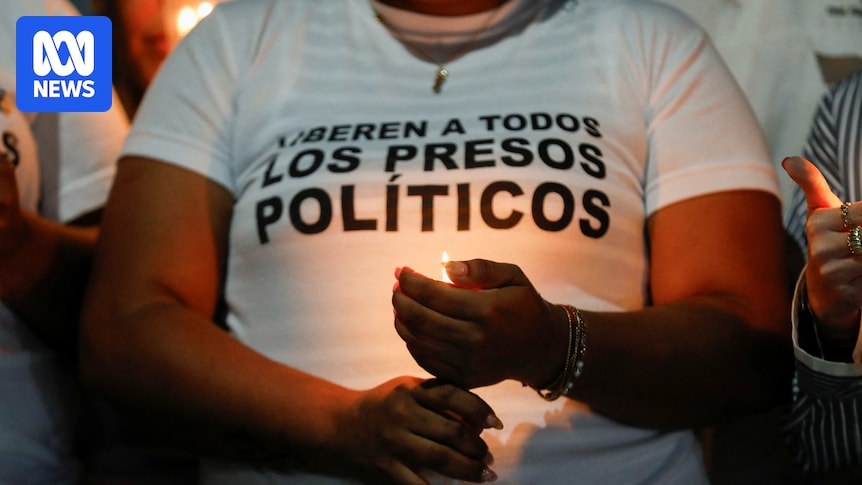
Zaida Martinez stood anxiously at the gates of El Helicoide, a notorious prison outside Caracas, hoping for news about her son. The 39-year-old janitor’s son was forcibly taken from his workplace over a month ago by masked, armed men in a police vehicle. “He has disappeared,” Martinez said, emphasizing the involvement of a police force in his abduction.
Her story is not unique. In the wake of Venezuela’s interim government’s promise to release a “significant number” of political prisoners, families like Martinez’s have gathered outside El Helicoide, waiting for loved ones to emerge. The prison, a spiral-shaped fortress, serves as the headquarters for Venezuela’s intelligence service and has a grim reputation as a site of torture.
Political Promises and International Reactions
The announcement of potential releases comes after a dramatic shift in Venezuela’s political landscape. Following a U.S. military operation that ousted Nicolás Maduro, the remnants of his regime pledged to release prisoners, ostensibly to promote peace. U.S. President Donald Trump hailed the move on social media, calling it a “very important and smart gesture.”
However, Foro Penal, a leading prisoner rights organization, reports that while around 72 prisoners have been released, approximately 800 remain detained on political grounds. Interim President Delcy Rodríguez has stated that the government is evaluating cases related to constitutional order, hate crimes, and violence for potential release.
Human Rights Concerns and Ongoing Detentions
Despite claims of progress, the United Nations’ Venezuela Fact-Finding Mission paints a troubling picture. The mission estimates that around 800 political prisoners remain, with only about 50 released by Monday. The UN criticizes Venezuela for falling short of its international human rights obligations, highlighting ongoing disappearances and torture.
“This falls far short of Venezuela’s international human rights obligations,” the UN mission stated.
Reports of arbitrary detentions continue, with hooded individuals conducting arrests without warrants. Some detainees are photographed with incriminating items not belonging to them, while others face torture, including beatings and electric shocks, to extract information about opposition groups.
Families’ Desperate Pleas for Justice
For many families, the wait outside El Helicoide is fraught with uncertainty and fear. Angela Crespo, whose husband has been imprisoned for nearly six years, has had no contact with him for over six months. Accused of involvement in Operation Gideon, a failed 2020 coup attempt, her husband was moved to a military facility, leaving her without information.
Maria Marquez faces a similar plight. Her son, also linked to Operation Gideon, has not been seen by his family since being transferred to El Rodeo prison. The lack of communication and proof of life is a source of anguish for Marquez, who took a costly taxi ride to the prison, hoping for his release.
“He’s innocent of everything, just like several others [in] there,” Marquez said, pleading for proof of life.
Community Support and Calls for Humanity
Amidst the despair, local communities have shown solidarity. Angelica, a local woman, and her daughter have been providing food and faith bracelets to the families waiting outside the prison. “Maybe they should be a little more aware and have a little more humanity, a little more heart,” she said, urging authorities to act with compassion.
As families continue their vigil, the promise of prisoner releases remains a beacon of hope, albeit dimmed by the harsh realities of Venezuela’s political and human rights landscape. The international community watches closely, as the situation in Venezuela remains a complex web of political maneuvering and human suffering.