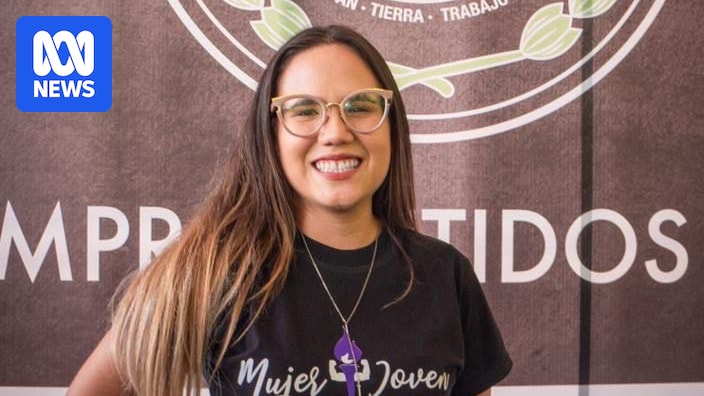
Diana Camacaro vividly recalls the moment her life was turned upside down. Just two days after the contentious 2024 Venezuelan election, the human rights activist received a chilling message via the Telegram app. It was from a former classmate with close ties to Venezuelan President Nicolás Maduro’s regime, warning her that she was on a list of individuals slated for arrest.
The 27-year-old was forced to abandon her home in Venezuela, a place she has yet to return to. Upon receiving the ominous message, she immediately sought refuge in a safe house, joining other political dissidents in hiding for over two months. Her passport, along with those of hundreds of other political activists, was canceled, eliminating any legal means of seeking asylum abroad.
Camacaro recounted her ordeal from the Colombian border town of Cucuta, where she remains in exile. “The person who was sheltering us in the safe house had been warned that she was possibly at risk of arrest,” Camacaro told 7.30. “When we saw that the situation was untenable, after we had already been in shelter for two-and-a-half months, we decided to leave because it was too long waiting for the situation to change.”
Exile and Struggle for Safety
Camacaro’s story is far from unique. Gaby Arellano, elected to Venezuela’s parliament in 2015 as an opposition member, was similarly forced to flee in 2018. “All my rights and the office I held were violated,” Arellano shared with 7.30, recounting her escape to Colombia.
Despite Nicolás Maduro now being in US custody following a dramatic operation in Caracas, Camacaro remains hesitant to return home. “Until there is a stable transition and a stable democratic government there, it is not safe for activists like us who are abroad to return,” she explained.
“Knowing that Maduro will finally be held accountable before international justice is a great relief for Venezuelans,” Camacaro expressed. “No country likes intervention, but in the case of Venezuelans, facing a criminal cartel that holds our state hostage, we know that these measures are necessary.”
Political Shifts and International Implications
In the wake of Maduro’s capture, Vice-President Delcy Rodríguez has been sworn in as interim president with US backing. Meanwhile, opposition leader María Corina Machado has vowed to return and called for elections.
Nearly a week after the US raid, the Venezuelan government has reportedly begun releasing a significant number of prisoners. “These release processes are taking place as of this very moment,” announced Jorge Rodriguez, the interim president’s brother.
President Donald Trump has declared the US will reclaim its former oil assets in Venezuela. The nation, which boasts the world’s largest oil reserves, has seen its industry crippled by sanctions and mismanagement. Camacaro believes that if relinquishing oil to the US is the price for a free Venezuela, it is worth it. “I’m sure most are willing to pay it,” she stated.
The Human Cost of Political Turmoil
The United Nations refugee agency reports that over 7.9 million Venezuelans have fled since Maduro’s rise to power in 2013, marking one of the largest displacement crises in recent history. Many have sought refuge in neighboring countries, with Colombia hosting the largest number.
Street artist Marcos Leon, who remains in Venezuela, travels to the border town of Cucuta to earn a living. “Every favour requires a returned favour,” Leon remarked, expressing concern over US involvement. “It’s a very rich country, in general. For agriculture, for the land, and for oil, and for gold, so that’s the fear that exists.”
For José Rafael Rodríguez Meléndez, who has lived in Cucuta for a decade selling produce, the situation remains dire. “I want to be in my country, but because of the difficult economic situation in Venezuela, one has to leave for the life one wants,” he shared.
“Twenty-three per cent of the nation’s population has been displaced under Mr Maduro,” reported the United Nations.
Hope and Uncertainty for Venezuela’s Future
For many in the Venezuelan diaspora, the hope for change is tempered with caution. While some, like Arellano, support Machado’s potential leadership, others remain skeptical. “She can’t just go straight in. She has already backed out several times. I think it has to be a new person,” Leon suggested.
As Venezuela stands at a crossroads, the world watches closely, hoping for a peaceful transition and a brighter future for its people. The road to recovery is fraught with challenges, but for Camacaro and others, the dream of returning to a free and democratic homeland remains a powerful motivator.