



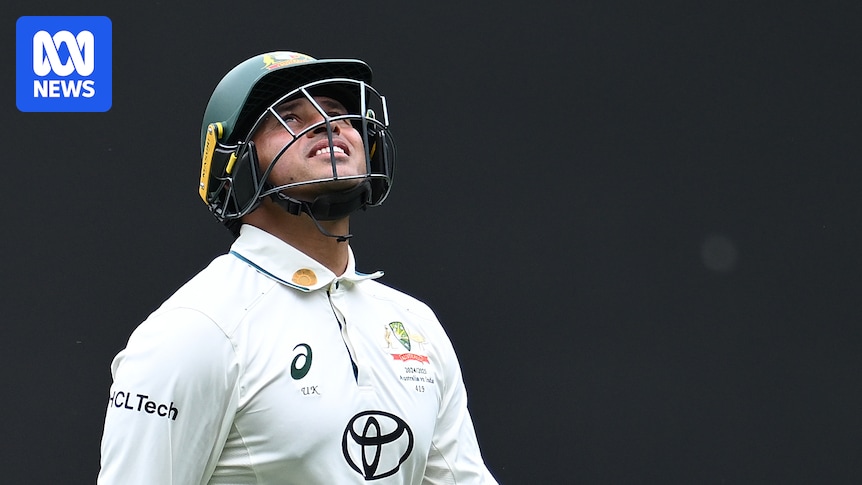
Usman Khawaja, a name synonymous with elegance and resilience in Australian cricket, has announced his retirement, leaving behind a legacy that transcends the cricketing field. Khawaja’s journey, marked by his unique style and determination, began with his international debut for Australia in the 2011 New Year’s Test against England in Sydney. This match, part of an otherwise forgettable Ashes series for Australia, marked the beginning of a career that would challenge conventions and inspire future generations.
Replacing the injured Ricky Ponting, Khawaja became the first Australian Test debutant to bat at number three since Justin Langer, 18 years prior. Facing England’s towering paceman Chris Tremlett, Khawaja’s audacious start, flicking his first ball for two and pulling his second to the boundary, signaled the arrival of a player who would do things his own way. Despite the match ending in an innings defeat for Australia, Khawaja’s performance was a bright spot in an otherwise bleak series.
A Career of Highs and Lows
Khawaja’s career, spanning 88 Tests, is a testament to his resilience. While his contemporaries like Steve Smith and David Warner amassed more Test appearances, Khawaja’s impact was profound. His 6,206 Test runs surpass the career totals of Australian greats like Adam Gilchrist and Ian Chappell. His 16 Test centuries, including seven scored outside Australia, highlight his adaptability and skill on diverse pitches.
Despite his talent, Khawaja faced numerous challenges. Like many young Australian cricketers, he was dropped early in his career and had to fight his way back into the team. His exclusion from the Test side for four calendar years, including 2020 and 2021, was a period of reflection and growth. Upon his return in 2022, Khawaja cemented his place as one of the world’s leading Test openers, proving his critics wrong with consistent performances.
Pioneering Diversity in Australian Cricket
Beyond his cricketing achievements, Khawaja’s legacy is deeply intertwined with his role as a trailblazer for diversity in Australian cricket. As the first Muslim to play Test cricket for Australia, Khawaja has been a vocal advocate for inclusivity. His presence in the team has raised awareness about Islam, with teammates respecting his faith by celebrating victories with non-alcoholic champagne.
Australia’s cricket team, historically lacking in diversity, has slowly begun to change, thanks in part to Khawaja’s influence. His openness about the challenges faced by players of color has prompted discussions on systemic issues within cricket’s pathways. Khawaja’s impact is evident with the emergence of young players of South Asian descent, such as Harjas Singh and Harkirat Bajwa, at the Under-19 level.
“Never let anyone convince you that you can’t, because if they do convince you, then you never will,” Khawaja declared during his retirement announcement at the SCG. “I’m a proud Muslim colored boy from Pakistan who was told that he would never play for the Australian cricket team. Look at me now. And you can do the same.”
The Legacy of a Modern-Day Athlete
Khawaja’s career is a blueprint for modern athletes who aspire to be role models both on and off the field. Alongside Australian captain Pat Cummins, Khawaja has shown that sports figures can and should engage with political and societal issues. His ability to navigate the pressures of being a South Asian Muslim in a predominantly white sport has paved the way for future generations.
As Khawaja retires, his story remains a powerful reminder of the impact one individual can have on a sport and a society. His journey from a young cricketer facing racial and cultural barriers to a celebrated Australian cricket icon is an inspiration to many. Usman Khawaja retires not only as a cricket great but as a symbol of change and hope for a more inclusive future in Australian cricket.