

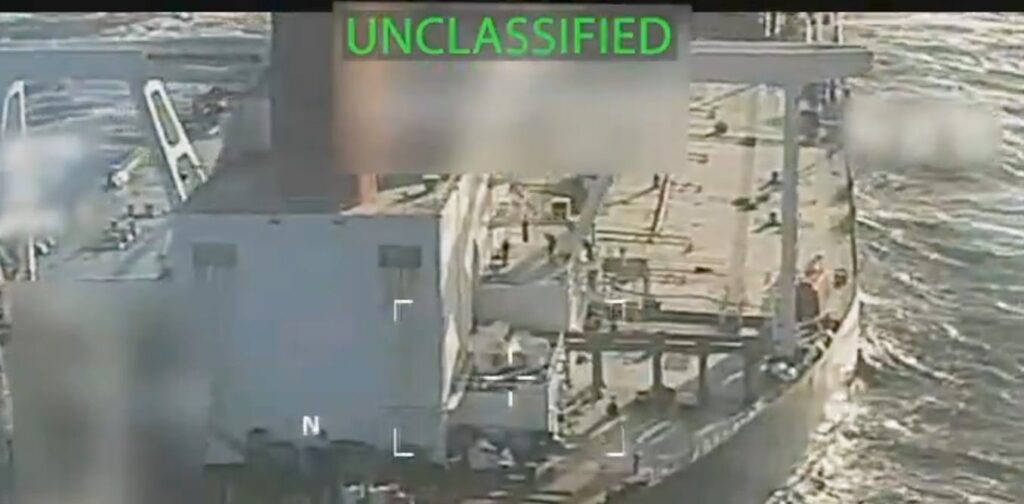
The U.S. seizure of an oil tanker off the Venezuelan coast on December 10, 2025, marks a significant escalation in the economic pressure campaign against President Nicolás Maduro’s government. The operation, involving American forces descending from helicopters onto the vessel, has been condemned by the Venezuelan government as “barefaced robbery and an act of international piracy.” This incident follows months of U.S. military buildup in the Caribbean.
According to the Trump administration, the seized tanker, a 20-year-old vessel named the Skipper, was allegedly heading to Cuba. However, experts like Francisco J. Monaldi from Rice University suspect that its final destination was likely China, given the ship’s size. The Skipper, previously sanctioned by the U.S. Treasury in 2022 for carrying prohibited Iranian oil, was reportedly controlled by Russian oil magnate Viktor Artemov and involved in an oil smuggling network.
Implications for Venezuela’s Economy
The seizure of the Skipper is a significant blow to Venezuela’s already struggling economy, which heavily relies on oil exports. Oil constitutes more than 80% of Venezuela’s exports, with a substantial portion going to the black market and independent refiners in China. The Venezuelan economy is deeply intertwined with the oil sector, which accounts for about 20% of the country’s GDP and over 50% of government income.
This development follows the U.S. sanctions placed on Venezuela in 2019, which were expanded in 2020 to include secondary sanctions on countries doing business with Venezuela. The Venezuelan government has described the seizure as unprecedented, highlighting that it is the first instance of a vessel departing Venezuela with a Venezuelan crew being seized.
Expert Insights and Historical Context
Francisco J. Monaldi provides a deeper understanding of the situation, noting that the U.S. has signaled its intention to not only seize the cargo but also the ship itself, representing a significant loss for the owning company. This move is part of a broader strategy to further squeeze Venezuela’s oil revenues through fresh sanctions.
Historically, Venezuela’s oil production has been in decline since the late 1990s. Before Hugo Chávez came to power in 1998, production peaked at 3.4 million barrels a day. By the time Nicolás Maduro succeeded Chávez in 2013, production had fallen to 2.7 million barrels a day. U.S. sanctions in 2019 further reduced production to 1.3 million barrels a day, with the COVID-19 pandemic exacerbating the situation, causing production to collapse to 400,000 barrels a day in 2020.
The Role of the Shadow Fleet
To circumvent U.S. sanctions, Venezuela relies on a “shadow fleet” of vessels that hide their identity using false flags and names. These ships pick up oil in Venezuela, sometimes transferring the cargo to another ship, posing significant environmental risks. The oil typically ends up in Malaysia under a new identity before reaching China.
Market Reactions and Future Prospects
The seizure of the Skipper had little immediate impact on global oil prices due to existing oversupply and Venezuela’s small share of the market. However, this could change depending on the U.S.’s future actions. The Trump administration is cautious about causing domestic price increases.
For Venezuelan oil, the impact is more pronounced. Already sold at a discount due to sanctions, the latest U.S. action is likely to widen these discounts. Venezuela has required prepayments for oil cargo, but the heightened risk of seizure means fewer buyers are willing to prepay, forcing Venezuela to offer higher discounts with fewer prepayments.
“The only way to get someone to buy Venezuelan oil amid the heightened risk of this moment is to offer higher discounts with fewer prepayments,” notes Monaldi.
This situation could lead to reduced export volumes and production cuts, further choking off the limited revenue Maduro relies on to keep the government functioning.
As the U.S. continues its pressure campaign, the future for Venezuela’s economy remains uncertain. The international community will be watching closely to see how these developments unfold and their broader implications for global oil markets and geopolitical dynamics.