
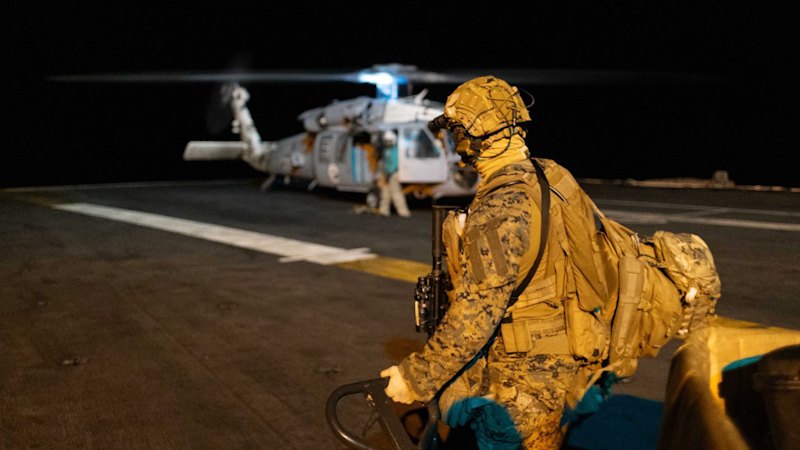
The United States has seized another oil tanker off the coast of Venezuela in international waters, an action Venezuela has condemned as “a serious act of international piracy.” This development was confirmed by US Homeland Security Secretary Kristi Noem on Sunday AEDT, just days after President Donald Trump announced a “blockade” on sanctioned oil tankers entering and leaving Venezuela.
Noem stated that the US Coast Guard intercepted a tanker last docked in Venezuela, marking the second such seizure in recent weeks amid a significant US military presence in the region. “The United States will continue to pursue the illicit movement of sanctioned oil that is used to fund narco-terrorism in the region,” Noem declared on social media. “We will find you, and we will stop you.”
Venezuelan Response and International Implications
The Venezuelan government has labeled the US actions as “criminal” and vowed to address the issue with the United Nations Security Council and other international bodies. “The Bolivarian Republic of Venezuela categorically denounces and rejects the theft and hijacking of another private vessel transporting Venezuelan oil, as well as the enforced disappearance of its crew, perpetrated by United States military personnel in international waters,” stated the Venezuelan government.
British maritime risk management company Vanguard identified the vessel as the Panama-flagged Centuries, intercepted east of Barbados in the Caribbean Sea. Jeremy Paner, a partner at Washington DC law firm Hughes Hubbard and a former Office of Foreign Assets Control investigator, noted that the vessel had not been sanctioned by the US. “The seizure of a vessel that is not sanctioned by the US marks a further increase in Trump’s pressure on Venezuela,” Paner commented. “It also runs counter to Trump’s statement that the US would impose a blockade of all sanctioned oil tankers.”
The Broader Context: US-Venezuela Tensions
This action follows a series of US measures aimed at curbing Venezuela’s oil exports, which are a critical source of revenue for the South American nation. President Trump recently ordered “A TOTAL AND COMPLETE BLOCKADE OF ALL SANCTIONED OIL TANKERS going into, and out of, Venezuela.” Since the initial seizure of a sanctioned oil tanker off the Venezuelan coast last week, an effective embargo has been in place, with loaded vessels remaining in Venezuelan waters to avoid capture.
The embargo has led to a sharp decline in Venezuelan crude exports. While many vessels transporting oil from Venezuela are under sanctions, others, including those carrying crude from Iran and Russia, have not been sanctioned. Some companies, notably US-based Chevron, continue to transport Venezuelan oil using their own authorized ships.
Impact on Global Oil Markets
Since the US imposed energy sanctions on Venezuela in 2019, traders and refiners have resorted to a “shadow fleet” of tankers that obscure their locations or use vessels sanctioned for transporting Iranian or Russian oil. The Centuries, which reportedly loaded in Venezuela under the alias “Crag,” is part of this dark fleet. It was carrying approximately 1.8 million barrels of Venezuelan Merey crude oil destined for China, according to documents from PDVSA, Venezuela’s state oil company.
China is the largest buyer of Venezuelan crude, accounting for roughly 4% of its imports, with December shipments expected to average more than 600,000 barrels per day, analysts report.
Currently, the oil market remains well-supplied, with millions of barrels awaiting offloading on tankers near China. However, if the embargo persists, oil prices could rise due to reduced supply.
Future Prospects and Diplomatic Challenges
As of this week, more than 70 oil tankers in Venezuelan waters are part of the shadow fleet, with about 38 under US Treasury sanctions, according to TankerTrackers.com data. The ongoing tensions between the US and Venezuela, coupled with the strategic importance of oil exports, suggest that diplomatic and economic challenges will continue to evolve.
The situation remains fluid, and the international community is closely monitoring developments. The Venezuelan government’s appeal to the United Nations and other international bodies could lead to further diplomatic discussions and potential resolutions.