


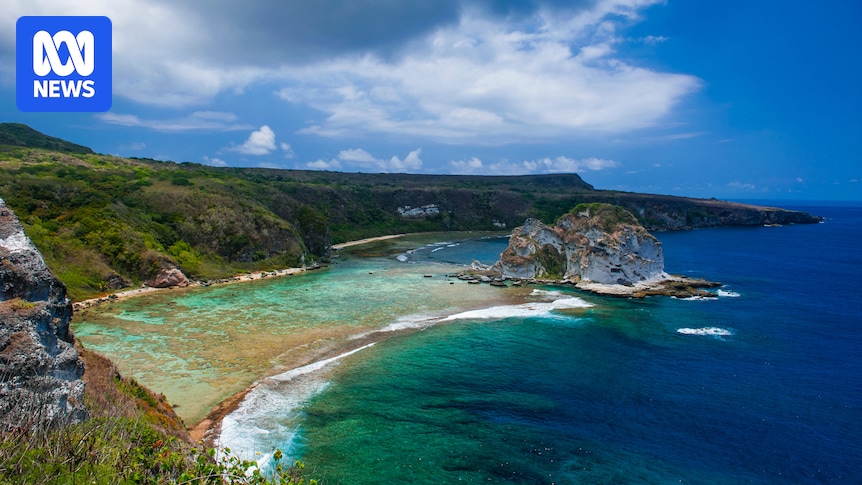
For the small Pacific island known as “the tip of America’s spear,” resisting the United States government is a formidable challenge. Guam’s governor, Lou Leon Guerrero, anticipates a tough battle as the US territory opposes a Trump administration initiative to open nearby waters for deep-sea mining.
“We are not a sovereign nation, so we have no control,” Ms. Guerrero stated, highlighting the limited autonomy of US territories. This resistance comes over a year after former President Donald Trump signed an executive order to expedite the exploitation of seabed minerals, marking a significant shift in US policy towards deep-sea mining in its Pacific territories.
Deep-Sea Mining Plans Unfold
The US Bureau of Ocean Energy Management (BOEM) has begun assessing interest in mining leases for the waters of two US Pacific territories, the Commonwealth of the Northern Mariana Islands and American Samoa, by issuing a “request for information and interest.” Concurrently, the National Oceanic and Atmospheric Administration has eased the permitting process for seabed mining, reducing the required number of environmental assessments and public comment periods.
Moreover, the Trump administration has expanded its search for seabed minerals, announcing a new survey mapping over 100,000 square kilometers of American Samoa waters. However, Guam, whose waters are connected with those of the Northern Marianas, was not consulted before BOEM issued its request for information about deep-sea mining. “We’re concerned about how it’s going to impact our fish here,” Ms. Guerrero expressed.
Strategic and Environmental Concerns
The Trump administration argues that minerals on the ocean floor are critical to national security, energy independence, and advanced manufacturing. In a world where the US is becoming increasingly assertive, there are concerns that the small Pacific Island territories have little bargaining power. However, Guam hosts US Air Force and naval bases, making the territories strategically significant as Washington seeks to counter China’s regional influence.
Ms. Guerrero hopes to leverage this strategic importance in opposing the deep-sea mining plans. “All three of us are united in our position, and that is to pause any activities of deep-sea mining until we get more [scientific] evidence and data about the consequences and the effects,” she asserted.
The Promise of Deep-Sea Minerals
Across the Pacific Ocean, polymetallic nodules—rock-like lumps containing nickel, copper, cobalt, and manganese—lie undisturbed at vast depths. The Trump administration is eyeing these resources, with plans to harvest the minerals using a robot to vacuum the nodules to the ocean’s surface for processing ashore.
“The US relies heavily on foreign sources, particularly China, for these materials,” BOEM stated. “Developing a domestic supply of critical minerals supports the [Trump] administration’s goals for energy independence, supply chain resilience, and technological leadership.”
Opposition and Environmental Concerns
Deep-sea mining has divided the Pacific, where many island nations worry about potential impacts on fish and other species from disturbed sediments. A recent study also suggested that the nodules on the sea floor could be generating oxygen, challenging the belief that most deep-sea habitats rely on oxygen sinking from the surface.
Guam’s Lieutenant Governor, Josh Tenorio, criticized the Trump administration’s push for seabed minerals as another environmental blow to a region already grappling with climate change impacts. “It’s a very violent proposal for deep-sea mining with limited research and with limited ethical supervision or proposed ethical parameters,” he remarked.
BOEM emphasized that while exploring the potential for commercial leasing of seabed critical minerals, no decision has been made to grant leases or conduct mining. “Initiating a request for information is the optional, first step in a multi-phase process to assess industry interest, environmental considerations, and cultural impacts before any leasing decisions are made,” it stated.
A United Front Against Mining
Despite assurances, opponents of deep-sea mining in the Pacific fear the Trump administration is determined to grant commercial leases. A bipartisan campaign against the plan has emerged across US territories in the Pacific, gathering over 60,000 public comments, letters, and petition signatures.
“This is a wildly unpopular initiative that the Trump administration is trying to force on the territories in the Pacific,” said Angelo Villagomez, a senior fellow at the Center for American Progress.
US territories have shown unprecedented unity in their response, noted Neil Weare, co-director of advocacy group Right to Democracy. “I’ve really never seen this kind of cohesion, not just across territories but even within territories,” he said.
Legal challenges to deep-sea mining in US territories are likely, predicted Emily Jeffers, a senior lawyer at the Center for Biological Diversity. “It is deeply offensive to the people of American Samoa and the Northern Mariana Islands that these lease sales might happen against the wishes of the entire population,” she stated.
Future Implications
BOEM has extended the comment period for the request for information in response to territorial leaders’ concerns, ensuring ample opportunity for participation. The bureau will review submissions to determine industry interest, environmental and cultural considerations, and potential conflicts with existing ocean uses, although there is “no fixed timeline.”
Ms. Guerrero remains hopeful that Guam’s strategic relationships with the US government and its role as a defense hub will provide leverage, but she remains cautious about the territory’s options. Advocates hope the united front of US Pacific territories against deep-sea mining will draw global attention.
“The US is investing billions and billions of dollars in the US territories, especially around national security, around defense, and this is the time for us to become very clear on the type of relationship that we have,” said Sheila Babauta, a former congresswoman for the Northern Marianas.
Ms. Babauta, chair of the grassroots non-profit organization Friends of the Mariana Trench, encourages local communities to continue standing up. “We’ve had this relationship with the United States for almost 50 years now, influencing our way of life and introducing values that sometimes don’t fit with an island-specific viewpoint,” she said. “I want to encourage our community here to continue practicing our culture.”