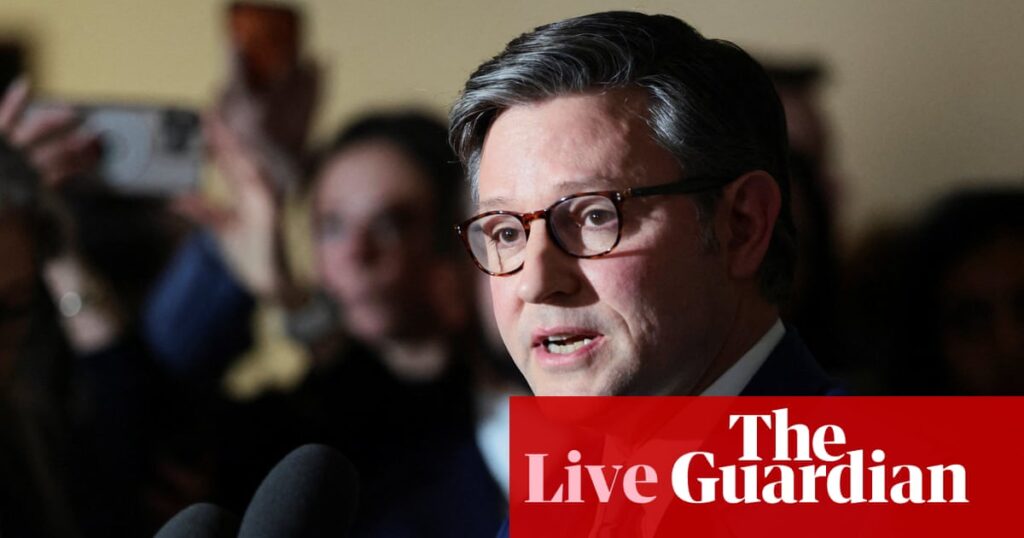
The recent US military action in Venezuela has ignited a political firestorm in Washington, with House Speaker Mike Johnson asserting that the operation does not constitute a regime change. This statement comes after a classified briefing by the Trump administration, during which Johnson emphasized that the US is not at war and has no troops on Venezuelan soil.
Johnson, a Republican, clarified, “With regard to the War Powers, we are not at war. We do not have US armed forces in Venezuela and we are not occupying that country.” He further noted that the US Constitution grants Congress the power to declare war, but it also provides the President with significant authority as commander-in-chief.
The speaker revealed he was informed of the military action at 4 a.m. on Saturday by Secretary of State Marco Rubio. Johnson described the intervention as a demand for behavioral change by the Venezuelan regime, rather than a regime change. He claimed that the interim government, now led by the deposed president’s deputy, is expected to address issues related to narcotics and international crime.
Political Reactions and Criticisms
Meanwhile, Senate Minority Leader Chuck Schumer criticized the administration’s plan for Venezuela as “vague” and “based on wishful thinking.” Schumer expressed concerns about the lack of a clear strategy for managing Venezuela post-intervention, stating, “Their plan for the US ‘running Venezuela’ is vague, based on wishful thinking and unsatisfying.”
The Democratic leader questioned the administration’s assurances regarding similar actions in other countries, warning that such interventions often harm US interests. Schumer’s remarks highlight the broader political divide over the US’s approach to foreign interventions.
Gunfire Incident Near Venezuelan Presidential Palace
In a related development, reports of gunfire near the Venezuelan presidential palace in Caracas have surfaced. According to Agence France-Presse, the gunfire was a response to unidentified drones over the Miraflores palace. The situation is reportedly under control, but the incident underscores the tense atmosphere in Venezuela.
“The first thing that came to mind was to see if there were planes flying overhead but there were not. I just saw two red lights in the sky,” said a resident near the palace.
US Oil Companies and Venezuelan Oil Reserves
As the US grapples with the implications of its actions in Venezuela, President Trump has suggested that American taxpayers might reimburse oil companies for repairing Venezuelan infrastructure. This proposal has sparked debate, with major oil companies expressing reluctance to invest due to political uncertainties.
Venezuela, once a major oil producer, now faces a significant decline in production. The Wall Street Journal reported that oil companies are cautious about investing in Venezuela without a stable government. “The oil industry is saying that they don’t know what Venezuela’s government is going to look like tomorrow,” noted Collin Eaton in a podcast interview.
Historical Context and Future Implications
The US’s involvement in Venezuela is reminiscent of past interventions in Latin America, which often led to prolonged instability. Experts warn that without a clear plan, the situation in Venezuela could deteriorate further, potentially impacting regional stability.
“The danger in Venezuela is only beginning,” Schumer stated. “Donald Trump has opened a Pandora’s box, and things will get out of hand very quickly.”
As the situation unfolds, the US administration faces mounting pressure to clarify its strategy and address concerns about the long-term consequences of its actions in Venezuela.
Judicial and Legislative Oversight
In the legal arena, Nicolás Maduro’s trial in New York has drawn attention to the judicial processes involved in international cases. The trial is overseen by Judge Alvin Hellerstein, known for his previous rulings against the Trump administration on immigration issues.
Additionally, Senate Judiciary Committee leaders Chuck Grassley and Dick Durbin have criticized the administration for excluding them from the briefing on Maduro’s arrest. They argue that their committee has jurisdiction over the agencies involved, highlighting the ongoing tension between the executive and legislative branches.
As the US navigates these complex issues, the international community watches closely, aware that the outcomes could have far-reaching implications for global politics and economic relations.