



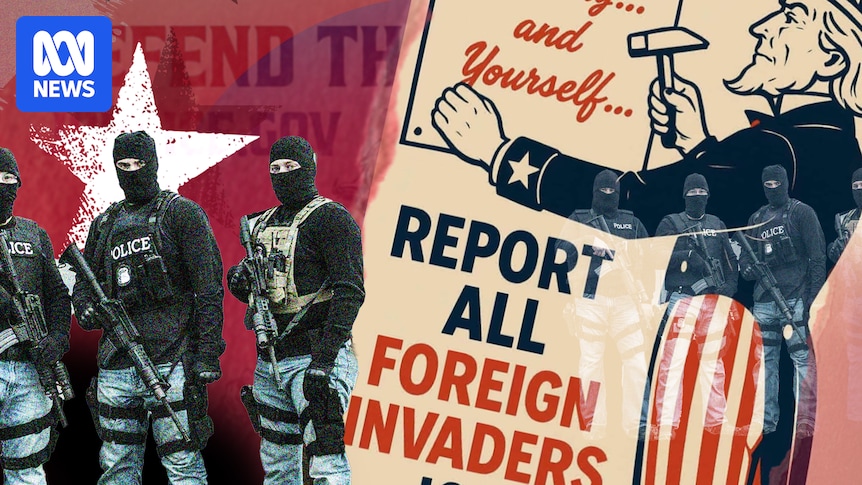
In a controversial move, the US Department of Homeland Security (DHS) has come under scrutiny for using material linked to white supremacy in its social media campaigns. The revelation, which emerged last October, highlights the use of extremist symbols and memes in recruitment ads for Immigration and Customs Enforcement (ICE), raising concerns about the agency’s messaging and intent.
The controversy centers around a series of videos released by DHS, one of which features a montage of American patriotism interspersed with nationalist imagery. A fleeting clip in the video shows a crescent moon in sunglasses at a piano, a reference to the “Moon Man” meme, which has been co-opted by white supremacist groups. Experts argue that such inclusion is unlikely to be accidental, suggesting it serves as a dog whistle to extremist communities.
Extremist Symbols in Government Messaging
The timing of these videos coincides with a significant hiring spree by ICE, aimed at executing the largest deportation operation in US history. The recruitment drive, which called for thousands of new agents, was accompanied by aggressive tactics, including high-profile raids and dramatic imagery of federal agents in action.
Heidi Beirich, co-founder of the Global Project Against Hate and Extremism, criticized the use of such imagery, stating, “Some of the images have been flat-out white supremacist. There’s just no question.” Beirich, who has studied extremist movements since the late 1990s, emphasized that the content was clearly targeted at a specific community familiar with the coded imagery.
“I don’t see how this is anything but absolutely terrifying and completely irresponsible,” she said.
Government’s Response and Further Controversies
Despite the backlash, references to far-right extremism have persisted on official US government channels. In January, the Department of Labor posted an image of Donald Trump saluting a stadium with the phrase “TRUST THE PLAN,” a mantra associated with the far-right QAnon movement. Another post featured George Washington with the caption “One Homeland. One People. One Heritage,” echoing Nazi-era slogans.
The DHS also faced criticism for a recruitment ad featuring the phrase “WE’LL HAVE OUR HOME AGAIN,” linked to a neo-Nazi anthem. The department denied intentional references to extremist material, claiming similarities were coincidental. However, Beirich dismissed this defense, arguing that such symbols are deeply rooted in hate subcultures and not randomly found.
Impact on ICE and Broader Implications
The use of extremist symbols has resonated with groups like The Proud Boys and Patriot Front, who have shared the content on platforms like Telegram. These groups, known for promoting white nationalism and violence, view the government’s messaging as aligning with their ideologies.
Meanwhile, reports have emerged of ICE agents leaving “death cards” — a tactic used by white supremacist groups — during traffic stops in Colorado, further fueling concerns about the agency’s conduct. The DHS condemned the incident and promised an investigation, though no responses have been provided to media inquiries.
“Leaving a racist death card behind after targeting Latino workers is deliberate intimidation rooted in a long history of racial violence,” said Alex Sanchez, president of Voces Unidas.
Internal and Political Reactions
Former DHS spokesperson David Lapan has expressed alarm over the agency’s shift towards a more aggressive and nationalistic tone. Lapan, who served during Trump’s first administration, noted a deterioration in messaging, describing it as “jingoistic” and “belligerent.”
The rapid recruitment of ICE agents, coupled with reduced training standards, has also raised red flags. Former ICE lawyer Ryan Schwank, who recently resigned, criticized the agency’s training as “deficient” and warned of constitutional violations by new agents.
Future of ICE and Policy Reforms
The Trump administration’s goal of one million deportations per year has led to a significant expansion of ICE, with over 220,000 applications and 12,000 new officers. However, Democrats in Congress are pushing for reforms, including stricter accountability measures and judicial warrants for home entries.
Amidst the debate, Trump’s new Homeland Security Secretary nominee, Markwayne Mullin, has signaled a willingness to adopt a more balanced approach, potentially easing tensions over the department’s policies.
As the controversy unfolds, the implications of the government’s use of extremist symbols continue to be a focal point in discussions about immigration policy and national security. The debate highlights the ongoing tension between aggressive enforcement and the need for accountability and reform within federal agencies.