
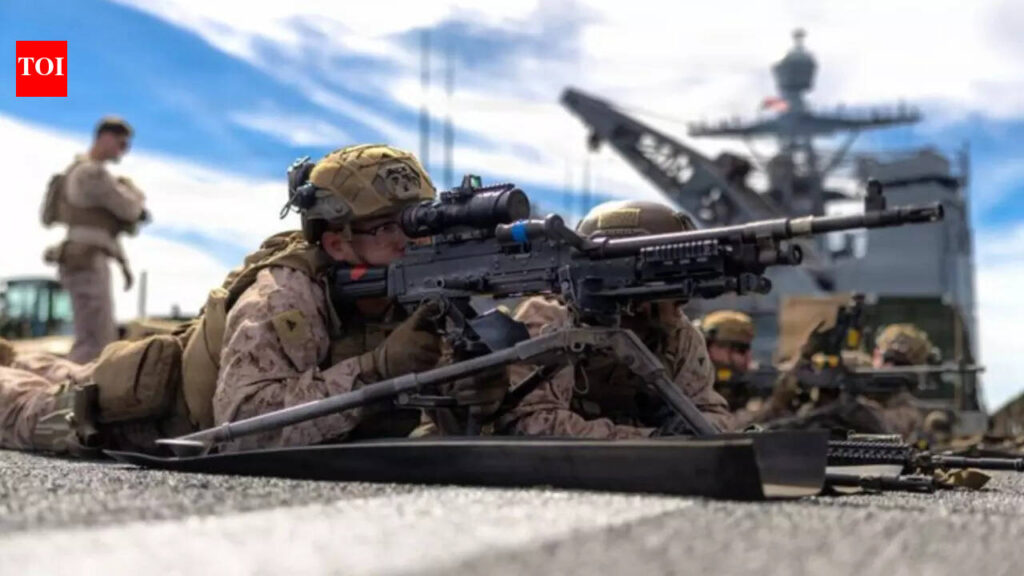
The United States is significantly expanding its military presence in the Middle East, deploying the amphibious assault ship USS Tripoli and thousands of Marines as tensions with Iran reach new heights. This strategic move comes amid an escalating conflict involving the US, Israel, and Iran, which has already led to missile strikes, drone attacks, and increased instability across the Gulf region.
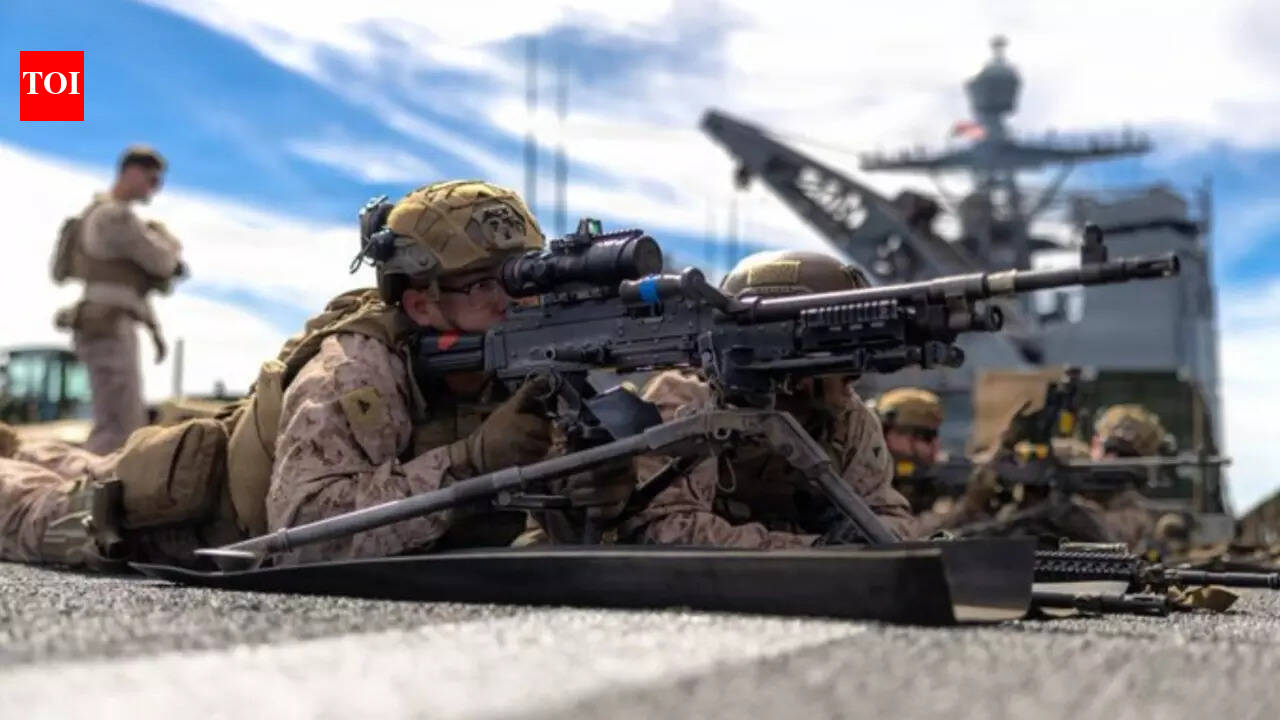
According to reports, the Pentagon has ordered the USS Tripoli (LHA-7) and its Marine Expeditionary Unit to the region, bringing combat-ready troops and advanced military equipment closer to the conflict zone. This deployment signals Washington’s preparation for a potential wider confrontation while aiming to protect strategic shipping lanes and American assets in the Middle East.
US Military Build-Up Amid Iran-Israel Conflict
The deployment reportedly includes approximately 2,000–2,500 Marines, alongside additional sailors and naval assets operating from the USS Tripoli and its accompanying ships. A Marine Expeditionary Unit is a highly flexible force capable of conducting a wide range of missions, such as:
- Amphibious assaults
- Evacuations of civilians
- Raids on enemy targets
- Humanitarian operations
- Securing strategic infrastructure
These units, operating from amphibious ships rather than land bases, allow the US military to respond swiftly to crises without relying on host-country permission. Officials have stated that the deployment was requested by United States Central Command, which oversees American military operations across the Middle East, to provide commanders with more options as tensions with Iran continue to rise.
Strategic Timing of Marine Deployment
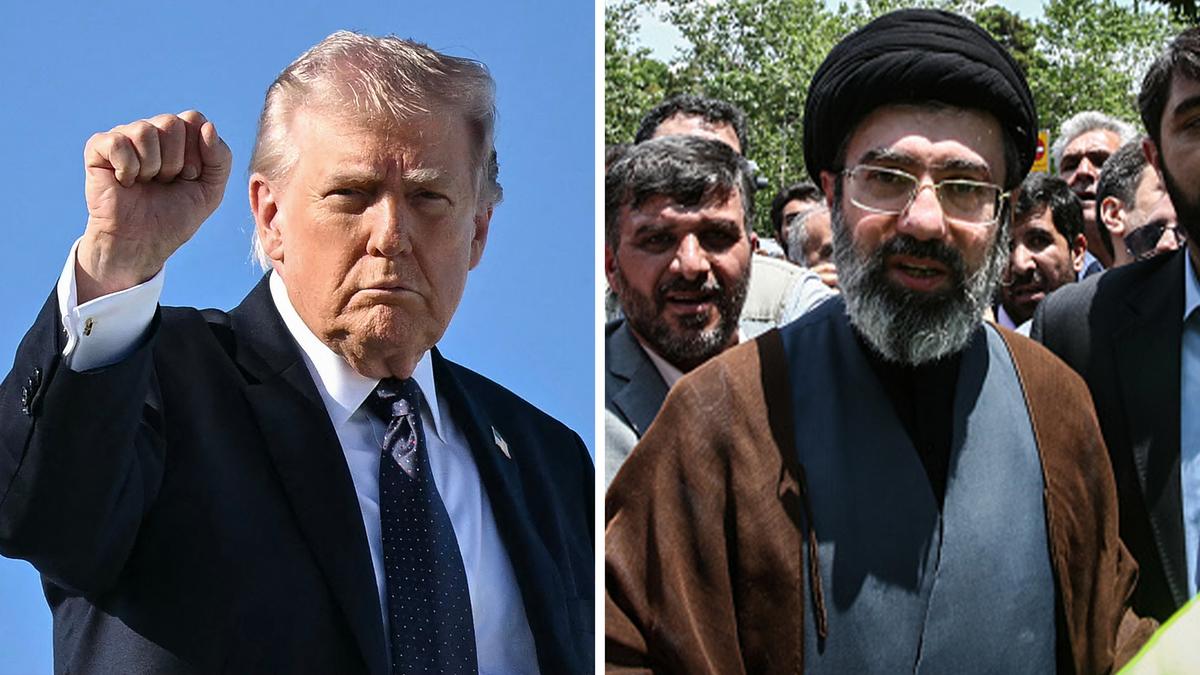
The decision to send Marines comes against the backdrop of a rapidly expanding regional conflict triggered by US-Israeli strikes on Iranian military and nuclear targets in late February 2026. These strikes reportedly resulted in the deaths of several senior Iranian leaders and damaged key military facilities, prompting Tehran to retaliate with missile and drone attacks on Israel and US positions across the Gulf.
Since then, the conflict has spread across multiple fronts, with Iranian missiles and drones targeting Israel and Gulf states, attacks on shipping routes near the Strait of Hormuz, drone and militia attacks on U.S. bases in Iraq and Syria, and rocket attacks by Iran-backed groups in Lebanon. The deployment of Marines is widely seen as a precautionary measure to deter further Iranian escalation while ensuring the US can respond quickly if the conflict widens.
Protecting the Strait of Hormuz
One of the primary concerns driving the deployment is the security of the Strait of Hormuz, a critical energy chokepoint through which roughly one-fifth of global oil shipments pass. Recent Iranian actions, including threats to shipping and increased naval activity, have raised fears that the strait could be disrupted or temporarily closed, potentially sending shockwaves through global energy markets and triggering a major international military response.
“The arrival of amphibious ships and Marines serves two purposes: protecting commercial shipping routes and preparing for possible military escalation.”
Capabilities of the USS Tripoli
The USS Tripoli, an America-class amphibious assault ship, functions almost like a small aircraft carrier. It can carry more than 1,600 Marines, helicopters and tilt-rotor aircraft, advanced fighter jets such as the F-35B, landing craft, and armored vehicles. This combination allows the ship to launch air strikes, amphibious landings, and rapid-response missions from the sea, providing the US military with the flexibility to operate across the Persian Gulf, Arabian Sea, and surrounding regions.
The Marine deployment is part of a broader US military buildup in the Middle East that has been expanding since early 2026. This buildup includes aircraft carrier strike groups, fighter jets such as F-35s and F-22s, missile defense systems, and additional naval warships. Analysts note that the scale of the deployment is among the largest in the region since the Iraq War era, reflecting Washington’s growing concern that the conflict with Iran could spiral into a regional war involving multiple countries and armed groups.
Regional Implications and Future Prospects
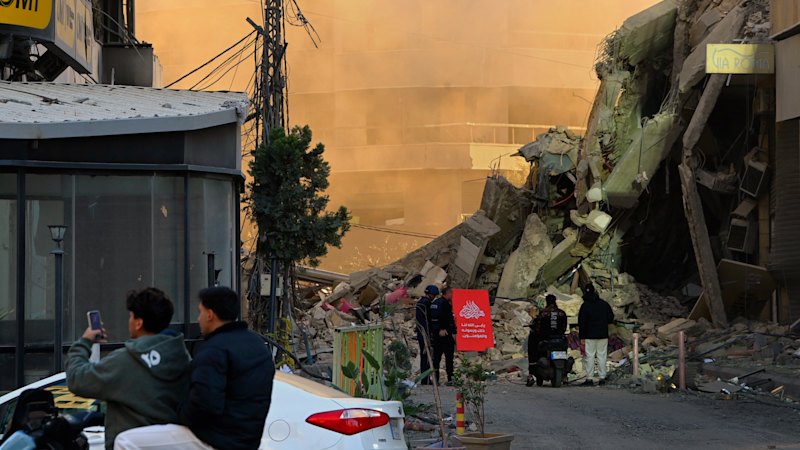
The war between Iran and the US–Israel alliance has already had ripple effects across the Middle East. Iranian retaliatory attacks have targeted US bases and regional allies, Hezbollah rockets have been launched from Lebanon, and shipping disruptions have raised fears of global economic fallout. Civilian casualties have also been mounting across several countries, while governments in the region brace for further escalation.
Meanwhile, international leaders, including European and Middle Eastern governments, have called for de-escalation and diplomatic negotiations. Military analysts suggest that the deployment of Marines does not necessarily indicate an imminent ground invasion of Iran. Instead, the move provides the US with several strategic options, such as evacuating civilians from conflict zones, protecting key infrastructure and shipping routes, launching limited raids or operations, and deterring Iranian attacks on American forces.
However, the presence of thousands of additional US troops also raises the stakes dramatically. If Iran were to target American forces or allies directly, the conflict could quickly expand into a much broader regional war. For now, the deployment underscores just how volatile the Middle East has become in recent weeks. With missile exchanges, drone strikes, and naval confrontations increasing across the region, the arrival of the USS Tripoli and its Marines signals that Washington is preparing for the possibility that the conflict may escalate further.
Whether the move serves as a deterrent or becomes the prelude to a wider war remains to be seen. However, one clear message is that the Middle East is once again at the center of a geopolitical crisis that could reshape global security and energy markets for years to come.