


The United States is “not at war” in Venezuela, according to Mike Johnson, the Republican Speaker of the House, following a controversial raid ordered by former President Donald Trump. The operation aimed to capture Venezuelan President Nicolás Maduro and announced intentions for the US to “run” the country. This statement comes after a weekend of heightened tensions and international scrutiny.
The surprise incursion follows months of escalating US pressure on Venezuela, including a blockade of oil shipments and airstrikes on vessels off its shores, resulting in at least 110 casualties. Trump’s administration has claimed that the interim leader, Delcy Rodríguez, will align with US interests, particularly regarding control over Venezuela’s vast oil reserves. However, Democrats have criticized the president for engaging the US in a conflict without congressional approval, contradicting his campaign promises.
US Strategy and Congressional Reactions
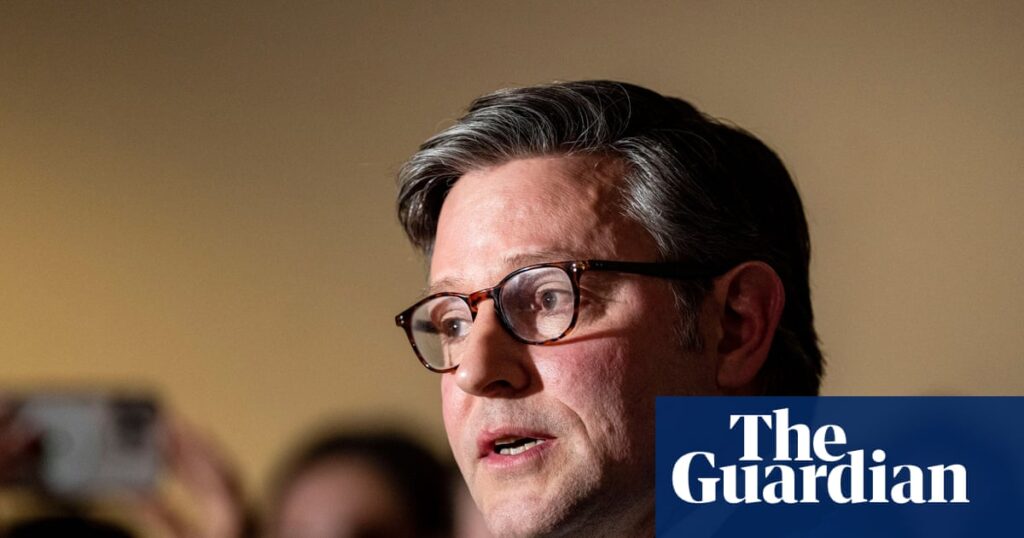
After a briefing with top administration officials, including Secretary of State Marco Rubio, Defense Secretary Pete Hegseth, and Attorney General Pam Bondi, Johnson reassured reporters that the US is not seeking military control over Venezuela. “We are not at war. We do not have US armed forces in Venezuela, and we are not occupying that country,” Johnson stated, countering Democratic claims that Trump bypassed Congress unlawfully.
Johnson emphasized that the US’s actions are aimed at demanding behavioral changes from Maduro’s regime, rather than a regime change. “The interim government is stood up now, and we are hopeful that they will be able to correct their action,” he added.
The Trump administration has accused Maduro of running a “narco-terrorist” government, trafficking drugs like fentanyl into the US, and allowing adversaries such as China, Russia, and Hezbollah to establish a presence in Venezuela. These allegations have been met with skepticism by experts.
Implications of US Actions in Venezuela
Johnson predicted that the US strategy of restricting Venezuela’s oil production would compel its socialist government to hold new elections. “We have a way of persuasion, because their oil exports, as you know, have been seized. And I think that will bring the country to a new governance in very short order,” he asserted, dismissing the need for US ground troops.
Democratic Senate Minority Leader Chuck Schumer expressed concerns that the briefing “posed far more questions than it ever answered,” warning of the potential for the US to be drawn into another conflict. “Their plan for the US running Venezuela is vague, based on wishful thinking and unsatisfying,” Schumer remarked. “I did not receive any assurances that we would not try to do the same thing in other countries.”
International and Domestic Responses
Maduro, along with his wife Cilia Flores, has been indicted on charges related to guns, drugs, and narco-terrorism. He pleaded not guilty during a court appearance in New York City. Meanwhile, an emergency UN Security Council meeting saw numerous countries condemning the US incursion as a “crime of aggression.”
Democratic senators plan to introduce a war powers resolution requiring congressional approval for further military action in Venezuela. However, its passage in the Republican-controlled Senate remains uncertain. Monday’s briefing was limited to top Democrats and Republicans, as well as bipartisan committee leaders overseeing intelligence, foreign policy, and armed forces. Notably, Congress’s judiciary committees were excluded, prompting bipartisan criticism.
“There is no legitimate basis for excluding the Senate judiciary committee from this briefing,” stated Republican Senate Judiciary Chair Chuck Grassley and Democratic Ranking Member Dick Durbin in a joint protest.
Brian Mast, Republican Chair of the House Foreign Affairs Committee, defended the operation, likening it to Trump’s previous military actions, such as the 2020 killing of Iranian General Qassem Suleimani. “They are not the protracted war administration, they never have been,” Mast commented.
Looking Ahead
As the situation unfolds, the Trump administration’s approach to Venezuela continues to be a point of contention both domestically and internationally. With further briefings scheduled and potential legislative action on the horizon, the US’s role in Venezuela remains a critical issue for policymakers and global observers alike.