



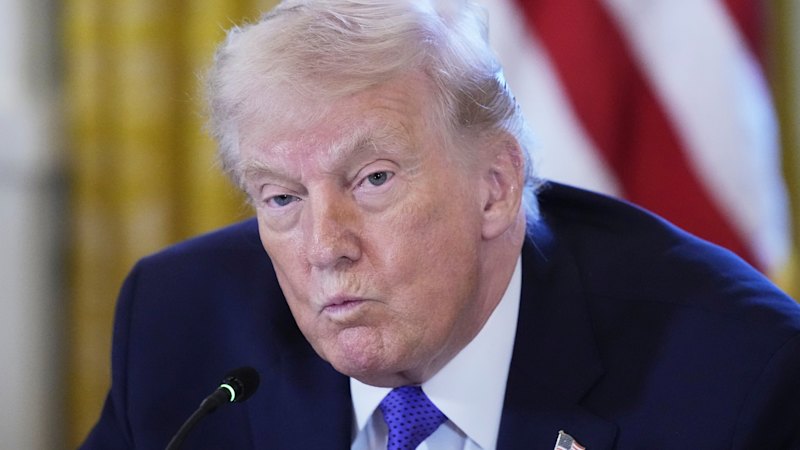
Australia’s longstanding alliance with the United States is facing unprecedented challenges, as political turbulence under former President Donald Trump prompts reevaluation of diplomatic ties. The shift in dynamics comes amid concerns over reliability and the erratic nature of US foreign policy, raising questions about the future of a century-old partnership.
Michael Fullilove, a prominent voice in international relations, argues for maintaining strong US engagement in the region despite the chaos introduced by Trump’s policies. “We should do whatever we can to keep the US deeply engaged in our region,” he stated, emphasizing the implausibility of downgrading relations based solely on Trump’s actions.
However, critics like David Gordon from Cranebrook argue that the traditional foundations of US-Australia relations—order, reliability, and dependability—have been undermined. “Who wants an unreliable, undependable, and capricious ally?” he questions, reflecting a growing sentiment of skepticism towards the alliance.
Strategic Concerns and Global Implications
The geopolitical landscape further complicates the situation. With Australia holding significant rare earth reserves and occupying a strategic position in the Indo-Pacific, there are fears of being caught in the crosshairs of US expansionist ambitions. Lyn Savage from Coogee warns of the risks, likening Trump’s approach to a “coloniser in the White House.”
Trump’s disregard for international law and his self-professed reliance on personal morality have intensified these concerns. His administration’s actions, such as the abduction of Venezuelan President Nicolás Maduro and the controversial interest in Greenland, illustrate a willingness to bypass diplomatic norms.
“My own morality. My own mind. It’s the only thing that can stop me.” — Donald Trump
Such statements have drawn parallels to dystopian narratives, with Minnesota Governor Tim Walz comparing Trump’s tactics to George Orwell’s 1984. The erosion of legal and social frameworks under Trump’s influence has left many questioning the integrity of the US as a global leader.
Domestic Reactions and Political Ramifications
In Australia, the political landscape is also shifting. Prime Minister Anthony Albanese’s recent decision to call a Commonwealth royal commission in response to the Bondi shootings highlights the pressures of navigating domestic and international challenges. Critics argue that his initial hesitation reflects a broader struggle to balance political astuteness with public sentiment.
Rob Harris’s analysis in the Herald suggests that Albanese’s eventual decision was a calculated move to address systemic failures while managing political optics. However, the delay opened the door for political opportunism, with opposition figures seizing the moment to criticize his leadership.
“Albanese is a good man in a crisis, the exact opposite of Sussan Ley and Frydenberg.” — Peter Campbell, Potts Point
Supporters of Albanese contend that his approach demonstrates a commitment to thoughtful governance, prioritizing systemic improvements over reactionary measures. This nuanced leadership style contrasts sharply with the divisive rhetoric emanating from the US.
The Role of Cultural and Intellectual Engagement
Amid this political upheaval, cultural forums like the Adelaide Writers’ Week have become battlegrounds for intellectual freedom. The exclusion of author Randa Abdel-Fattah has sparked debate over censorship and the role of such festivals in fostering open dialogue.
Richard Flanagan, a celebrated author, underscores the importance of preserving spaces for free expression. “This festival of world-class literary creatives feeds on freedom, not censorship,” he asserts, warning against the dangers of stifling debate.
“Without such festivals, we slide slowly but surely downward toward a dystopian world controlled by autocrats.” — Cleveland Rose, Dee Why
The controversy highlights broader societal tensions, as cultural institutions grapple with the balance between inclusivity and sensitivity to diverse perspectives.
Looking Ahead: Navigating Uncertain Waters
As Australia and the US navigate these turbulent times, the future of their alliance remains uncertain. The challenges posed by shifting political landscapes, strategic interests, and cultural dynamics require careful consideration and adaptive strategies.
For Australia, maintaining a robust and reliable partnership with the US is crucial, yet contingent upon mutual respect and shared values. As the world watches, the decisions made in the coming months will shape the trajectory of this pivotal relationship and its impact on global stability.
In the words of Michael Fullilove, “We must do whatever we can to keep the US deeply engaged in our region,” a sentiment that underscores the complexity and importance of this enduring alliance.