



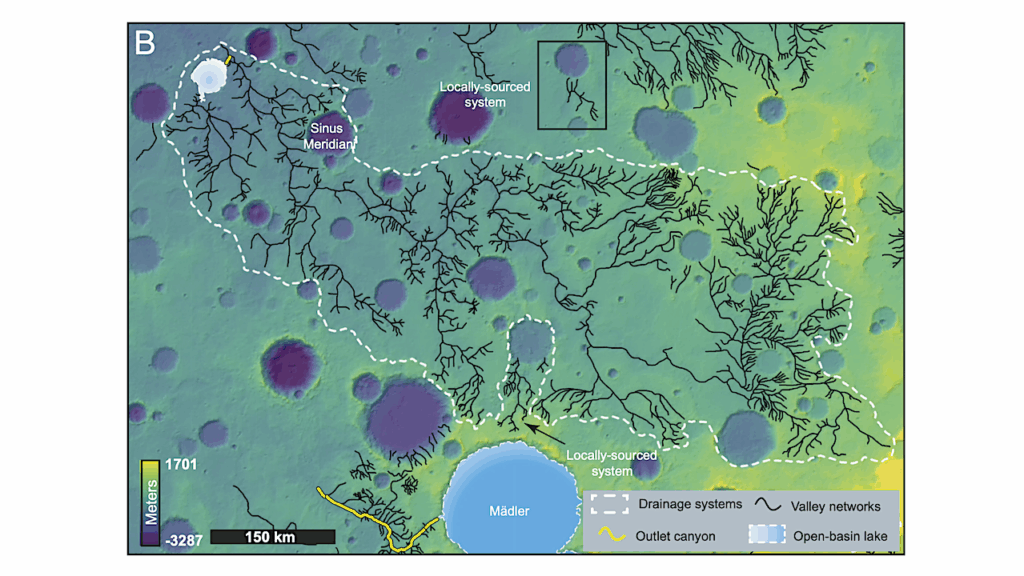
Billions of years ago, Mars was a planet where rain fell, water flowed through valleys and rivers, and possibly even reached a vast Martian ocean. These ancient waterways carved out landscapes similar to Earth’s river systems, which are known for their ecological diversity. Now, researchers from The University of Texas at Austin have mapped these Martian river drainage systems for the first time, potentially identifying regions where life could have once thrived.
A study published in the Proceedings of the National Academy of Sciences (PNAS) has outlined 16 large-scale river basins on Mars, marking a significant advancement in our understanding of the planet’s hydrological history. “We’ve known for a long time that there were rivers on Mars,” said Timothy A. Goudge, a co-author of the study and assistant professor in the Department of Earth and Planetary Sciences at the UT Jackson School of Geosciences. “But we really didn’t know the extent to which the rivers were organized in large drainage systems at the global scale.”
Mapping Mars’ River Basins
Goudge, along with postdoctoral fellow Abdallah S. Zaki, synthesized existing datasets of Mars’ valley networks, lakes, and rivers. They identified 19 clusters of valley networks, streams, lakes, canyons, and sediment deposits, 16 of which formed watersheds of 100,000 square kilometers or larger—a threshold that defines large drainage basins on Earth. This comprehensive mapping marks the first systematic, planet-wide identification of large river basins on Mars.
“We did the simplest thing that could be done. We just mapped them and pieced them together,” said Zaki, who led the research. On Earth, large watersheds are more prevalent, with 91 such systems, including the Amazon River basin, which spans about 6.2 million square kilometers. In comparison, Mars’ large drainage systems, although fewer, provide crucial insights into the planet’s past.
The Significance of Large Drainage Systems
Large river basins are often cradles of biodiversity on Earth, transporting nutrients and supporting diverse ecosystems. The Amazon River basin and the Indus River basin are prime examples of how these systems can foster life. On Mars, the large drainage systems, despite covering only 5% of the planet’s ancient terrain, account for about 42% of the total material eroded by rivers.
“The longer the distance, the more you have water interacting with rocks, so there’s a higher chance of chemical reactions that could be translated into signs of life,” Zaki explained.
These findings suggest that the large drainage systems on Mars could be prime targets for future astrobiological exploration. The sediment deposits, rich in nutrients, are potential sites to search for signs of past life.
Implications for Future Exploration
The discovery of these extensive river systems has significant implications for future Mars missions. “It’s a really important thing to think about for future missions and where you might go to look for life,” Goudge emphasized. The 16 large drainage areas identified could guide future explorations aimed at uncovering Mars’ habitability.
Meanwhile, the research underscores the innovative work being conducted at the Jackson School. Department Chair Danny Stockli praised the study, noting, “Tim Goudge and his team continue to be leaders in the field, making groundbreaking contributions to the understanding of Mars’ planetary surface and hydrologic processes.”
The study, also co-authored by David Mohrig, a professor in the Department of Earth and Planetary Sciences, highlights the potential of Mars as a new frontier for astrobiology. As researchers continue to unravel the mysteries of Mars’ ancient rivers, the possibility of discovering signs of past life becomes increasingly tangible.
As exploration of Mars continues, these findings will play a crucial role in shaping the direction of future missions. By understanding the planet’s hydrological past, scientists can better assess where life might have existed and where it might still be found.