



Billions of years ago, Mars was a planet where rain fell, rivers flowed, and water filled craters and canyons, potentially reaching a vast Martian ocean. This ancient hydrological activity has intrigued scientists for decades, offering tantalizing clues about the planet’s past and its potential to have harbored life. Now, for the first time, researchers have mapped large river drainage systems on Mars, providing a new perspective on its ancient landscape.
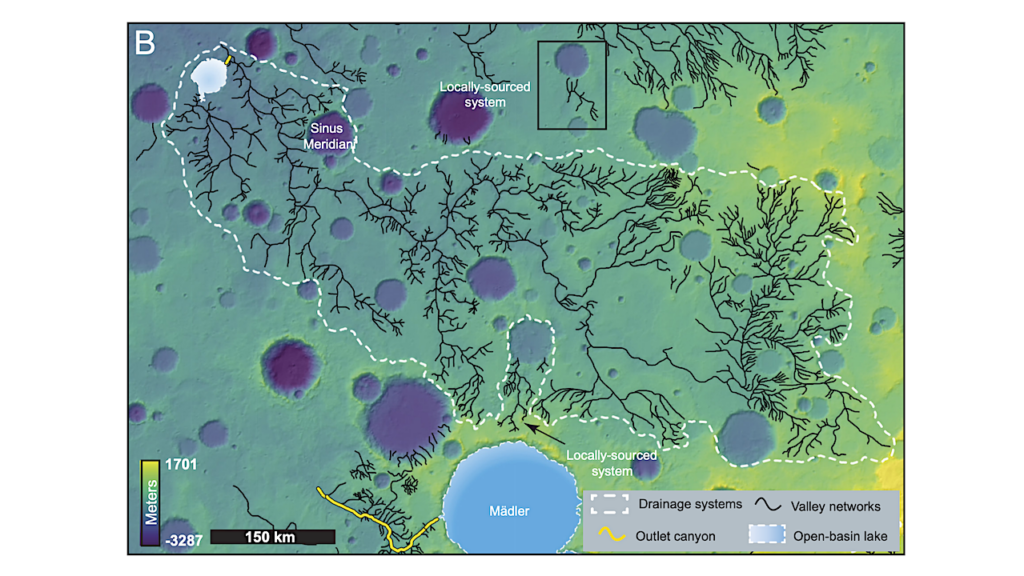
A study published in the Proceedings of the National Academy of Sciences (PNAS) by researchers at The University of Texas at Austin outlines 16 large-scale river basins on Mars. These areas, they suggest, could have been the most likely cradles for life when water was abundant on the red planet.
Mapping Mars’ Ancient Rivers
“We’ve known for a long time that there were rivers on Mars,” said Timothy A. Goudge, co-author of the study and assistant professor in the Department of Earth and Planetary Sciences at the UT Jackson School of Geosciences. “But we really didn’t know the extent to which the rivers were organized in large drainage systems at the global scale.”
Goudge, along with postdoctoral fellow Abdallah S. Zaki, synthesized previously published datasets of Mars’ valley networks, lakes, and rivers to outline these drainage systems. They identified 19 clusters of valley networks, streams, lakes, canyons, and sediment deposits, 16 of which formed watersheds exceeding 100,000 square kilometers—the threshold for large drainage basins on Earth.
“We did the simplest thing that could be done. We just mapped them and pieced them together,” said Zaki, who led the research.
Earthly Comparisons and Implications for Life
On Earth, large river systems like the Amazon River basin are among the most ecologically diverse regions, supporting tens of thousands of species. The Amazon, the largest river basin on Earth, spans about 6.2 million square kilometers. In contrast, Mars has far fewer large drainage systems due to its lack of tectonic activity, which on Earth creates the varied topography necessary for such systems.
Despite covering only 5% of Mars’ ancient terrain, these large drainage systems account for about 42% of the total material eroded by Martian rivers. This suggests that these basins were significant conduits for sediment transport, potentially carrying nutrients essential for life.
“The longer the distance, the more you have water interacting with rocks, so there’s a higher chance of chemical reactions that could be translated into signs of life,” Zaki explained.
Future Exploration and the Search for Life
The discovery of these large drainage systems offers promising targets for future Mars missions. While Mars is predominantly covered by smaller drainage systems, the 16 identified large basins could be the most promising areas to search for signs of past life.
“It’s a really important thing to think about for future missions and where you might go to look for life,” Goudge emphasized.
Department Chair Danny Stockli praised the research, noting, “Tim Goudge and his team continue to be leaders in the field, making groundbreaking contributions to the understanding of Mars’ planetary surface and hydrologic processes.”
This study, also co-authored by David Mohrig, professor in the Department of Earth and Planetary Sciences, highlights the potential of large drainage systems on Mars to unlock secrets of the planet’s past and its capability to support life.
As exploration of Mars continues, these findings will guide scientists in selecting sites for future missions, offering a clearer path to uncovering the mysteries of the red planet’s ancient waterways and their role in its potential habitability.
