




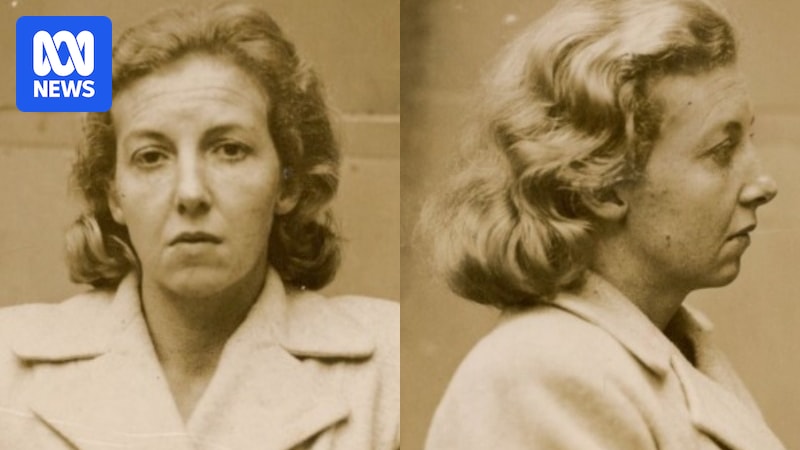
Handwritten letters from Jean Lee, the last woman executed in Australia, and her co-accused have been unveiled as part of a case file now accessible to the public for the first time in decades. The capital case file of Jean Lee, sealed for 75 years under the Public Records Act, was opened today, offering a glimpse into a controversial chapter of Australian legal history.
Jean Lee was executed in 1951 alongside her partners, Robert Clayton and Norman Andrews, for the 1949 murder of bookmaker William ‘Pop’ Kent in Carlton, an inner suburb of Melbourne. Her execution marked a significant moment as she was one of only two women executed in Australia during the 20th century and the first in Victoria since 1895. The case has continued to stir debate, 75 years after the events unfolded at Melbourne’s Pentridge Prison.
A Life of Crime Leading to Murder
Jean Lee’s journey from a small-town upbringing in Dubbo, New South Wales, to the gallows is a tale of desperation and crime. Born to what authorities described as “respectable law-abiding parents,” Lee’s life took a tumultuous turn after her marriage at 18 and the birth of her daughter a year later. By 1942, she had separated from her husband and struggled to support her child, turning to sex work and petty crime.
Her criminal record, detailed in the case file, shows multiple arrests for theft and solicitation. Lee’s relationship with Robert Clayton, a petty criminal, led to a blackmail scheme where Lee would lure victims into compromising situations, only for Clayton to appear and demand compensation under the guise of being her husband.
In late 1949, Lee, Clayton, and Norman Andrews traveled from Sydney to Melbourne, targeting William ‘Pop’ Kent during the Spring Racing Carnival. Their intent was to rob him, but when their plan went awry, violence ensued, leading to Kent’s death. A post-mortem revealed severe beating and strangulation as the cause.
The Controversial Trial
The trial of Lee, Clayton, and Andrews was a media spectacle, with the 436-page transcript now available in the case file detailing the police evidence. Initially, Clayton implicated Lee and Andrews in Kent’s murder, while Lee maintained her innocence until police revealed Clayton’s betrayal. Her confession, later recanted, became a focal point of the trial.
“I was hysterical then and I don’t know why I said it, or anything. I know I said it,” Lee testified during cross-examination.
Despite her defense, the jury found all three guilty, sentencing them to death in March 1950. The courtroom drama peaked with Clayton’s outburst at the jury, highlighting the tension and emotions surrounding the case.
Failed Appeals and Public Outcry
Following their conviction, the trio’s sentences were briefly overturned due to improper police interrogation methods, only to be reinstated by the High Court. An appeal to the Privy Council in London was their last hope, funded by public donations opposed to the death penalty. However, the appeal was dismissed swiftly, sealing their fate.
The imposition of the death penalty sparked political and public debate. Labor leader John Cain publicly opposed the execution, particularly of Lee, given the rarity of executing women. Despite petitions and public support, the government proceeded with the executions amid strong public sentiment against leniency.
“The decision to hang Lee — a woman — is a course that has not been taken for over half a century and regardless of political feeling must be looked on with grave concern by most citizens,” Cain remarked in December 1950.
The Execution and Its Aftermath
On February 19, 1951, Jean Lee, Robert Clayton, and Norman Andrews were executed. Reports from the time describe Lee’s distress in her final hours, culminating in her being carried to the gallows. The executions were witnessed by a select few, including a reporter from The Truth, who documented the somber event.
Among the poignant items in the case file are letters from Clayton and Andrews, requesting that their belongings be sent to loved ones. These personal artifacts offer a humanizing glimpse into the lives of those condemned, highlighting the stark reality of capital punishment.
The release of these documents reignites discussions on the death penalty and its implications, offering a historical lens through which to examine justice and morality in Australia. As the public delves into these records, the story of Jean Lee and her co-accused continues to resonate, prompting reflection on a justice system that once sealed their fate.