

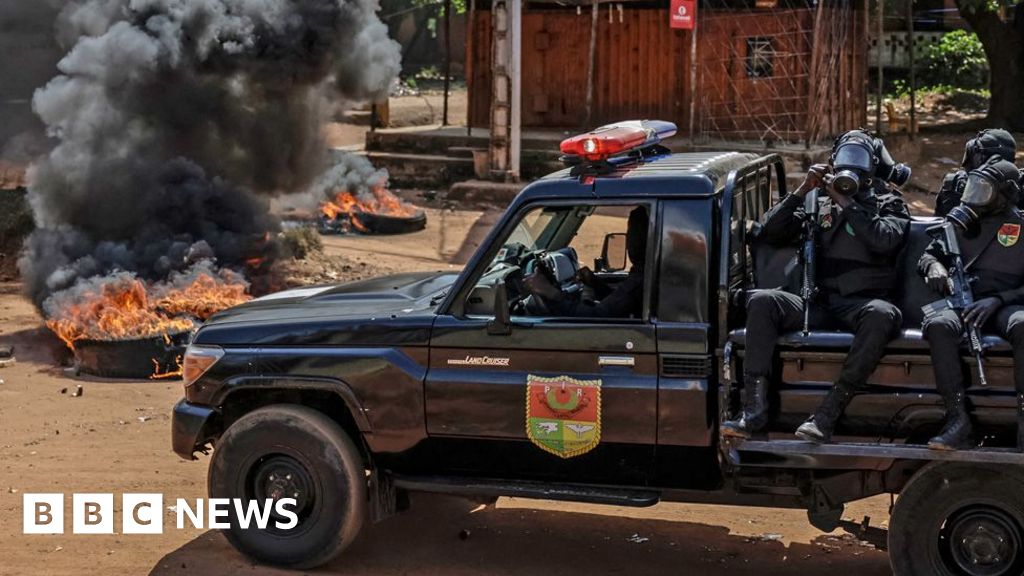
In a country where political instability is almost a norm, the recent military takeover in Guinea-Bissau has sparked a heated debate. Was it a genuine coup or a cleverly orchestrated sham? The incident unfolded last Wednesday when military officers announced they had seized control, a familiar scenario for a nation that has witnessed at least nine coups since its independence from Portugal in 1974.
Despite the classic signs of a coup—gunfire near the presidential palace, the arrest of President Umaro Sissoco Embaló, and a televised military address—skepticism abounds. Notably, Senegalese Prime Minister Ousmane Sonko and former Nigerian President Goodluck Jonathan have expressed doubts, suggesting that Embaló himself may have orchestrated the takeover.
Pre-Coup Political Climate
The military’s assertion that they acted to prevent a plot involving politicians and a notorious drug baron adds another layer of complexity. This claim comes just days after a tense presidential election, where Embaló sought a second term against his closest rival, Fernando Dias da Costa. The election was marred by controversy, with Dias backed by former Prime Minister Domingos Pereira, who was disqualified from the race under contentious circumstances.
The election results were due the day after the military takeover, but the process was abruptly halted. The military’s intervention included suspending the electoral process and destroying key election data, leaving the results unpublished.
The Day of the Takeover
On the day of the coup, chaos erupted in Bissau. Embaló reported his arrest from the presidential palace, while the military declared their actions as a necessary measure to stabilize the nation. High-profile arrests followed, including Pereira and Interior Minister Botché Candé. The electoral commission’s headquarters were attacked, and crucial election data was obliterated.
Embaló’s subsequent release and flight to Senegal have fueled further speculation. PAIGC official Flávio Baticã Ferreira questioned the ease with which Embaló left the country, suggesting it contradicts typical coup dynamics. In contrast, some analysts argue that allowing Embaló to leave might have been a strategic move to ensure a peaceful transition.
Voices of Doubt
Goodluck Jonathan, who was in Guinea-Bissau as part of an election observation mission, voiced his skepticism. He noted the unusual nature of Embaló’s ability to communicate with foreign media during the coup. Jonathan described the event as a “ceremonial coup,” a term that underscores the ambiguity surrounding the incident.
“What happened in Guinea-Bissau was not a coup… for want of a better word, I would say it was a ceremonial coup,” Jonathan remarked.
The appointment of Gen Horta N’Tam, a known ally of Embaló, as the new military leader further complicates the narrative. Embaló has yet to address allegations of his involvement in orchestrating the coup.
Motivations Behind a Possible Sham
Critics have long accused Embaló of fabricating coup attempts to suppress opposition, a charge he denies. His history of dissolving parliament and postponing elections has contributed to suspicions. Political analyst Ryan Cummings suggests that while the military may have acted independently, the political stalemate between Embaló and Dias could have precipitated their intervention.
West Africa analyst Beverly Ochieng points to internal political tensions and the exclusion of Pereira from the presidential race as factors that may have prompted military involvement.
Current Leadership and Public Reaction
Gen N’Tam has assumed the presidency for a transition period of one year, forming a new government. Meanwhile, Embaló has relocated to Congo-Brazzaville, reportedly displeased with Senegal’s characterization of the coup as a sham. Dias, who evaded arrest, has sought asylum in Nigeria.
The response from Bissau-Guineans remains mixed, with many questioning the true nature of the events. As the nation grapples with its latest political upheaval, the international community watches closely, pondering the implications for regional stability.
For more insights and updates on this developing story, visit BBCAfrica.com and follow us on Twitter @BBCAfrica, on Facebook at BBC Africa, or on Instagram at bbcafrica.