

At first glance, the small African island of Anjouan appears to be a classic offshore secrecy haven. With no corporate taxes, minimal bureaucracy, and limited oversight, it offers the ideal conditions for businesses seeking to avoid scrutiny. However, beneath this façade lies a troubling reality: the island is home to a network of companies issuing fake corporate licenses, including those for banks, insurance brokers, and cryptocurrency exchanges. These licenses, however, are not worth the virtual paper they are printed on.
Local authorities have declared the island’s regulators as “fictitious entities” operating “illegally.” Despite this, a network of companies continues to sell hundreds of these licenses, likely generating millions in annual fees from banks and casinos eager to operate under the guise of legitimacy.
The Rise and Fall of Anjouan’s Regulatory Authority
Anjouan is one of three semi-autonomous islands that form the Comoros Union, a nation off Africa’s east coast. In the late 1990s, Anjouan declared independence from its neighboring islands, establishing its own corporate regulator, the Anjouan Offshore Finance Authority (AOFA). However, the AOFA struggled for legitimacy from the outset. In 2007, the Comoros vice-president accused it of facilitating “money laundering operations.” A World Bank report later deemed the creation of offshore banks in Anjouan illegal under Comoros law.
Despite being officially stripped of its status by banking laws in 2013 and 2015, the AOFA has maintained a public register of licensed companies. Since its dissolution, it has signed up over 50 banks, insurance companies, brokers, and gambling sites, continuing to operate in the shadows.
“They … have in reality no physical or legal existence in the territory of the Union of the Comoros,” said Ait-Ahmed Djalim, a Comoros Central Bank official, highlighting the fictitious nature of these entities.
Black Market Casinos and the Australian Connection
Despite warnings from Comoros authorities, online casinos continue to exploit Anjouan’s dubious licensing. Leon Casino, for instance, proudly displays its Anjouan license while targeting Australian customers, despite lacking an Australian gambling license. The casino offers banned products like virtual slot machines and in-play sports betting, yet it sponsors Australian UFC fighters and hosts VIP events.
In a test by ABC, Leon Casino’s payment options included credit card, Pay ID, Apple Pay, Google Pay, and cryptocurrency. However, under scrutiny, two vendors, including MiFinity, vanished from its website after inquiries. This incident underscores the lack of oversight associated with Anjouan licenses, yet they still facilitate player deposits.
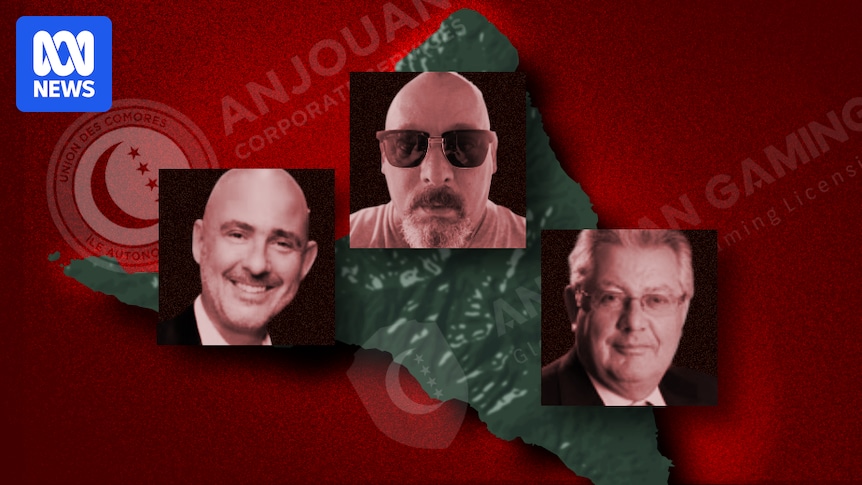
The Mystery of Anjouan Corporate Services
The AOFA’s credibility is further undermined by its “official” website, which features a misspelled email address and no government involvement. Businesses seeking licenses are directed to Anjouan Corporate Services, an entity with no listed directors or board members. According to Mr. Djalim, this firm operates illegally.
The firm’s social media is managed by “Toby S,” a consultant whose phone number traces back to the United Arab Emirates. Historical records reveal connections to British businessman Ronnie Dvorkin, who was linked to another “fictitious entity” identified by the Comoros Central Bank.
At a 2025 Dubai conference, Adam Dvorkin, alongside Toby and Elliot Sorsky, represented Anjouan Corporate Services. Elliot Sorsky is listed as the director, while Adam Dvorkin serves as a consultant. Despite inquiries, none of the involved parties responded to ABC’s requests for comment.
The Costa Rica Connection and Global Implications
Anjouan Corporate Services has a sister company, Anjouan Licensing Services, which emerged in May 2023. This entity claims to have issued over 1,300 gambling licenses, potentially earning up to 22 million euros annually. Like its counterpart, it cites oversight from the AOFA, despite being labeled illegal by former Comoros attorney-general Azad Mzé.
Domain records link Anjouan Licensing Services to a Costa Rican company, Fast Offshore, run by Canadian Ron Mendelson. Mendelson, who promotes Anjouan as a cost-effective licensing option, has connections within the island’s licensing industry. His consultancy assists companies in obtaining gambling licenses, further complicating the global reach of Anjouan’s dubious operations.
“With the lowest market costs and a setup process that takes just days when you partner with Fast Offshore, Anjouan is redefining offshore success for [gambling] businesses,” Mendelson wrote in December.
As the international community grapples with the implications of Anjouan’s fraudulent licensing, the need for stricter regulatory oversight and international cooperation becomes increasingly evident. The island’s operations not only undermine legitimate regulatory frameworks but also pose significant risks to consumers worldwide.