




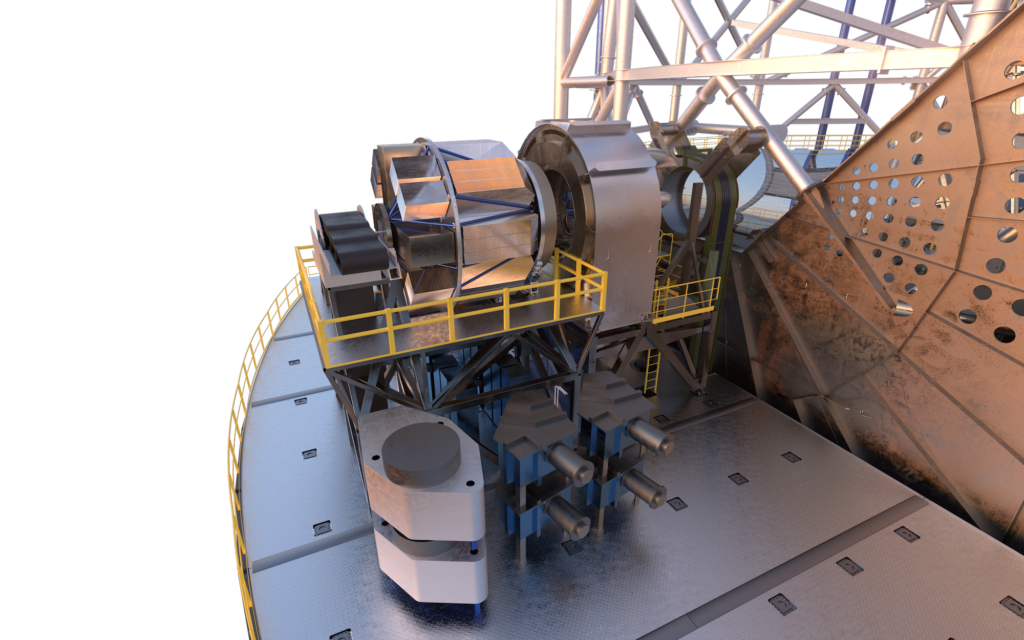
The University of Michigan (U-M) has made a significant leap in astronomical research by joining an international consortium led by the European Southern Observatory (ESO) to design and construct the Multi-Object Spectrograph, known as MOSAIC. This collaboration marks U-M as the only U.S. university participating in this groundbreaking project.
The MOSAIC instrument will be a pivotal component of the 39-meter Extremely Large Telescope (ELT), set to become the world’s largest optical telescope upon completion in approximately four years. With the capability to measure light from over 200 sources simultaneously, MOSAIC is expected to transform our understanding of galaxy formation and the distribution of matter from the Big Bang to the present day.
Revolutionizing Astronomy with ELT
The ELT, currently under construction in Chile’s Atacama Desert, is poised to revolutionize astronomical observation with its unprecedented size and capabilities. Unlike the space-based James Webb Space Telescope (JWST), the ELT will operate from Earth, offering a different set of advantages.
“This instrument and this telescope will be, in almost all cases, better than the JWST in terms of its power to see the distant past and in terms of its fineness of detail,” said Christopher Miller, a U-M professor of astronomy and a member of the MOSAIC board. This highlights the ELT’s potential to provide unparalleled insights into the universe.
U-M’s Role and Contributions
U-M’s involvement in the MOSAIC project is not only a testament to its commitment to advancing scientific knowledge but also an opportunity for its faculty, staff, postdocs, and students to engage in cutting-edge research. Key figures from U-M, including Sally Oey, Oleg Gnedin, and Sean Johnson, who leads a scientific subgroup for MOSAIC, are actively participating in the project’s early stages.
“The idea was that Michigan would get involved early enough so that our faculty, our staff, our postdocs, and our students would have an opportunity to be involved in building the plan to do the science,” Miller explained.
Scientific Potential and Impact
The MOSAIC instrument will utilize the ELT’s extensive light-gathering power combined with a multi-object spectrograph, enabling surveys that are currently beyond the reach of existing technology. Michael Meyer, professor and chair of the U-M Department of Astronomy, emphasized the instrument’s significance:
“MOSAIC represents a final, and critical piece, of U-M’s investment in the ESO 39-meter ELT instrumentation program. It combines the light-gathering power of the ELT with the advantages of a multi-object spectrograph to undertake surveys that cannot be done with any other capability.”
By conducting the first exhaustive inventory of matter in the early universe, MOSAIC will shed light on the distribution of matter within and between galaxies, greatly enhancing our understanding of galaxy formation and evolution. The instrument will also offer insights into the chemical composition of the gas surrounding galaxies.
The Future of Astronomy
As the ELT prepares to see its first technical light later this decade, the astronomical community eagerly anticipates the discoveries that MOSAIC will enable. The instrument’s ability to operate in both visible and near-infrared light and analyze over 200 objects simultaneously is a game-changer.
“That’s what gets me excited. The term that we use for it is multiplexing,” Miller said. “We’re used to getting information on astronomical objects one at a time, but now we’re getting to 10 times that, even 100 times that. And out of that comes the new discoveries and new science.”
The collaboration between U-M and the international consortium represents a significant step forward in the field of astronomy, promising to unlock secrets of the universe that have long eluded scientists. As construction progresses, the world watches with anticipation for the transformative insights the ELT and MOSAIC will bring.