




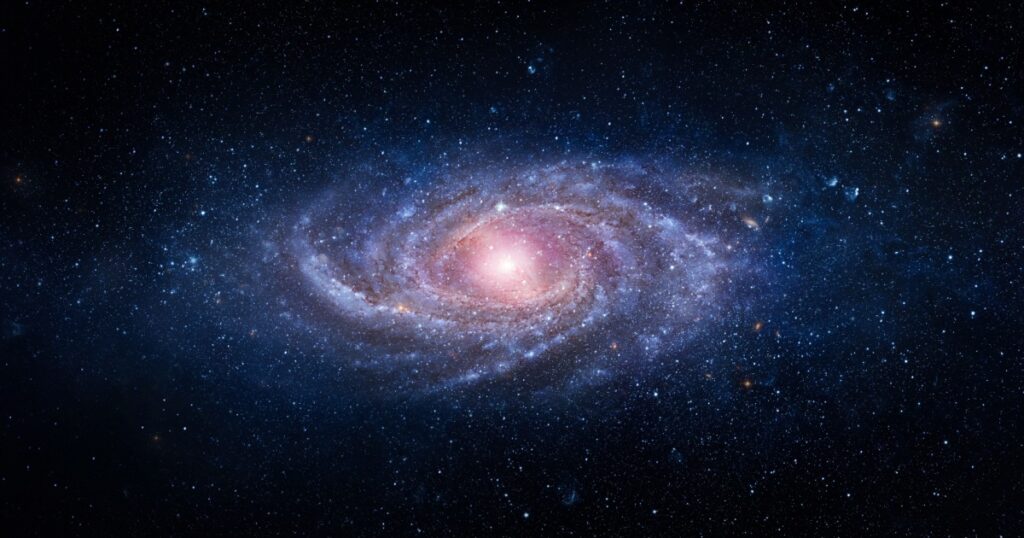
Astronomers have made a groundbreaking discovery by identifying a pulsar and a supernova well outside the usual confines of the Milky Way’s galactic plane. This unexpected finding challenges existing astronomical theories about where such cosmic phenomena typically occur. Published in the journal Astronomy & Astrophysics, the discovery has sparked fresh interest in the dynamics of our galaxy.
Objects in space, such as stars and planets, are primarily governed by gravitational forces. These forces determine where stars form, their size, and the orbits of planets around them. In our solar system, as well as in the broader Milky Way, these celestial bodies usually align along a disk-shaped path orbiting the galaxy’s central black hole. While stars can form outside this disk, it is a rarity.
Therefore, when astronomers spotted a supernova and a pulsar far from the usual galactic plane, it was a significant surprise. The system, named Calvera after the character in The Magnificent Seven, is located 37 degrees above the galactic plane and approximately 6,500 light-years from Earth. The supernova remnant and the pulsar are about 13,000 and 16,500 light-years apart, respectively.
Understanding Pulsars and Supernovae
Pulsars are a type of neutron star known for their regular pulsing signals, often formed as the result of a supernova explosion. The supernovae observed in this study consist of plasma released during an explosion, which interacts with surrounding stellar material. The researchers estimate that the supernova explosion occurred between 10,000 to 20,000 years ago.
Lead author Emanuele Greco from the Instituto Nazionale di Astrofisica explained the significance of the discovery:
“Massive stars – that is, at least eight times more massive than the Sun – form almost exclusively in the galactic plane, where the gas density is highest and favors star birth. Finding their remnants at such distances from the plane is extremely rare.”
The Implications of the Discovery
The discovery of the Calvera system challenges the conventional understanding that most star-forming materials, such as gas and dust, are concentrated within the galactic plane. Greco noted,
“Our study shows that even the quietest and seemingly empty regions of the galaxy can harbor extreme processes. Not only have we precisely constrained the physical properties of the Calvera system, but we have also demonstrated that, locally, it is possible to find densities sufficient to generate X-ray and gamma-ray emissions even very far from the galactic plane.”
This revelation invites astronomers to reconsider the potential for star formation and cosmic phenomena in the outskirts of the Milky Way. The discovery also highlights the role of serendipity in astronomical research, as such distant objects are often detected by chance while scientists focus on more remote regions of the universe.
Future Research and Exploration
The unexpected location of the Calvera system, relatively close to Earth, provides a unique opportunity for further study. Astronomers are eager to explore the system’s properties in greater detail, which could yield insights into the formation and evolution of stars outside the galactic plane.
As the scientific community continues to analyze this discovery, the findings may lead to a broader understanding of the Milky Way’s structure and the processes that govern star formation. This could ultimately reshape the way we perceive the galaxy’s peripheries and the potential for discovering similar phenomena in the future.
The discovery of the pulsar and supernova in the Calvera system marks a significant step forward in astronomical research, challenging existing paradigms and opening new avenues for exploration in the vast expanse of our galaxy.