




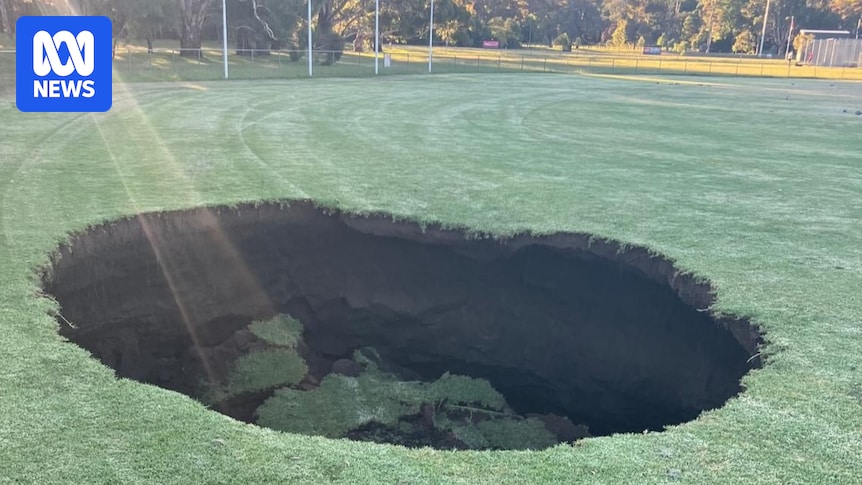
Residents in Melbourne’s north-east were taken by surprise on Tuesday when a sinkhole emerged in their local park. The sinkhole, measuring approximately 8 meters wide and 5 meters deep, appeared overnight at the previously pristine AJ Burkitt Oval in Heidelberg. While the sudden appearance of sinkholes can be alarming, the processes that lead to their formation often occur over many years, or even centuries.
Sinkholes are primarily the result of cavities forming beneath the earth’s surface. These cavities can develop due to a range of factors, including erosion and human activity. Over time, a layer of earth forms a ceiling over the cavity, maintaining the appearance of solid ground. However, when this surface layer becomes too thin and weak, it collapses, resulting in a sinkhole.
What Causes Sinkholes?
There are various reasons why a sinkhole might form, each with its own timeframe. On the longer end of the spectrum, sinkholes can be created by a process known as suffosion, where groundwater dissolves carbonate rock such as limestone, hollowing out the earth over thousands of years. This gradual process is responsible for the ancient limestone sinkholes found around Mount Gambier in South Australia.
However, sinkholes can also form much more rapidly under certain conditions. If enough water is present, soil can undergo liquefaction, becoming so saturated that it weakens and collapses. Flowing groundwater can even carry soil away from the area, creating underground cavities. In 2020, a broken stormwater pipe was blamed for a sinkhole in a Kew park, while a burst water main in Port Melbourne in 2014 created a sinkhole large enough to swallow a car.
Human activity can also exacerbate conditions that lead to sinkholes. Investigators have suggested that nearby tunnel boring machines may have contributed to the sinkhole in Heidelberg. Similarly, tunneling through wet, sandy soil at the Snowy 2.0 site in 2023 caused a sinkhole to open, halting construction.
Challenges in Detecting Sinkholes
Detecting sinkholes before they collapse is notoriously difficult. The surface layer that remains intact as the ground beneath erodes away makes them hard to identify. Francois Guillard, a senior lecturer in geotechnical engineering at the University of Sydney, explains that predicting sinkhole locations is challenging. “The visibility of it at the surface is actually quite sudden, because it’s the collapse of the roof over a cavity that can have been formed for a year,” he said.
Various techniques are employed to identify potential sinkholes, including soil sampling and satellite imagery analysis. Seismic waves are also used to detect changes and weaknesses in the underground soil. However, Dr. Guillard notes that conducting such assessments over broad areas remains difficult. “It’s possible to do this kind of assessment on a localized region but on broader areas, it’s more difficult,” he said, adding that research is ongoing to improve these tools.
Addressing and Preventing Sinkholes
The typical approach to fixing a sinkhole involves filling it in, often with special resins or concrete to stabilize the soil. However, Dr. Guillard emphasizes the importance of identifying the original cause of the sinkhole to prevent further damage. “Controlling underground water flow can be quite difficult,” he said. “You need to control the drainage and you don’t want to just divert the water because then you can have the same problem 100 meters away.”
The emergence of the Heidelberg sinkhole serves as a reminder of the complex interplay between natural processes and human activities in shaping our environment. As urban development continues, understanding and mitigating the risks associated with sinkholes will be crucial in safeguarding communities and infrastructure.