


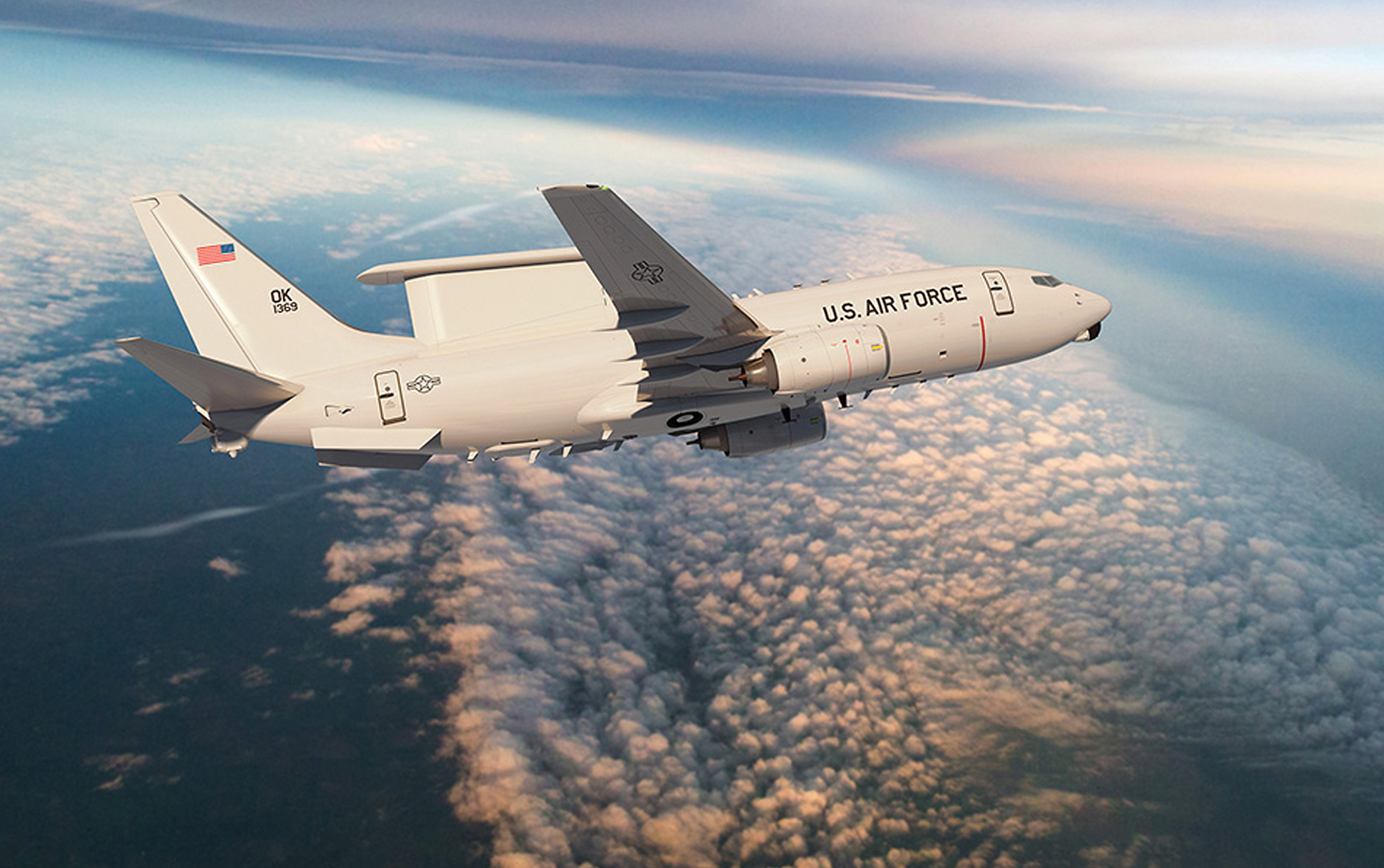

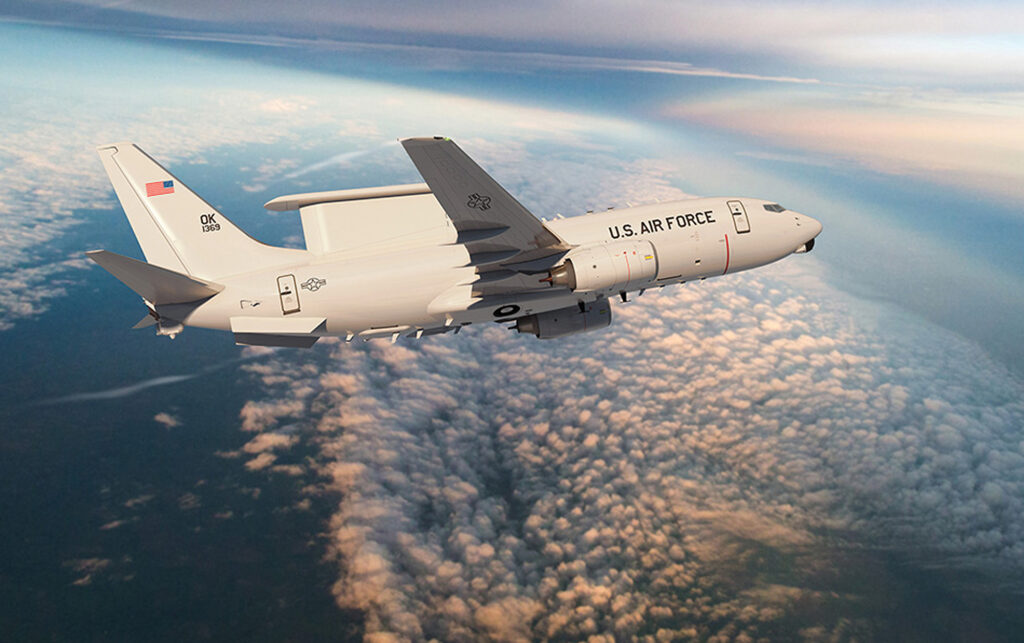
(ILLUSTRATION) An artistic rendering of a U.S. Air Force E-7A Wedgetail. Boeing illustration.
The U.S. Air Force has awarded contract modifications worth a combined $2.4 billion to Boeing for the procurement of the E-7 Wedgetail aircraft. Announced on March 12, this contract is part of the engineering and manufacturing development phase for the advanced airborne battle management system. The modifications also include continued work on the aircraft’s radar system.
The Air Force has not disclosed the exact number of E-7s to be purchased under the $2.3 billion option exercise modification, which constitutes the majority of the funding. The Wedgetail is intended to replace the aging fleet of E-3 Sentry aircraft, which have been in service for decades.
Background and Strategic Importance
The E-7 Wedgetail is an advanced early warning and control aircraft that offers significant improvements over the E-3 Sentry. The latter, known as the AWACS, is equipped with Cold War-era sensor technology, which is increasingly challenging to maintain. The E-7’s electronically scanned array radar provides a faster and more comprehensive tracking capability, allowing operators to monitor multiple targets simultaneously.
Previously, the Air Force had struck a deal with Boeing worth up to $1.2 billion, later finalized as a $2.56 billion contract, to develop two rapid prototype E-7s. This recent contract modification nearly doubles the value of the E-7 program to over $5 billion, with work expected to be completed by August 2032 across facilities in Seattle, Oklahoma City, Huntsville, Alabama, and Heath, Ohio.
Congressional and Military Perspectives
In a statement to Air & Space Forces Magazine, the Air Force confirmed that an updated acquisition strategy for the E-7 has been approved, as mandated by the 2026 Consolidated Appropriations Act. This strategy aims to advance the development and transition of the E-7 into the engineering and manufacturing development phase.
“This strategy executes Congressional direction to continue development and transition to an engineering and manufacturing development (EMD) phase,” the Air Force stated. “The aircraft acquired for the EMD phase will allow the Air Force to mature the system design, conduct risk reduction, and perform comprehensive test and verification activities in accordance with Congressional intent.”
Congress has shown strong support for the E-7 program, injecting $1.1 billion into the effort through the 2026 National Defense Authorization Act. This move was in response to skepticism from Pentagon leaders during the Trump administration, who proposed canceling the E-7 in favor of a mix of smaller Navy E-2D Hawkeye aircraft and targeting satellites.
Future Implications and Challenges
The future of the E-7 program remains uncertain. Air Force Secretary Troy Meink recently indicated that while the service would comply with Congress’ directive to acquire the prototype E-7s, there is no commitment beyond that. A recent Air Force solicitation has requested business cases for a fleet size ranging from the two prototypes to a full complement of 26 aircraft.
Australia, which already operates the E-7, has deployed its Wedgetails in various international operations, showcasing the aircraft’s capabilities. The U.S. Air Force’s decision to invest in the E-7 reflects a strategic move to modernize its airborne warning and control systems, ensuring enhanced operational readiness and capability.
As the Air Force continues to navigate budgetary constraints and strategic priorities, the E-7 Wedgetail’s development will be closely monitored by military analysts and lawmakers alike. The program’s success could pave the way for further advancements in military aviation technology and strategy.