



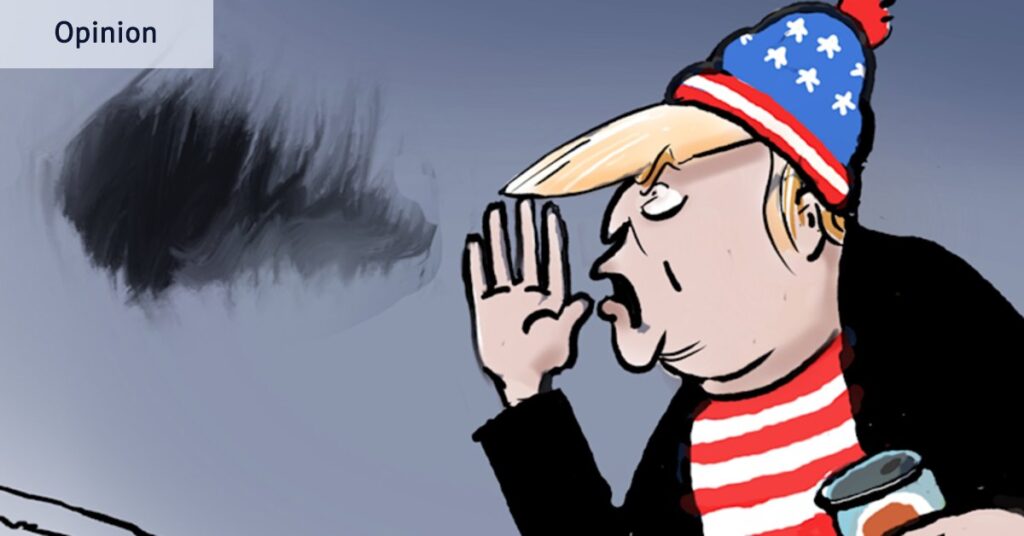
Political comedy is often a tightrope walk, and former President Donald Trump recently found himself off balance. A meme he posted depicting Barack and Michelle Obama as apes was swiftly deleted after backlash, particularly from Republicans concerned about the implications for the upcoming midterms. This incident underscores a broader pattern of controversial online behavior linked to the Trump administration, where memes and digital content often carry deeper, more troubling messages.
The recent meme is not an isolated incident. In February of last year, the White House shared a video titled “ASMR: Illegal Alien Deportation Flight,” which depicted shackled men being loaded onto planes. The video, with over 104 million views, was criticized for its insensitivity and was seen as part of a broader strategy of using digital content to communicate with Trump’s base.
Manipulated Images and Disinformation
In January, a photograph of civil rights attorney Nekima Levy Armstrong, who was arrested during a protest against ICE in Minnesota, was manipulated and shared by the White House. The altered image showed Armstrong in distress, with tears digitally added to her face, without any disclaimer. This act of disinformation was defended by Kaelan Dorr, the deputy communications director, who stated: “Enforcement of the law will continue. The memes will continue.”
Such actions have raised alarms about the administration’s use of digital content as a tool for spreading extremist ideologies. The memes often contain coded messages that resonate with white supremacist ideologies, creating a dangerous link between online rhetoric and real-world policies.
The Coded Messaging Phenomenon
One example of this coded messaging is a meme shared by the Department of Homeland Security titled “Christmas after mass deportations.” While it might appear as a simple holiday-themed post, an investigation by The Atlantic revealed references to the Agartha meme, a concept popular among certain online communities. Agartha refers to a mythical Aryan civilization, and its inclusion in government communications is troubling.
Another instance involved a New Year’s Eve post from the White House featuring Trump and the word “remigration,” a term associated with far-right ideologies advocating for the removal of non-white immigrants. These examples illustrate how white supremacist theories have infiltrated official communications, often going unnoticed by the general public.
Historical Parallels and Expert Opinions
Experts warn that the use of such coded messages is not new and draws parallels to historical instances where propaganda was used to subtly influence public opinion. Dr. Jane Smith, a historian specializing in political communication, notes, “The use of coded language allows for plausible deniability while still rallying a specific audience. It’s a tactic that’s been used throughout history to galvanize support without overtly stating controversial views.”
Furthermore, the recruitment ad for ICE featuring Uncle Sam with the caption “Which way, American man?” references a book revered by white nationalists. This subtle nod to extremist literature is part of a broader strategy to appeal to a specific demographic while maintaining a veneer of mainstream acceptability.
Implications and Future Outlook
The implications of this strategy are significant. As these messages permeate online discourse, particularly among younger audiences, they contribute to the normalization of extremist ideologies. The Trump administration’s approach to digital communication has set a precedent that future administrations may follow, potentially exacerbating divisions within the country.
White House press secretary Karoline Leavitt’s response to criticism of Trump’s meme about the Obamas highlights a broader issue. She urged the media to focus on substantive issues rather than distractions. However, the very nature of these distractions reveals much about the underlying issues facing the nation.
As the digital landscape continues to evolve, the challenge for both policymakers and the public will be to discern the true intent behind seemingly innocuous content. The need for media literacy and critical engagement with online content has never been more urgent.
The Opinion newsletter offers a weekly wrap of views that will challenge, champion, and inform your perspective. Sign up to stay informed and engaged with the issues that matter.