



Amid mounting concerns over a looming affordability crisis, with health insurance premiums poised to spike for over 20 million Americans, former President Donald Trump has unveiled a surprising domestic policy priority. On Sunday, Trump announced that his domestic policy chief’s main focus is the construction of a triumphal arch in Washington D.C.
Speaking at a White House holiday gathering, Trump lauded Vince Haley, his former speechwriter and a longtime aide to Newt Gingrich, who now heads the White House Domestic Policy Council. “Vince is unbelievable on policy,” Trump stated. “And we have a policy thing that’s going to be unbelievable happening.”
The Vision for a New Monument
The proposed triumphal arch, which Trump likened to the famous Arc de Triomphe in Paris, is planned to be built near the Arlington Bridge, opposite the Lincoln Memorial. “We’re building an arc, like the Arc de Triumph,” Trump remarked, blending English with French in his announcement shared on social media by the White House.
“It’s something that is so special. It will be like the one in Paris,” he continued, referencing the historical monument constructed between 1806 and 1836 to honor those who died in the French revolutionary and Napoleonic wars. However, Trump assured that the new arch would surpass its Parisian counterpart. “It blows it away. Blows it away in every way,” he asserted.
Public Reaction and Historical Context
The announcement comes at a time when many Americans are grappling with economic challenges, raising questions about the timing and priority of such a project. Critics argue that resources might be better allocated to address pressing domestic issues such as healthcare and economic inequality.
Historically, triumphal arches have been symbols of victory and national pride. The Arc de Triomphe, commissioned by Napoleon Bonaparte, stands as a testament to military triumphs and national unity. Trump’s vision for a similar structure in the U.S. capital reflects a desire to create a lasting legacy, yet it diverges from the traditional focus of addressing immediate domestic concerns.
Expert Opinions and Implications
According to political analysts, the move represents a bold, albeit unconventional, approach to domestic policy. “This initiative is emblematic of Trump’s style—grand, symbolic gestures that aim to capture public imagination,” said Dr. Emily Carter, a political science professor at Georgetown University. “However, the practicality and timing of such a project are debatable given the current socio-economic climate.”
Meanwhile, urban planners and historians have expressed mixed reactions. Some view the project as an opportunity to enhance the cultural landscape of Washington D.C., while others caution against diverting attention from more urgent infrastructure needs.
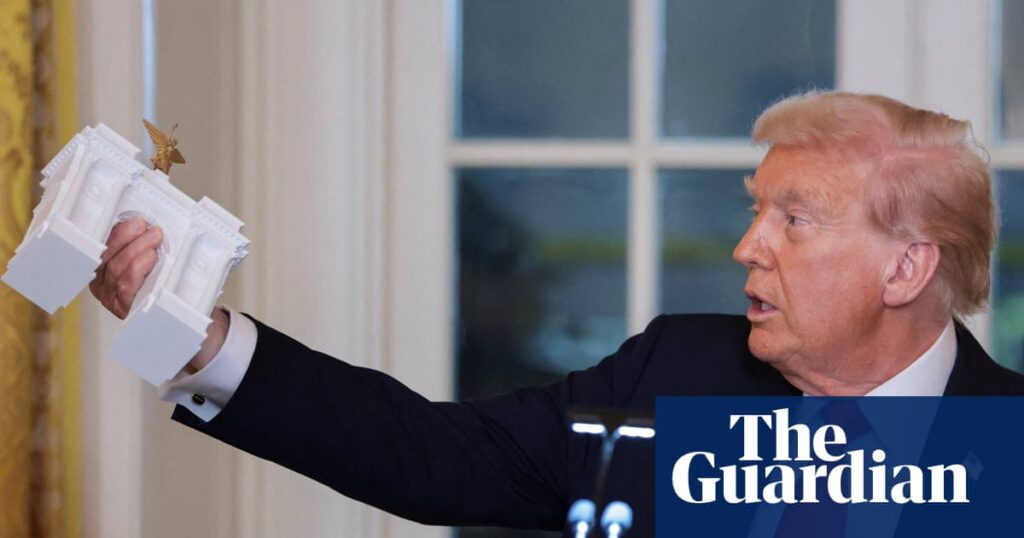
“Vince came in one day and his eyes were teeming,” Trump recalled, describing Haley’s reaction to the arch’s model. “I mean, he couldn’t believe how beautiful it was. He saw it, and he wanted to do that.”
Looking Forward
As the project progresses, it remains to be seen how it will be received by the public and whether it will indeed become a defining feature of Trump’s domestic policy legacy. The initiative highlights the ongoing debate over national priorities and the role of symbolic architecture in shaping a country’s identity.
For now, the triumphal arch stands as a testament to Trump’s vision for grandeur and legacy, leaving many to ponder its place in the broader narrative of American history and policy.