

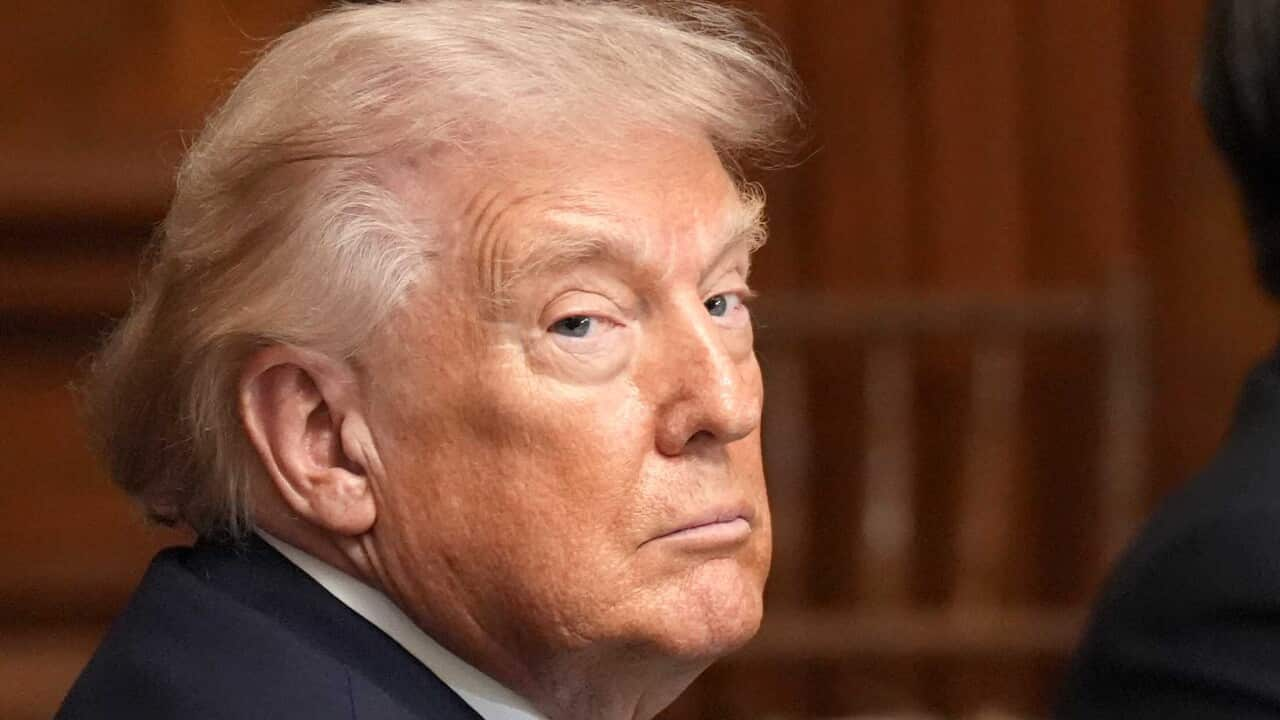
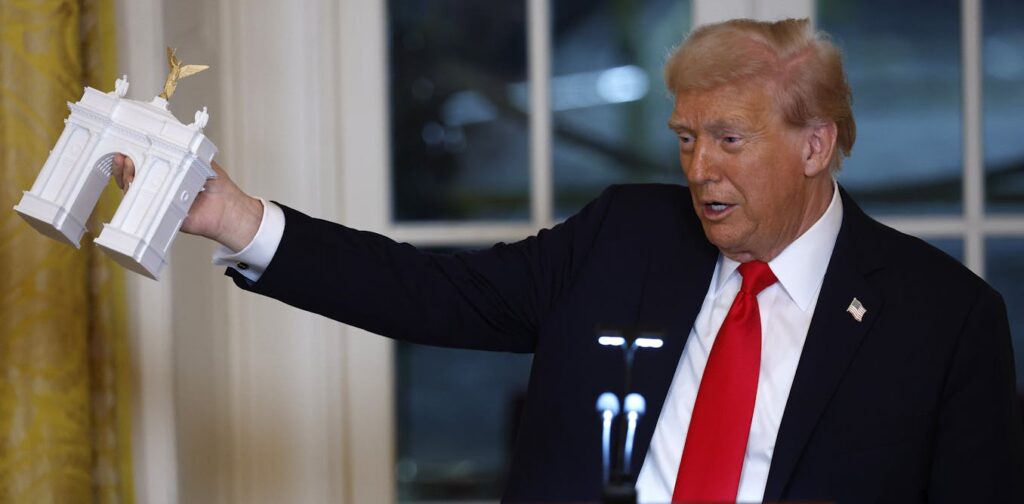
Donald Trump took a moment this week amidst domestic and international upheavals to unveil three new design concepts for his proposed “Independence Arch” in Washington, D.C. All three designs bear a striking resemblance to the iconic Arc de Triomphe in Paris, with one version featuring gilded details reminiscent of Trump’s embellishments to the Oval Office.
Commissioned in anticipation of the 250th anniversary of the Declaration of Independence on July 4, the triumphal arch is steeped in a tradition of commemorating military victories, from the Roman Empire to Napoleon Bonaparte. This aligns with Trump’s foreign policy vision and his ambition for the United States to exert control over the Western Hemisphere, a strategy he has termed the “Donroe Doctrine.”
The ‘Arc de Trump’
When Trump first showcased models of the proposed arch last October, a reporter inquired about its intended honoree. Trump candidly responded, “Me. It’s going to be beautiful.” In a subsequent update in December, he asserted that the new arch “will be like the one in Paris, but to be honest with you, it blows it away. It blows it away in every way.”
Trump acknowledged one aspect where the Parisian arch holds an edge: “The only thing they have is history […] I always say [it’s] the one thing you can’t compete with, but eventually we’ll have that history too.” The president envisions his arch as a future historical landmark, emphasizing Washington, D.C.’s lack of a triumphal arch compared to other major cities.
Planned to be situated near Arlington National Cemetery and the Lincoln Memorial, the arch would visually engage with some of the capital’s most renowned landmarks. This proposal is part of a broader initiative to leave a lasting mark on Washington’s architectural landscape, including recent renovations to the White House and the proposed US$400 million ballroom extension.
Triumph and Design
The Arc de Triomphe in Paris, commissioned by Napoleon Bonaparte in 1806 to celebrate the French imperial army’s victory at the Battle of Austerlitz, was completed in 1836. Its architects, Jean-François Thérèse Chalgrin and Jean-Arnaud Raymond, drew inspiration from classical arches, particularly Rome’s Arch of Titus.
Trump’s proposed arch, while lacking distinct American design elements, echoes the neoclassical style of earlier monuments that reference antiquity. The Washington Monument, for instance, is modeled after an Egyptian obelisk and features a pyramid cap made of aluminium, symbolizing American technological progress at the time of its completion in 1884.
Public Monuments and Their Meanings
Trump’s triumphal arch is poised to enter the ongoing debate about public monuments and their significance. During the Black Lives Matter movement, many statues of historical figures were removed for being perceived as symbols of racism and imperialism. Trump has reinstated at least one Confederate statue and his desire to erect a monument to himself is unsurprising.
The creation of new memorials, like the proposed Independence Arch, serves as a statement, akin to the removal of controversial statues. It aligns with Trump’s administration’s mission of “restoring truth and sanity to American history.”
The pressing question remains whether the Independence Arch can be completed by July 4, a formidable challenge even for Trump. As for its reception, only time will tell.