


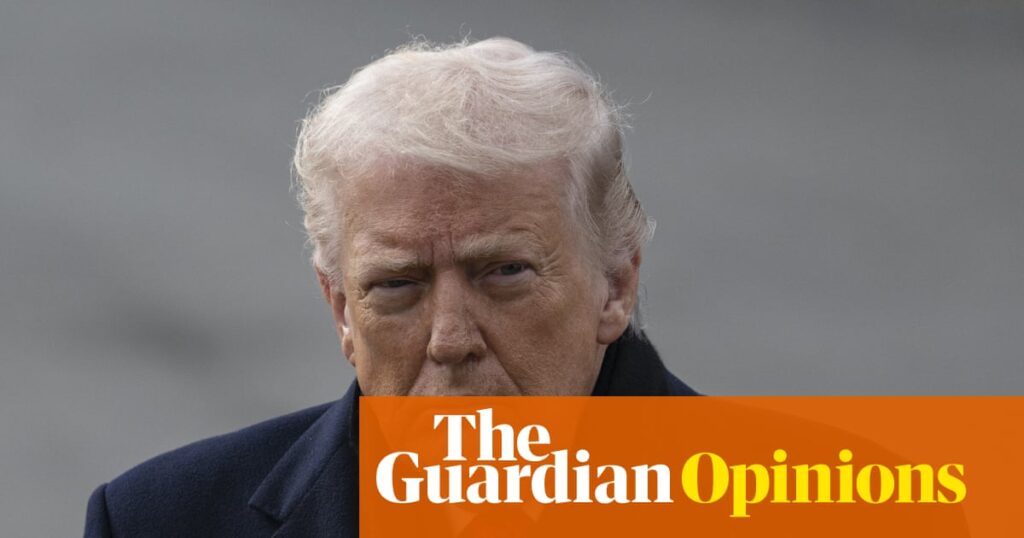
A European-wide chorus of resistance, led by Keir Starmer, has emerged in response to Donald Trump’s controversial plan to acquire Greenland, potentially by force, and to initiate a tariff war against any nation that opposes him. This bold move signals a critical moment in international relations: if Trump persists, it could mark the end of the liberal rules-based order that has persisted, albeit shakily, during his presidency.
The question now is whether the 2020s will witness the complete collapse of this order and the chaos that may ensue, or if an international coalition can unite to forge a new global framework. The United States has increasingly distanced itself from its historical commitments to the rule of law, human rights, and democratic principles, leaving a leadership vacuum on the world stage.
The Decline of U.S. Global Leadership
In recent weeks, the United States has seemingly abandoned its role as a champion of international cooperation and diplomacy. The principles enshrined in the Atlantic Charter, co-authored by Franklin D. Roosevelt and Winston Churchill, which laid the groundwork for the United Nations, appear to be discarded. This includes commitments to “freedom of the high seas,” free trade, and opposition to colonial expansion.
Trump’s political adviser, Stephen Miller, has articulated a vision of a world “governed by strength … by force … [and] by power,” a stark contrast to the post-war consensus. This shift has prompted calls for Europe and other democracies to assert their values and leadership in a rapidly changing geopolitical landscape.
Europe’s Response and the Call for a New Charter
Greenland’s situation has become a catalyst for Europe and the global south to reconsider their roles on the world stage. Keir Starmer, supported by the UK Attorney General at the United Nations’ 80th anniversary in London, has advocated for a renewed commitment to the values that have historically underpinned international institutions since 1945.
Starmer suggests drafting a new values statement, echoing the UN Charter’s preamble, “We the peoples…”, to reaffirm support for self-determination, the rule of law, and democratic accountability. This charter would also address modern challenges, such as climate change, gender equality, and the influence of non-state actors.
“We have to ask how we can advance multilateral cooperation in a multipolar world,” Starmer stated, emphasizing the need for a collective approach to global challenges.
Challenges and Opportunities in a Multipolar World
The proposed charter would recognize the necessity of shared power in a multipolar world, rejecting the notion of great-power domination. It would also acknowledge the existential threats posed by climate change, the demands for gender equality, and the rising influence of the global south.
Moreover, the charter would emphasize the importance of multilateral cooperation to prevent the weaponization of interdependence, as seen in China’s control of rare earth elements and strategic maritime choke points.
Europe faces a moment of truth. Its silence in the face of the Trump administration’s violations of international trade rules and withdrawal from global organizations has been notable. Trump’s recent decision to form an alternative “board of peace,” involving select states, further complicates the geopolitical landscape.
The Path Forward: A New Era of Cooperation
For any new global initiative to succeed, it must transcend elite power dynamics and connect local aspirations with global cooperation. The principles of equality of opportunity and fairness, as articulated by Roosevelt’s four freedoms, remain relevant today.
In retrospect, Trump could have negotiated a favorable agreement over Greenland, leveraging Denmark’s offer of military bases and mineral access. However, his aggressive stance has underscored a departure from the era when the U.S. was seen as “a shining city on the hill.”
“It’s clear that the president has this wish of conquering over Greenland,” remarked the Danish foreign minister, reflecting on the recent talks in Washington.
Despite the current challenges, the possibility for the U.S. to reclaim its leadership role remains. As President John F. Kennedy once urged, the world must strive for “a new world of law where the strong are just and the weak are secure and the peace preserved.” This vision, though distant, is one that the U.S. and the international community must endeavor to achieve once more.