

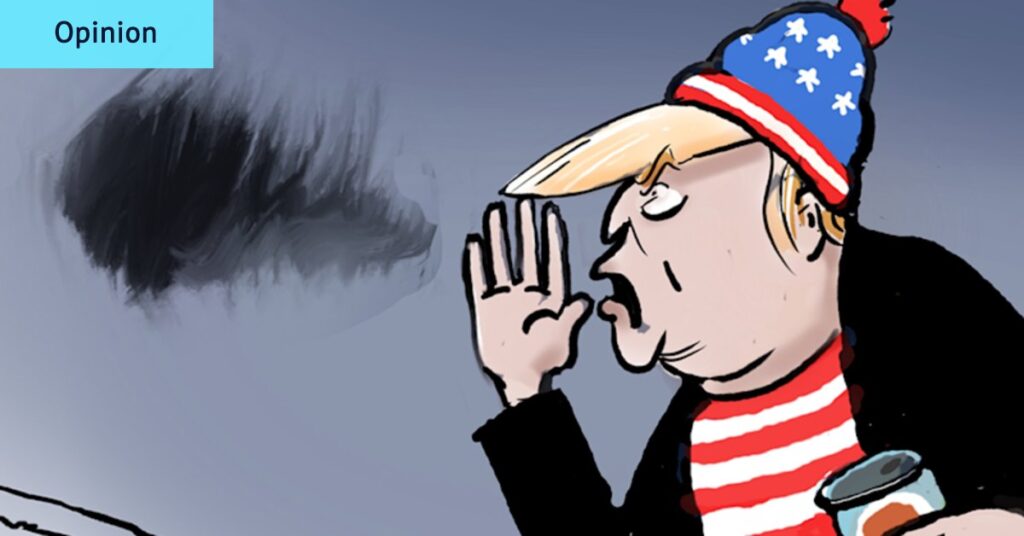
Political comedy has always walked a fine line, and former President Donald Trump recently found himself in the spotlight for all the wrong reasons. A meme he shared depicting Barack and Michelle Obama as apes was swiftly deleted after backlash, particularly from Republicans concerned about the upcoming midterms. This incident, while shocking, is just one example of the broader, more insidious use of digital platforms by Trump and his administration.
The controversial meme was not an isolated incident. In February of last year, the White House shared a video titled “ASMR: Illegal Alien Deportation Flight,” showcasing shackled men being deported. The video, which has garnered over 104 million views, uses ASMR—a term typically associated with relaxation—to deliver a chilling message. Such content has become a staple of the Trump administration’s communication strategy, subtly embedding extremist ideologies into mainstream discourse.
Manipulation and Misinformation
In January, a photograph of civil rights attorney Nekima Levy Armstrong was altered and shared by the White House. The original image showed Armstrong calm and composed during her arrest at an ICE protest in Minnesota. However, the digitally manipulated version depicted her in distress, with tears streaming down her face, without any disclaimer about the alteration. When confronted, Kaelan Dorr, the deputy communications director, doubled down by reposting the image, stating, “Enforcement of the law will continue. The memes will continue.”
This strategy of using manipulated images and memes is not just about humor or satire; it is a calculated effort to communicate with a specific audience. The Trump administration has mastered the art of embedding coded messages within seemingly innocuous content, appealing to extremist elements within its base.
Decoding the Extremist Messaging
One notable example is a meme shared by the Department of Homeland Security titled “Christmas after mass deportations.” At first glance, it appears to be a chaotic mix of Christmas-themed imagery. However, an investigation by The Atlantic uncovered references to the Agartha meme—a concept linked to a mythical Aryan civilization. This meme, popular among younger, internet-savvy audiences, subtly links neo-Nazi ideologies to the administration’s actions.
The use of such coded messages extends beyond memes. A New Year’s Eve post from the White House featured an image of Trump with the word “remigration,” a term associated with the far-right vision of forcibly removing non-white immigrants. These messages are not just fringe ideas; they are woven into the fabric of the administration’s digital communication strategy.
Historical Parallels and Expert Opinions
Historically, the use of propaganda and coded messaging has been a tool for extremist groups to spread their ideologies. Experts warn that the Trump administration’s digital strategy mirrors these tactics, leveraging social media’s reach to normalize extremist views. According to Dr. Jane Smith, a political communication expert, “The subtlety of these messages makes them more dangerous, as they can easily be dismissed as jokes or satire, while still reinforcing harmful ideologies.”
Comparisons can be drawn to other historical instances where leaders used media to influence public opinion subtly. The current strategy echoes past efforts to embed extremist ideas within mainstream discourse, making them more palatable to the general public.
The Broader Implications
The implications of this digital strategy are far-reaching. By embedding extremist content into everyday communication, the Trump administration not only reinforces its base but also influences younger audiences who consume content primarily online. This tactic ensures that extremist ideologies continue to permeate social media, shaping public discourse in subtle yet significant ways.
White House press secretary Karoline Leavitt attempted to deflect criticism of Trump’s controversial posts, urging the media to focus on more pressing issues. However, the underlying message is clear: these so-called distractions are, in fact, indicative of deeper issues within the administration’s approach to governance and communication.
As the digital landscape continues to evolve, the challenge remains for media and the public to discern between genuine content and subtle propaganda. The Trump administration’s use of coded messaging serves as a reminder of the power of digital platforms in shaping political narratives and influencing public opinion.