


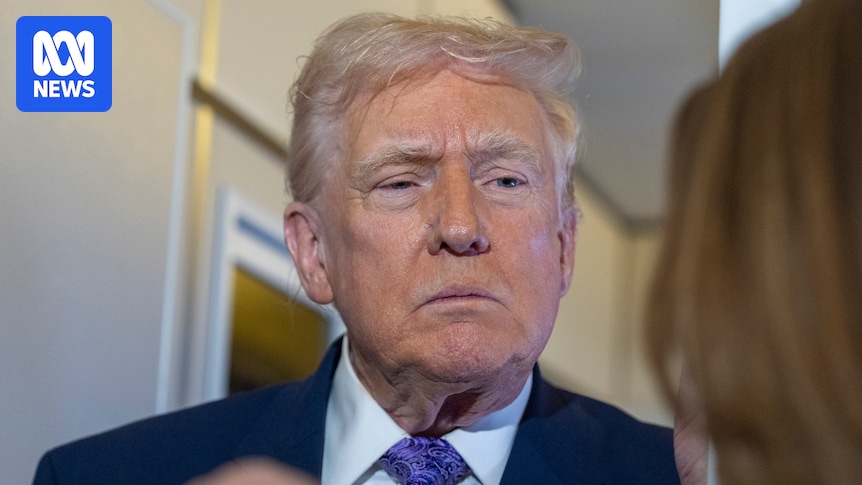
US President Donald Trump took to social media on Saturday to declare that the airspace above Venezuela should be considered closed. This statement marks the latest escalation in the ongoing tensions between Trump and Venezuelan President Nicolás Maduro, raising concerns that the US might be preparing for military action against the South American nation.
However, the question arises: does the US president possess the authority to close another country’s airspace? The answer, according to international law, is no.
Trump’s Controversial Statement
In his social media posts, President Trump asserted that the airspace “above and surrounding” Venezuela should be regarded as “closed in its entirety.” The White House has yet to clarify whether this was a formal policy announcement or a reinforcement of Trump’s longstanding campaign against Maduro. The lack of response from the administration leaves room for speculation about the intentions behind the statement.
Legal Boundaries and International Law
By international law, each nation maintains “complete and exclusive sovereignty over the airspace above its territory.” This principle means that countries can only exert legal authority over their own airspaces, rendering Trump’s declaration legally unenforceable. Nonetheless, airlines and pilots might interpret Trump’s statement as a cautionary measure, potentially avoiding the region for safety reasons.
Impact on Airlines
While US airlines have been barred from direct flights to Venezuela since 2019, some American carriers still traverse its airspace en route to other South American destinations. Just days before Trump’s social media post, the US Federal Aviation Administration (FAA) advised pilots to exercise caution when flying over Venezuela due to increased military activity. The FAA requires US operators to provide 72 hours’ notice before entering Venezuelan airspace.
International airlines not based in the US can still choose to fly to Venezuela, but many have suspended services citing safety concerns. Despite this, flights from Panama, Curaçao, and Colombia landed in Caracas on Sunday, as tracked by Flightradar24.
Venezuela’s Response
Venezuela has accused Trump of issuing a “colonial threat” aimed at undermining its sovereignty. The country’s foreign ministry has “forcefully rejected” Trump’s airspace closure claim, labeling it a “hostile, unilateral, and arbitrary act.” In response, Venezuela issued a 48-hour ultimatum for airlines to resume canceled services or risk losing their permits, effective November 24.
On Wednesday, Venezuela’s civil aviation authority announced the revocation of permits for several airlines, including Avianca, Gol, Iberia, Latam, TAP, and Turkish Airlines, accusing them of aligning with “state terrorism promoted by the United States.” Countries like Colombia, Brazil, and Spain, which have significant Venezuelan populations, are directly impacted by these measures.
Historical Context and Ongoing Tensions
Such tensions are not unprecedented. In 2019, during Trump’s first term, the US Department of Transportation suspended direct commercial flights to and from Venezuela, and the FAA restricted US operators from flying below 26,000 feet over Venezuelan airspace. While the US can impose such restrictions on American airlines, it cannot dictate the operations of foreign carriers or control another nation’s airspace.
The Broader US-Venezuela Conflict
This development is part of a broader strategy by the Trump administration to intensify pressure on Maduro. The administration has considered both military and non-military options, including CIA covert actions and airstrikes on Caribbean vessels, which have resulted in over 80 casualties since September. While the US claims these actions target drug smuggling, critics argue that Trump seeks regime change in Venezuela.
The US government does not recognize Maduro as Venezuela’s legitimate leader and has charged him with narcoterrorism. Last week, Trump hinted at potential land strikes, though he later downplayed the comment, urging reporters not to “read anything into it.” Meanwhile, Senate Democrat leader Chuck Schumer criticized Trump’s actions, emphasizing that “Congress has the sole power to declare war — not the President.”
“President Trump’s reckless actions towards Venezuela are pushing America closer and closer to another costly foreign war,” Schumer stated on X.
As tensions mount, US military presence in the region has increased significantly, with the USS Gerald R Ford, America’s most advanced aircraft carrier, stationed nearby. This deployment is part of “Operation Southern Spear,” which includes nearly a dozen Navy ships and approximately 12,000 sailors and Marines.
The situation remains fluid, with potential implications for international relations and regional stability. As the world watches, the next steps by both the US and Venezuela will be crucial in determining the future of this geopolitical standoff.