




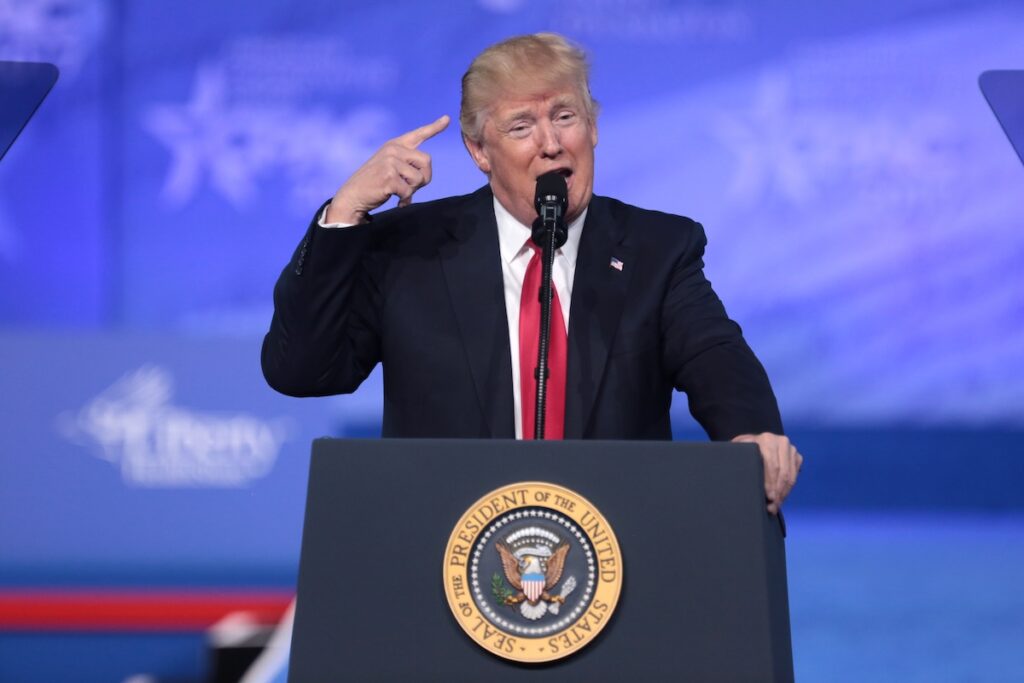
An aggressive President Donald Trump is making strategic maneuvers to destabilize adversarial governments in Venezuela and Iran. This campaign, aimed at undermining efforts by China and Russia to forge anti-Western alliances, has sparked international controversy and raised questions about global power dynamics.
In a meticulously planned military operation on January 3, U.S. troops abducted Venezuela’s President Nicolas Maduro from Caracas, transporting him across the Caribbean Sea to a New York jail. A few days later, Trump expressed support for protesters in Iran, promising “help is on the way” for demonstrators facing violent crackdowns in Tehran and other cities. However, he did not specify the form or timing of this assistance.
Strategic Shifts and Global Implications
The rapid regime change strategy appears to be in its early stages, targeting nations like Venezuela and Iran, which have been vocal critics of the U.S. and key players in what Western analysts label the “Axis of Upheaval.” This group includes China, Russia, Iran, and North Korea, with Venezuela acting as an honorary member.
According to the American administration, both Venezuela and Iran engage in “gray zone” actions—activities short of open warfare—that threaten U.S. interests, including terrorism. The American Enterprise Institute, a pro-Trump think tank, noted that the unopposed U.S. interference in these countries demonstrates that “China and Russia can’t protect their friends from the superpower’s wrath.”
The Economic and Geopolitical Context
Years of U.S.-led economic sanctions have pushed Venezuela and Iran closer to China and Russia, seeking assistance to bypass trade restrictions and gain diplomatic and military support. In return, China and Russia have reaped geopolitical benefits, with Venezuela serving as a friendly outpost in the Western Hemisphere and Iran in the Near and Middle East.
Venezuela offered China discounted petroleum products until production slumped, while Iran provided China with oil at a 12% discount below global prices.
However, Russia faces potential economic losses in Venezuela, with prestige and influence at stake. The Center for European Policy Analysis (CEPA) highlighted that “the political and symbolic costs could be much more damaging” than economic ones.
China and Russia’s Calculated Responses
China and Russia’s reactions to Trump’s actions have been notably restrained. China’s formal response to Maduro’s seizure and Venezuela’s blockade was framed in legalistic terms, citing violations of international law. However, Beijing has yet to take concrete action.
Russia’s silence may reflect its preoccupation with the ongoing war in Ukraine, which has defied initial predictions of a swift resolution. The conflict has led to significant geopolitical shifts, including NATO’s expansion and increased European defense capabilities.
China’s embassy in Washington warned of taking “all necessary measures to safeguard its legitimate rights and interests” in response to Trump’s tariff threats, but has so far remained inactive.
Potential Fallout and Future Prospects
Trump’s strategy aims to diminish China’s influence in Latin America and disrupt its advantageous oil deals with Iran. The U.S. has already intercepted a Venezuelan oil tanker bound for China, and Trump has demanded the expulsion of Chinese, Russian, and Iranian agents from Venezuela.
The potential fall of Iran’s Islamist government poses risks for China, including the loss of discounted oil and threats to its Belt and Road project, which connects China to the Persian Gulf. This land route significantly reduces transit time, offering strategic advantages.
Looking Ahead: Uncertain Outcomes
The question remains whether Trump’s approach, which excludes deploying U.S. troops to stabilize Venezuela or a post-Islamist Iran, will succeed in transforming these nations into cooperative partners. The muted responses from Beijing and Moscow suggest a cautious wait-and-see approach, as they assess the evolving geopolitical landscape.
As global tensions rise, the international community watches closely, anticipating potential shifts in alliances and power structures. The outcomes of Trump’s bold moves could reshape the geopolitical map, with far-reaching consequences for international relations.