




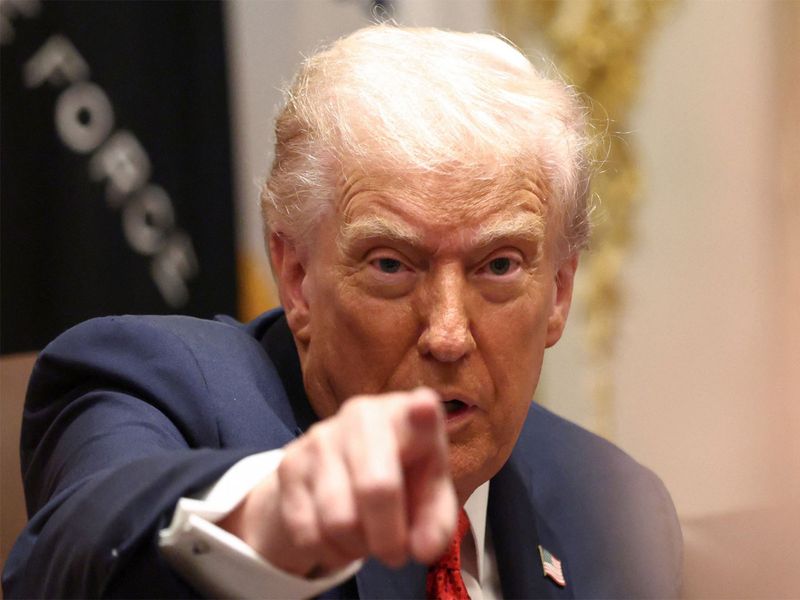
US President Donald Trump’s announcement of a 25% tariff on countries engaging in trade with Iran has sent ripples of concern through New Delhi. The potential implications for India’s trade relations with Washington, its commerce with Tehran, and strategic interests such as the Chabahar port are significant.
In a social media post, Trump declared, “Any country doing business with the Islamic Republic of Iran will pay a tariff of 25% on any and all business being done with the US,” labeling the order as “final and conclusive.” This move is part of renewed US efforts to economically isolate Tehran.
India’s Trade Dilemma
For India, the warning is particularly alarming. Indian exports to the US are already burdened with steep duties. In the absence of a bilateral trade agreement, Indian goods face a 25% reciprocal tariff, compounded by an additional 25% punitive levy due to India’s continued purchase of Russian crude oil.
If the proposed Iran-related tariff is applied cumulatively, total duties on Indian exports could soar to 75%, among the highest imposed by the US on any major trading partner. India and Iran have historically maintained steady trade relations. According to the Indian Embassy in Tehran, India exported goods worth $1.24 billion to Iran in 2024-25, while imports stood at $440 million, bringing total bilateral trade to $1.68 billion. Indian exports are primarily non-sanctioned humanitarian goods, including rice, tea, sugar, and pharmaceuticals.
“India’s total trade with Iran was about $1.6 billion last year, barely 0.15% of India’s overall trade. India’s share in Iran’s total imports is only around 2.3%,” a government source noted, suggesting minimal direct impact on India.
Strategic Concerns at Chabahar Port
The tariff threat has rekindled questions about India’s strategic engagement at the Chabahar port, which serves as a crucial connectivity hub to Afghanistan and Central Asia. The project has previously received US sanctions waivers due to its role in regional development and humanitarian access. There is no immediate clarity on whether the proposed tariff regime would affect Chabahar-linked trade or operations.
Beyond strategic concerns, Iran’s internal unrest is already impacting Indian exporters, particularly in the basmati rice sector. Industry bodies report payment delays, shipment uncertainties, and increased risk perception, disrupting exports and causing a sharp fall in domestic prices.
The Indian Rice Exporters Federation (IREF) stated that exporters are struggling to receive payments from Iranian buyers and advised caution in entering new contracts. India exported $468.1 million worth of basmati rice to Iran between April and November of the current fiscal year, totaling 5.99 lakh tonnes, making Iran its largest basmati destination.
Global Implications and Reactions
Internationally, the proposed tariff has drawn attention as it would impact not only India but also major Iran trading partners such as China, Turkiye, and the UAE. Former US official Evan A. Feigenbaum warned that the move could further strain already fragile trade relationships.
“So 50% tariffs on India—already the highest on any country in the world—weren’t enough for him. Now, it’s going to be another 25% for a layered tariff on India of 75%? It’s not as if there was much of a relationship left to tank but still… And congratulations to China, Turkey, and the UAE—all trading partners of Iran that he is about to whack with this too?” Feigenbaum posted on X.
Looking Ahead
For India, the coming weeks will be crucial as New Delhi assesses whether the US threat translates into policy—and how it intersects with humanitarian trade, strategic projects, and an increasingly uncertain global trade environment. As the situation unfolds, both diplomatic and economic strategies will need to adapt to mitigate potential impacts on India’s trade and strategic interests.