




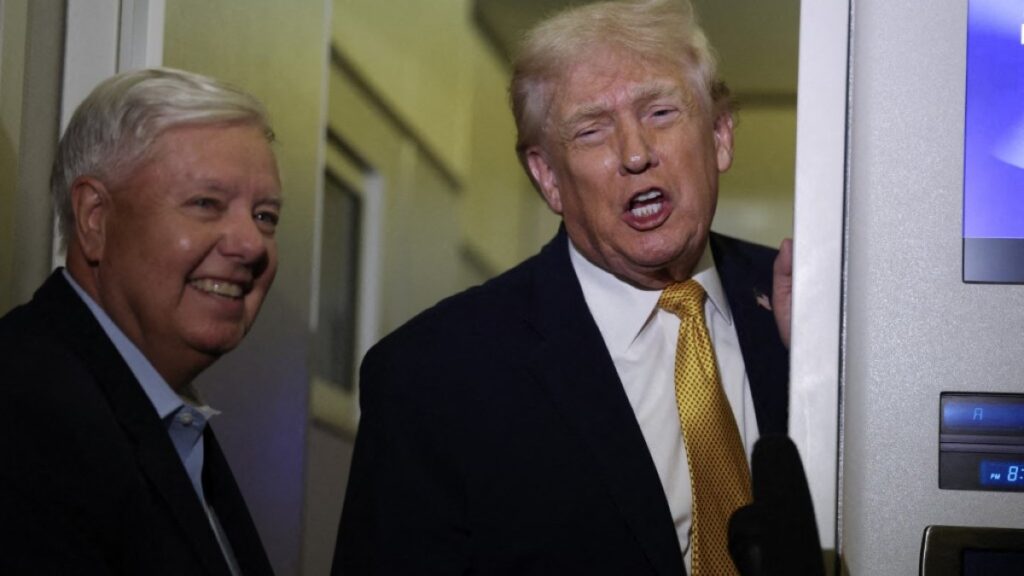
United States President Donald Trump has expressed support for a new bill aimed at imposing sanctions on countries purchasing Russian oil, including major economies like China and India. This announcement was made by Senator Lindsey Graham, an influential Republican from South Carolina, who confirmed Trump’s backing after a “very productive” meeting on Wednesday.
The proposed legislation, known as the Sanctioning Russia Act, is a bipartisan effort co-authored by Graham and Democrat Senator Richard Blumenthal. The bill seeks to empower President Trump with the authority to levy tariffs of up to 500 percent on imports from nations engaged with Russia’s energy sector.
Details of the Sanctioning Russia Act
According to Senator Graham, the bill is designed to provide President Trump with significant leverage over countries like China, India, and Brazil. These nations have been identified as major buyers of Russian oil, which Graham argues is financing President Vladimir Putin’s military actions in Ukraine.
“This bill will allow President Trump to punish those countries who buy cheap Russian oil fueling Putin’s war machine,” Graham stated. “It gives the President tremendous leverage to incentivize them to stop buying the cheap Russian oil that provides the financing for Putin’s bloodbath against Ukraine.”
Despite existing US and European sanctions targeting Russia’s energy sector, China and India remain significant importers of Russian crude. An analysis by the Centre for Research on Energy and Clean Air revealed that in November, China accounted for nearly half of Russia’s crude oil exports, while India took about 38 percent. Although Brazil also increased its imports of subsidized Russian oil following the 2022 invasion of Ukraine, these imports have recently declined.
Geopolitical Context and Implications
This legislative push by the US comes amid ongoing negotiations between Moscow and Kyiv, facilitated by Washington, to end the nearly four-year conflict in Ukraine. The Trump administration has recently endorsed European proposals for security guarantees for Ukraine, which include post-war monitoring and a European-led multinational peacekeeping force.
However, Russia has consistently opposed the deployment of NATO member troops in Ukraine, and its stance on these new security measures remains unclear. The potential sanctions outlined in the Sanctioning Russia Act could further complicate these delicate negotiations.
Expert Opinions and Historical Parallels
Experts suggest that the proposed sanctions could significantly alter global energy markets. Dr. Sarah Thompson, a geopolitical analyst at the Global Policy Institute, notes that “sanctioning major economies like China and India could lead to a reshuffling of global energy alliances and trade routes.”
Historically, such economic measures have been used as tools of diplomacy and coercion. For instance, the US has previously employed sanctions against Iran to curb its nuclear ambitions, which resulted in significant economic impacts on both Iran and its trade partners.
Looking Forward
The introduction of the Sanctioning Russia Act signals a robust stance by the Trump administration in its efforts to pressure Russia and its trading partners. As Ukraine makes concessions for peace, the timing of this legislation could influence the dynamics of the ongoing negotiations.
“This will be well-timed, as Ukraine is making concessions for peace and Putin is all talk, continuing to kill the innocent,” Graham remarked, emphasizing the urgency of the situation.
As the bill progresses through the legislative process, its implications for international relations and global energy markets will be closely monitored. The potential for heightened tensions with China, India, and Brazil could have far-reaching consequences, not only for the countries involved but also for the broader geopolitical landscape.