


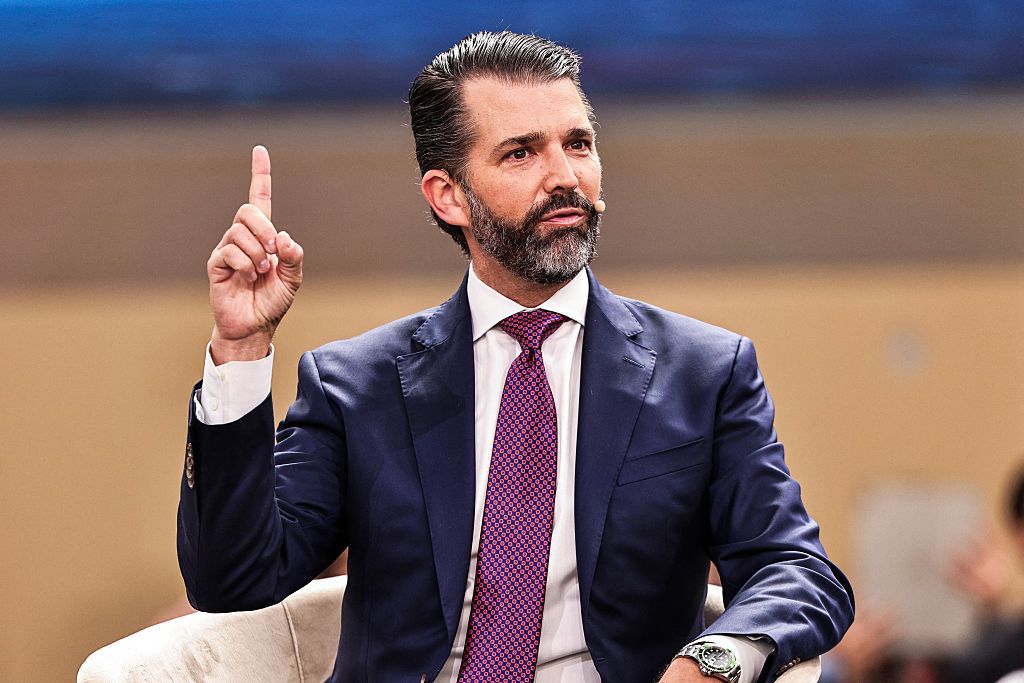
Donald Trump Jr., the son of U.S. President Donald Trump, has stirred controversy with his recent comments on Ukraine, suggesting that his father might withdraw support if Kyiv fails to negotiate a peace agreement with Russia. Speaking at the Doha Forum in Qatar on December 7, Trump Jr. criticized Ukraine for its corruption, amidst a major scandal that has rocked the country’s political landscape.
His remarks come as President Trump intensifies diplomatic efforts to resolve the ongoing conflict in Ukraine, a situation exacerbated by a corruption scandal leading to the resignation of several high-ranking officials, including Andriy Yermak, the former head of the Presidential Office. Although Trump Jr. holds no official position in the administration, he has reportedly engaged in backchannel discussions with Ukrainian officials alongside Special Envoy Steve Witkoff.
Trump Jr.’s Controversial Comments
During his address in Qatar, Trump Jr. was asked about his father’s potential decision to distance the U.S. from Ukraine. He responded, “I think he may,” highlighting his father’s unpredictability as a strategic advantage. “What’s good about my father and what’s unique about my father is you don’t know what he’s going to do,” he continued, emphasizing the need for honest diplomatic dealings.
Trump Jr. accused Ukraine of being “a far more corrupt country than Russia” prior to the war and labeled President Volodymyr Zelensky as “one of the greatest marketers of all times.” He argued that Ukraine’s corruption issues make it unreasonable for the U.S. to continue its military and financial support. Furthermore, he criticized the effectiveness of sanctions against Russia, claiming they have not provided tangible benefits.
Contradictions and Criticisms
Despite his harsh critique of Ukraine, Trump Jr. has not applied the same scrutiny to his father’s administration, which has faced its own ethical challenges. Since taking office again in January 2025, President Trump has dismantled several anti-corruption mechanisms within the U.S. government. Shortly after his inauguration, he dismissed 15 inspectors general, key officials responsible for oversight of federal agencies, including those tracking U.S. military aid to Ukraine.
The Trump administration also disbanded the Foreign Influence Task Force, an FBI unit aimed at preventing foreign interference in U.S. elections. Additionally, Attorney General Pam Bondi dissolved Justice Department groups focused on seizing assets from Russian oligarchs.
Trump himself has been indicted on multiple charges, including racketeering and falsifying business records.
Implications for U.S.-Ukraine Relations
The ongoing corruption scandal in Ukraine and Trump Jr.’s comments could have significant implications for U.S.-Ukraine relations. A delegation from the U.S. Defense and State departments visited Kyiv in 2023 and 2024, conducting inspections that found no evidence of military aid theft. However, the Trump administration’s stance and actions may influence future support and diplomatic strategies.
Moreover, the administration has been criticized for accepting extravagant gifts from foreign governments, including a $400 million luxury “jumbo plane” from Qatar, where Trump Jr. delivered his recent remarks. Such actions raise questions about the administration’s commitment to transparency and ethics.
Looking Ahead
As President Trump continues to navigate complex international relations, the unpredictability highlighted by Trump Jr. may serve as both a strategic tool and a source of uncertainty. The future of U.S. involvement in Ukraine remains in flux, contingent on diplomatic developments and the administration’s evolving policy priorities.
Observers will be closely watching how these dynamics unfold, particularly in light of the ongoing corruption challenges in both Ukraine and the U.S. government. The situation underscores the intricate balance of international diplomacy and domestic politics, with potential ramifications for global stability.