

Donald Trump has stated he is unconcerned about China’s live-fire military exercises encircling Taiwan, asserting his strong relationship with Chinese President Xi Jinping, who “hasn’t told me anything about it.” The remarks came as the People’s Liberation Army (PLA) continued its surprise attack simulation, which began on Monday and extended into Tuesday with missile launches into the Taiwan Strait.
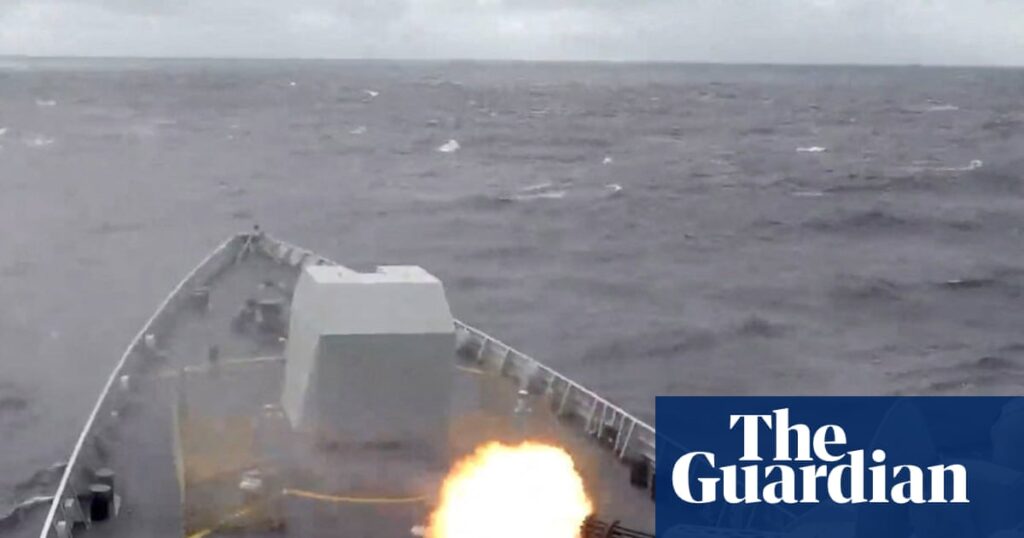
The PLA, the military arm of China’s ruling Communist Party, announced the deployment of destroyers, frigates, fighters, bombers, drones, and long-range missiles “in close proximity” to Taiwan. These maneuvers aim to test “sea-air coordination and precise target hunting and neutralization,” including attacks on submarines and other maritime targets.
China’s Ambitions and Military Posturing
Beijing views Taiwan as a breakaway province and has long expressed its intent to annex the island, aiming for military capability to invade by 2027, as per past U.S. intelligence assessments. Meanwhile, China employs various military and non-military tactics to pressure Taiwan into “peaceful reunification.”
In the 24 hours leading up to Tuesday morning, Taiwan’s defense ministry reported detecting at least 14 navy vessels, 14 coast guard ships, a surveillance balloon, and 130 warplanes and drones around Taiwan. The exercise, dubbed “Justice Mission 2025” by China, underscores Beijing’s strategic objectives.
Trump’s Response and U.S. Policy
When questioned about the drills, Trump expressed confidence in his rapport with Xi Jinping, stating, “I certainly have seen it … I don’t believe he is going to be doing it,” referring to an actual invasion. “Nothing worries me,” he added. The U.S. remains Taiwan’s most significant ally against Beijing’s annexation plans, though Trump’s stance has been inconsistent, especially during his second term. Despite meeting Xi in October, Trump noted that Taiwan “didn’t come up,” and he is expected to visit Beijing for a formal meeting next year.
Military Exercises and Regional Reactions
On Tuesday morning, live rockets were observed being launched from Pingtan, a Chinese coastal region near Taiwan’s main island. Shortly after, the PLA stated, “At 9:00 am, December 30, the ground forces of the PLA Eastern Theater Command conducted long-range live fire drills in the waters to the north of the Taiwan Island and achieved desired effects.”
Taiwan’s defense ministry reported that the impact sites were “scattered around Taiwan’s 24 nautical mile zone.” Defense Minister Wellington Koo criticized the drills for disregarding international norms, aiming to “achieve cognitive warfare and deplete Taiwan’s combat capabilities … and to create division and conflict within Taiwanese society.”
The PLA and Chinese state media highlighted the exercises’ focus on simulating a blockade of Taiwan’s major ports and repelling “external foreign interference.” An attack on Taiwan is expected to involve the U.S. in its defense, potentially drawing in Japan, as suggested by recent statements from Japan’s prime minister, which have angered Beijing.
Historical Context and Recent Developments
This week’s drills are the sixth and largest targeting Taiwan since 2022, following major exercises in response to a visit by then U.S. House Speaker Nancy Pelosi. Such exercises require extensive planning and are often linked to perceived provocations. This week, Chinese officials and state media specifically cited the U.S. government’s recent approval of a record $11 billion weapons sale to Taiwan.
“In response to the continuous provocations by pro-independence forces in Taiwan and the large-scale US arms sales to Taiwan, we must of course resolutely oppose and forcefully counter them,” China’s Foreign Minister Wang Yi stated in Beijing.
An editorial in the state-run Xinhua news agency remarked, “The drills were a clear reminder for the DPP that the trend of national reunification is unstoppable, and that the will of the people cannot be defied.”
Implications for Taiwan and Global Reactions
Despite China’s aggressive posturing, Taiwan maintains that the vast majority of its population rejects Chinese rule and supports maintaining the status quo. Taiwan’s President Lai Ching-te emphasized on Tuesday that China is not acting as a responsible global power, asserting Taiwan’s commitment to defending its sovereignty.
“We will act responsibly and not escalate conflict or stir up disputes,” President Lai stated, underscoring Taiwan’s resolve amid rising tensions.
As the situation unfolds, the international community watches closely, aware that any escalation could have significant geopolitical consequences. The U.S. and its allies continue to navigate the delicate balance of supporting Taiwan while managing complex relations with China.