




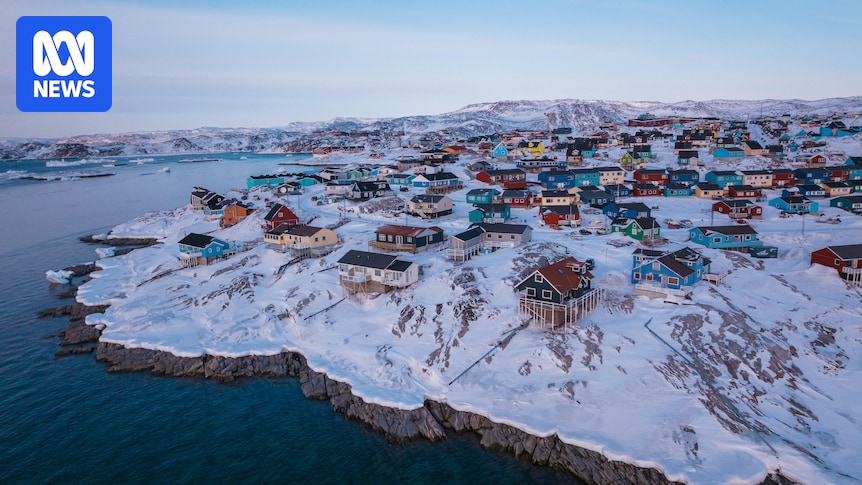
US President Donald Trump has dismissed concerns that his administration’s interest in acquiring Greenland could disrupt the NATO military alliance. This comes as Greenlandic and Danish officials prepare to meet with US Vice-President JD Vance and Secretary of State Marco Rubio in Washington on Wednesday, following renewed threats from Trump to take control of the Arctic island.
Greenland’s Prime Minister Jens-Frederik Nielsen, speaking in Copenhagen, reaffirmed the island’s allegiance to Denmark and dismissed the notion of becoming a US territory. “We face a geopolitical crisis, and if we have to choose between the US and Denmark here and now, then we choose Denmark,” Nielsen stated alongside Danish Prime Minister Mette Frederiksen. “We choose NATO. We choose the Kingdom of Denmark. We choose the EU.”
Trump, however, brushed off these concerns, telling reporters in Washington, “That’s their problem.” The President has suggested he is considering various options, including military force, to acquire Greenland, though he expressed a preference for negotiating a deal. “One way or the other, we’re going to have Greenland,” he asserted.
Historical Context and Military Presence
Greenland, an autonomous territory within the Kingdom of Denmark, is strategically significant due to its location in the Arctic. Since 1945, the US military presence on the island has reduced significantly, from over 17 bases and installations to the solitary Pituffik Space Base, which currently houses approximately 200 soldiers. This base is crucial for missile warning, missile defense, and space surveillance operations for both the US and NATO.
Denmark’s parliament recently approved a bill allowing US military bases on Danish soil, expanding a 2023 military agreement with the Biden administration that granted US forces broad access to Danish air bases. Despite this cooperation, Danish officials have consistently stated that Greenland is not for sale.
Local Concerns and International Reactions
Naaja Nathanielsen, Greenland’s minister for business and mineral resources, has voiced strong opposition to the US’s intentions, calling it “unfathomable” that a NATO ally would consider taking over another member’s territory. “People are not sleeping, children are afraid, and it just fills everything these days … we can’t really understand it,” Nathanielsen said during a meeting with British lawmakers. She emphasized that Greenland’s residents should have a say in their future, stating, “For others this might be a piece of land, but for us it’s home.”
Meanwhile, Danish officials have underscored their commitment to the US alliance. A Danish government official confirmed that Denmark provided support to US forces in the east Atlantic during a recent operation to intercept an oil tanker accused of violating US sanctions. This operation, which began in the Caribbean Sea, was part of a broader US effort to enforce a blockade on Venezuelan waters.
NATO’s Position and Future Implications
NATO Secretary-General Mark Rutte has refrained from commenting on the Greenland issue, emphasizing his role in maintaining alliance unity. “I never, ever comment when there are discussions within the alliance,” Rutte stated at the European Parliament in Brussels. He highlighted the importance of focusing on security in the Arctic region, including Greenland, as part of NATO’s strategic priorities.
The potential acquisition of Greenland by the US raises significant questions about international law, territorial sovereignty, and the future of Arctic geopolitics. As global interest in the Arctic’s resources and strategic position grows, the region may become a focal point for international diplomacy and conflict.
The upcoming meeting in Washington will be closely watched for any developments or shifts in the US’s approach to Greenland. As the situation unfolds, the implications for NATO and the broader international community remain uncertain.