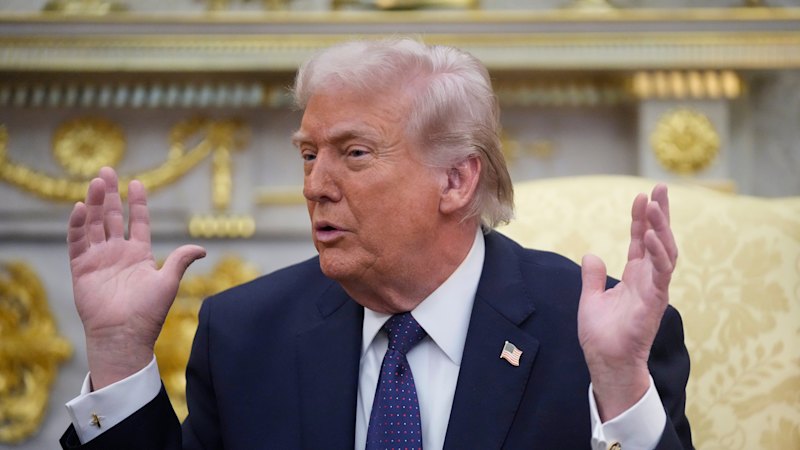




US President Donald Trump has launched a scathing critique of European leaders, labeling them as “weak” in their handling of migration and the ongoing conflict in Ukraine. Speaking in an interview with Politico, Trump predicted dire consequences for Europe, suggesting that rising immigration would lead to the destruction of European nations. He also criticized European leaders for their approach to the war in Ukraine, urging Ukrainian President Volodymyr Zelensky to concede territory to Russia as part of a peace deal.
The remarks have intensified the existing divide between Trump and America’s European allies on foreign policy, raising questions about the future of US support for Ukraine in its conflict with Russia. Trump’s comments come at a time when European nations are grappling with the complexities of immigration and cultural integration, issues that have fueled political debates across the continent.
Trump’s Critique of European Migration Policies
During the interview, Trump expressed his disapproval of European migration policies, describing them as a “disaster.” He refrained from naming specific leaders but singled out cities like London and Paris as examples of urban decline linked to immigration. Trump claimed that migrants from diverse regions, including the Middle East and Africa, were contributing to social and economic challenges in Europe.
“They’re coming in from all parts of the world, not just the Middle East,” Trump stated. “They’re coming in from the Congo, tremendous numbers of people coming from the Congo. And even worse, they’re coming from prisons of the Congo and many other countries.”
Trump’s comments echo sentiments expressed in a recent White House national security statement, which criticized Western leaders for allowing mass migration. The statement has resonated with certain European political figures, such as Nigel Farage in the UK, Alice Weidel in Germany, and Marine Le Pen in France, who advocate for stricter immigration controls.
Implications for US-European Relations
The President’s remarks have sparked debate about the implications for US-European relations, particularly in the context of the Ukraine conflict. Trump’s suggestion that Ukraine should cede land to Russia has been met with resistance from Zelensky, who has been actively seeking international support to maintain Ukraine’s territorial integrity.
European leaders have expressed concern over Trump’s stance, which appears to diverge from the broader Western consensus on supporting Ukraine. The President’s comments come amid a backdrop of diplomatic efforts by Zelensky, who has been meeting with key figures such as British Prime Minister Keir Starmer and NATO Secretary General Mark Rutte to bolster support for Ukraine.
Expert Opinions and Historical Context
Experts have weighed in on Trump’s comments, noting that they reflect a broader trend of rising populism and nationalism in Western politics. Analysts suggest that Trump’s rhetoric may embolden right-wing movements in Europe that are critical of multiculturalism and immigration.
About 21 percent of people in Sweden were foreign-born, the country’s statistics agency reported last year, compared with 12.4 percent in 2005. In England and Wales, the foreign-born population increased from 13.4 percent in 2011 to 16.8 percent in 2021.
Historically, migration has been a contentious issue in Europe, with various countries adopting different approaches to integration and multiculturalism. The current political climate, marked by economic challenges and social change, has intensified debates over national identity and sovereignty.
Looking Ahead: Potential Consequences
The fallout from Trump’s comments could have significant consequences for international diplomacy and the transatlantic alliance. As Europe navigates its internal challenges, the US’s role as a global leader may be tested, particularly if Trump’s views influence future policy decisions.
For Ukraine, the stakes remain high as it seeks to defend its sovereignty against Russian aggression. The outcome of diplomatic efforts and international support will be crucial in shaping the future of the region.
As the situation evolves, the world will be watching closely to see how these dynamics unfold and what they mean for global stability and cooperation.